Description
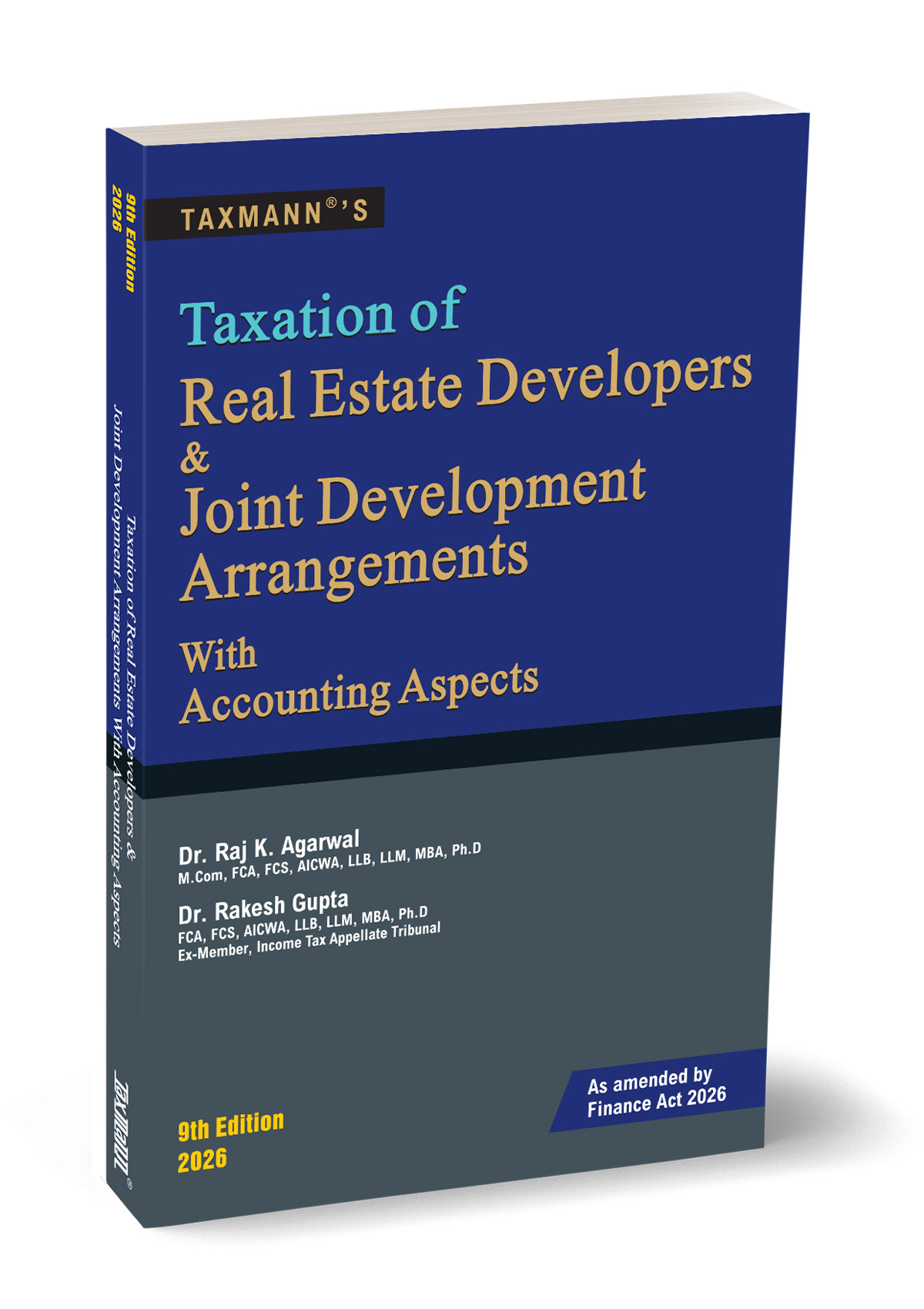
Taxation of Real Estate Developers & Joint Development Arrangements with Accounting Aspects is one of the most authoritative and exhaustive treatises available on the taxation of real estate transactions in India, with a specialist focus on joint development arrangements (JDAs)—a structuring mechanism whose tax treatment remains among the most contested and evolving areas of income tax law. The book is uniquely significant for the current year, as it also integrates the provisions of the new Income-tax Act 2025 (effective from 1st April 2026 for Tax Year 2026-27) alongside corresponding cross-references to the Income-tax Act 1961. This dual-statute mapping—spanning every substantive section discussed—makes it an indispensable reference during the transition to the recodified statute.
The authors, both practising for over four decades and each holding fellowship of ICAI, ICSI, and associateship of ICAI (Cost), bring an uncommon combination of professional practice depth, appellate tribunal experience, and academic rigour to a subject that straddles income tax, accounting standards, and commercial law. The book addresses the tax positions of two of the three principal stakeholders in a JDA—the land owner and the developer—with the accounting dimension treated not as an appendix but as an integral analytical layer woven throughout.
The book is written for practitioners operating at the intersection of real estate, taxation, and accounts. Its primary readership includes:
Chartered Accountants engaged in tax advisory, audit, or litigation involving real estate developers, builders, and landowners
Advocates and Tax Consultants representing clients before Income Tax Appellate Tribunals, High Courts, and the Supreme Court in real estate tax disputes
Company Secretaries and Cost Accountants advising on structuring of real estate transactions and compliance
Corporate Finance and Legal Teams of real estate development companies, housing finance entities, and large land-owning trusts or families
Tax Officials and ITAT Members seeking a consolidated reference on divergent judicial positions
Academics and Researchers in taxation and real estate law
The text assumes advanced domain familiarity—it does not simplify concepts for a generalist audience but instead addresses points of genuine legal controversy and professional judgment with analytical depth.
The Present Publication is the 9th Edition | 2026, amended by the Finance Act 2026. This book is authored by Dr Raj K. Agarwal & Dr Rakesh Gupta with the following noteworthy features:
[Dual-Statute Cross-Referencing] Every provision of the Income-tax Act 1961 discussed in the book is mapped to its corresponding section in the new Income-tax Act 2025. This is done systematically throughout the text—not merely in footnotes—making the book actionable both for matters still pending under the 1961 Act and for fresh assessments under the 2025 Act
[Issue-Based Architecture] Rather than organising content section-by-section in a commentary format, the book is structured around discrete, practical tax issues and controversies. Each issue is framed as a question or problem statement, followed by analysis of the statutory position, the accounting treatment, and the judicial view—including conflicting High Court and ITAT decisions
[Comprehensive Judicial Digest] The List of Cases spanning multiple pages covers decisions of the Supreme Court, all major High Courts, and the ITAT—including very recent rulings up to 2025. Each case is cross-referenced to the specific paragraph where it is discussed, enabling targeted look-up
[Accounting Standards Fully Integrated] The accounting treatment for real estate transactions is not relegated to a standalone chapter. The book analyses the evolution from AS-7 (1983 and Revised 2002) through AS-9, the ICAI Guidance Note of 2006, the Revised Guidance Note of 2012, IFRS 15, IFRIC 15, and the Income Computation and Disclosure Standards (ICDS-III and ICDS-IV)—and then maps each standard’s principles directly onto the income tax computation framework
[Section 45(5A)/Section 67(14)—Dedicated Chapter] The introduction of section 45(5A) by the Finance Act 2017 (now section 67(14) of the Income-tax Act 2025) fundamentally altered the capital gains landscape for JDA land owners. The book contains a full chapter devoted to the analysis of this provision, including its scope, conditions, valuation of stamp duty consideration, and the several unresolved controversies that have emerged since its introduction
[‘On Money’ and Search Case Scenarios] Uniquely, the book addresses the practical realities of income tax search and seizure proceedings in real estate cases—including the tax treatment of ‘on money’ receipts, extrapolation methodologies used by the department, best judgment assessments, and the manner of additions where unaccounted income and expenses are both evidenced
The book covers the following substantive areas:
For the Developer
Revenue Recognition Methodology — The foundational controversy between the Completed Contract Method (CCM) and the Percentage of Completion Method (PCM)—is examined exhaustively across three distinct legal periods: pre-2003 (AS-7 era), post-2003 (AS-9 and Guidance Note era), and the current Ind AS/ICDS framework. The judicial controversy spanning decades and jurisdictions is mapped comprehensively. Specific issues addressed include
Valuation of WIP and inventory
Allowability of foreseeable losses
Matching of advertisement, commission, and borrowing costs
Taxability of rental income from stock-in-trade
Transfer charges
Transferable Development Rights (TDRs)
Cancellation of bookings
MAT applicability
Tax treatment of advances received from customers
For the Land Owner
The determination of whether land contributed under a JDA is a capital asset or a business asset is analysed with reference to judicial divergence across multiple High Courts. The year of transfer of land—a question that has produced some of the most contested and contradictory judicial pronouncements in Indian real estate tax law—is examined through the lens of every major decision. Issues of conversion of capital asset into stock-in-trade under section 45(2)/67(6), the definition of ‘transfer’ under section 2(47)/2(109), and the full-value of consideration in kind are covered in depth
Deeming Provisions — Stamp Duty, Deemed Income, and Deemed Consideration
Chapter 14 is one of the most practically valuable sections of the book, dedicated to the three interlocking deeming provisions that affect both developers and land owners: section 50C/sections 2(110) & 78 (deemed sale consideration for capital assets), section 43CA/section 53 (deemed sale consideration for stock-in-trade), and section 56(2)(x)(b)/section 92(2)(m)(ii) (deemed income in the hands of the buyer or recipient). The book addresses over twenty distinct issues arising from each provision, including applicability to leasehold rights, development rights, pre-possession transfers, depreciable assets, related-party transactions, JDA consideration in kind, and the interplay with exemptions under sections 54/54F/82/86
Affordable Housing — Section 80-IBA/Section 142
A dedicated chapter analyses the deduction available to developers of affordable housing projects under section 80-IBA of the 1961 Act (section 142 of the 2025 Act), including eligibility conditions, project size parameters, carpet area restrictions, and judicial developments
Agricultural Land
The taxability of capital gains on transfer of agricultural land—including urban and rural classifications, exemptions, and computation nuances—is covered as a discrete chapter given its frequent occurrence in JDA structures where agricultural land is brought into development
The structure of the book is as follows:
15 Substantive Chapters covering the full spectrum from JDA formation and structure through developer taxation, accounting standards, IFRS, ICDS, landowner taxation, capital vs. business asset determination, conversion provisions, the definition of transfer, deeming provisions (section 50C/43CA/56(2)(x)), the JDA-specific capital gains provision (section 45(5A)), agricultural land, and affordable housing
8 Appendices Reproducing Primary Texts — AS-7 (Construction Contracts) in full, AS-9 (Revenue Recognition) in full, AS-27 (Financial Reporting of Interests in Joint Ventures) in full, Census 2011 urbanisation data (relevant for classifying agricultural land), IAS 11 (Construction Contracts), ICDS-III and ICDS-IV, relevant provisions of the Income-tax Act 2025 (with 1961 Act mapping), and CBDT Notifications SO 9447 and 11186 on urbanisation
35+ Pages of Case Law Index mapping hundreds of decisions alphabetically to the specific paragraphs within the text where they are discussed—enabling rapid look-up by case name during argument preparation
![Financial Reporting [for November 2022]](https://hindlawhouse.com/wp-content/uploads/2022/07/SW-300x300.jpg)