Description
New Labour Codes with New Draft Rules and Comparative Study of New Labour Codes and Old Labour Laws
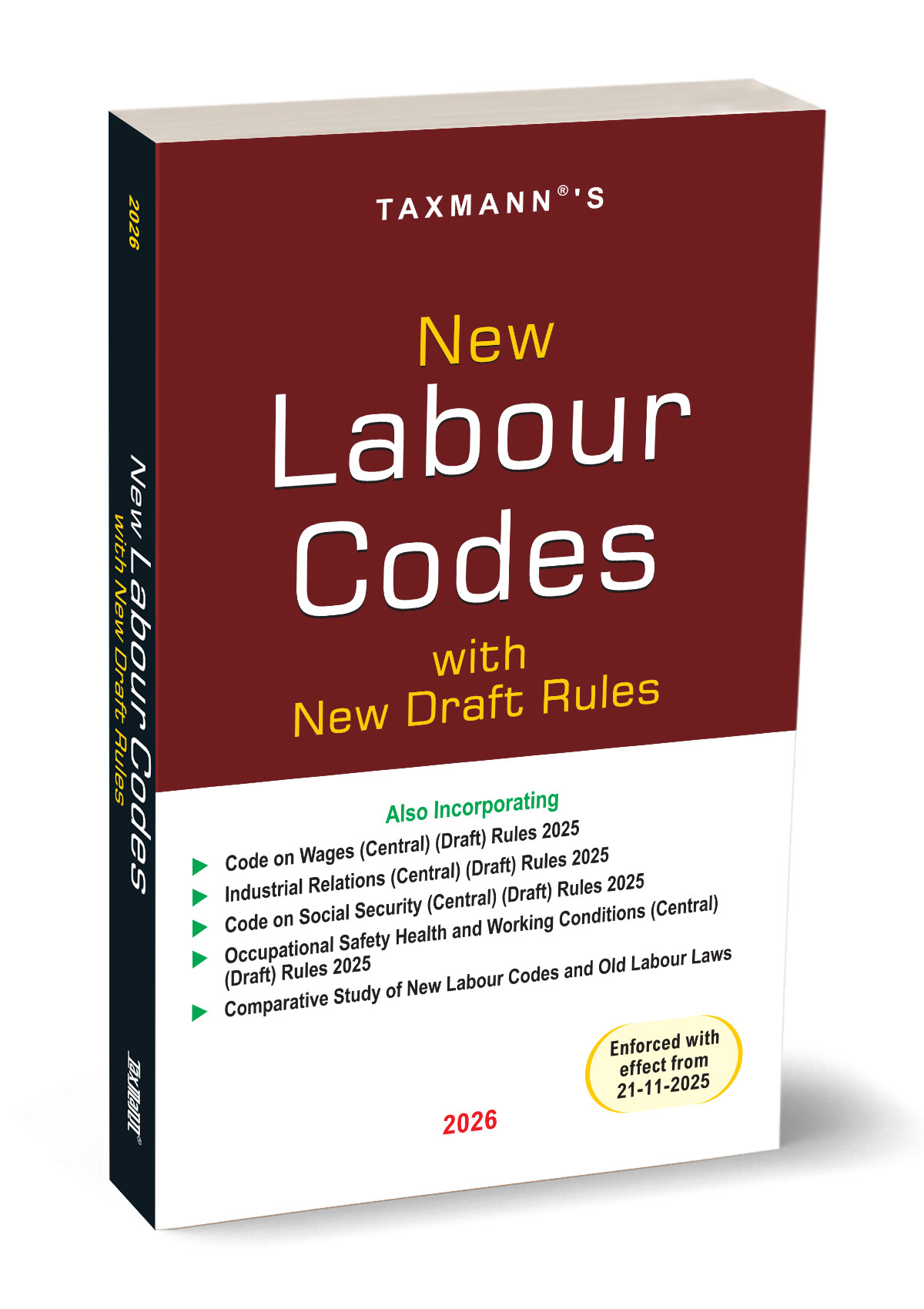
New Labour Codes with New Draft Rules and Comparative Study of New Labour Codes and Old Labour Laws is a comprehensive statutory and transition-oriented reference work that presents India’s restructured labour law framework in its complete and functional form. The publication is built on three equally critical pillars—the Labour Codes, the Comparative Study with repealed labour laws, and the Draft Central Rules—without which a correct understanding or application of the new regime is not possible. The book consolidates the full text of all four Labour Codes—the Code on Wages 2019; the Industrial Relations Code 2020; the Code on Social Security 2020; and the Occupational Safety, Health and Working Conditions Code 2020—along with a Code-wise comparative study mapping these enactments to the legacy labour statutes they replace, and the Draft Central Rules 2025 that operationalise the statutory framework. The law stated in the book is up to date, reflecting the post-enforcement phase of the Labour Codes. This publication is not conceived as a conventional Bare Act compilation. It is editorially designed as a comprehensive labour law transition manual, enabling readers to understand the law as enacted, as transformed from the old regime, and as intended for implementation.
This book is intended for all stakeholders who require clarity, continuity, and compliance certainty under the Labour Codes framework, including:
Employers, HR Heads, Industrial Relations Managers, & Compliance Officers
Labour Law Practitioners, Advocates, & Consultants
Company Secretaries, Chartered Accountants, & Cost Accountants
Payroll & Wage Administration Professionals
Factory Management, EHS Professionals, & Contractor Administrators
Academicians, Researchers, and Students of Labour & Employment Law
Regulators, Inspectors, & Policy Professionals
The Present Publication is the Latest 2026 Edition, updated till 1st January 2026. It is authored/edited by Taxmann’s Editorial Board, with the following noteworthy features:
[Three-Pillar Editorial Architecture] The publication is structured around three equally important components—the Labour Codes, the Comparative Study, and the Draft Rules—ensuring completeness from a legal, transitional, and operational perspective
[Complete Text of All Four Labour Codes] Reproduces the full statutory text of all four Labour Codes, along with arrangements of sections and relevant notifications, reflecting the operative legal framework
[Code-wise Comparative Study with Old Labour Laws] Provides a structured comparison between the new Codes and the repealed Central Labour enactments, enabling readers to trace legislative continuity, deviation, and consolidation
[Draft Central Rules 2025 Incorporated] Includes the Draft Central Rules framed under each Code, detailing procedural requirements, compliance mechanics, forms, registers, returns, licensing, and electronic processes
[Post-Enforcement Orientation] Designed for application after enforcement, not as a reform proposal, with emphasis on implementation and compliance
The coverage of the book is as follows:
The Labour Codes (Primary Law) – The book contains the complete and updated statutory text of:
Code on Wages 2019
Industrial Relations Code 2020
Code on Social Security 2020
Occupational Safety, Health and Working Conditions Code 2020
Each Code is presented with its arrangement of sections and relevant notifications, forming the binding legal foundation of India’s labour law regime
The Comparative Study (Transition & Continuity) – A dedicated, Code-wise comparative study forms the second core pillar of the book. This section systematically maps the provisions of each Labour Code against the repealed labour laws, including:
Wage laws such as the Minimum Wages Act, Payment of Wages Act, Payment of Bonus Act, and Equal Remuneration Act
Industrial relations laws such as the Trade Unions Act, Industrial Employment (Standing Orders) Act, and Industrial Disputes Act
Social security enactments covering EPF, ESI, gratuity, maternity benefit, employee compensation, and welfare legislations
Occupational safety and working conditions laws, such as the Factories Act, Mines Act, Contract Labour Act, and Inter-State Migrant Workmen Act
This comparative framework explains how definitions are unified, thresholds are revised, coverage is expanded, enforcement mechanisms are restructured, and compliance obligations are re-engineered. It enables readers to understand not merely what the new law provides, but how and why it differs from the earlier regime
The Draft Central Rules 2025 (Operationalisation) – The third pillar of the publication is the inclusion of the Draft Central Rules issued under each Labour Code. These Draft Rules translate the statutory framework into practical compliance systems, covering:
Registration, licensing, and approvals
Forms, registers, and returns
Electronic filing and digital compliance mechanisms
Inspection, reporting, and administrative procedures
Supersession of legacy rules under the repealed Acts
By incorporating the Draft Rules in Gazette format, the book enables readers to move seamlessly from substantive law to procedural execution
The structure of the book is as follows:
Comparative Study to establish transition clarity before reading the Codes
Code-wise Statutory Presentation for focused and independent reference
Integrated Placement of Draft Rules to connect legal provisions with implementation mechanics
Logical Flow supports both academic study and practical use