
Description
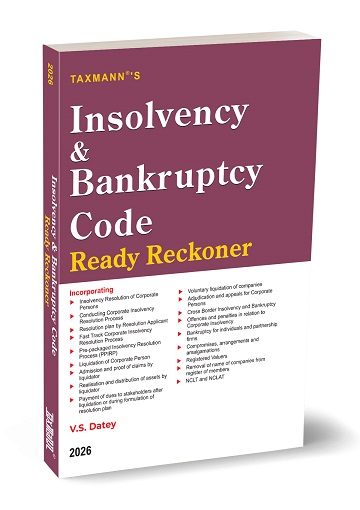
Insolvency & Bankruptcy Code Ready Reckoner is a comprehensive, practice-oriented reference work that presents the Insolvency and Bankruptcy Code 2016 (IBC) as a complete insolvency resolution and economic revival framework, rather than a mere debt recovery statute. Designed in the nature of a ready reckoner, this publication explains the law as it operates in practice—covering corporate insolvency resolution, pre-packaged insolvency, liquidation, individual and partnership bankruptcy, adjudication, appeals, and enforcement—within a single, integrated volume. The 2026 Edition reflects the law as updated, incorporating legislative amendments, regulatory developments, and evolving judicial interpretation. The book follows the actual lifecycle of insolvency proceedings, enabling professionals to move seamlessly from default and initiation, through resolution or liquidation, to distribution, dissolution, and appellate remedies. Its structured, paragraph-numbered format makes it an indispensable desk reference for practical insolvency work.
This book is intended for the following audience:
Insolvency Professionals (IRPs, RPs, Liquidators, IPEs) handling CIRP, PPIRP, liquidation, claims, distributions, and regulatory compliance
Advocates and Insolvency Litigators practising before NCLT, NCLAT, and higher courts
Banks, Financial Institutions, ARCs, and Credit Teams involved in insolvency initiation, CoC participation, resolution planning, and enforcement strategy
Chartered Accountants, Company Secretaries, Cost Accountants, and Registered Valuers supporting insolvency, restructuring, and valuation assignments
Corporate Management, In-house Legal, and Compliance Teams dealing with financial distress, restructuring, or voluntary exit
Academicians, Researchers, and Advanced Students seeking a structured, practice-aligned understanding of the IBC ecosystem
The Present Publication is the 2026 Edition, updated till 20th December 2025. It is authored by V.S. Datey with the following noteworthy features:
[Process-oriented Ready Reckoner] Designed as a true ready reckoner, the book follows the actual lifecycle of insolvency proceedings—from default and initiation to resolution, liquidation, distribution, closure, and appeals—enabling quick, stage-wise reference during live matters
[End-to-end Insolvency Coverage] Provides comprehensive coverage of Corporate Insolvency Resolution Process (CIRP), Pre-Packaged Insolvency Resolution Process (PPIRP), Fast Track CIRP, Liquidation, Voluntary Liquidation, and Bankruptcy of Individuals and Partnership Firms, within a single integrated framework
[Resolution-first Orientation] Explains the Insolvency and Bankruptcy Code as a revival and value-maximisation mechanism, consistently reinforcing the principle that liquidation is a measure of last resort, supported by statutory provisions and judicial interpretation
[Resolution Plan & CoC Mechanics] Offers focused treatment of resolution applicant eligibility, resolution plan formulation, evaluation and approval, Committee of Creditors’ commercial decisions, and post-approval legal consequences
[Dedicated PPIRP Coverage] Contains a structured, standalone treatment of Pre-Packaged Insolvency Resolution Process, covering eligibility, initiation, post-admission procedures, claims handling, competitive improvement of plans, and approval mechanics—particularly relevant for MSMEs
[Liquidation & Distribution Framework] Analyses liquidation in detail, including appointment and powers of the liquidator, admission and proof of claims, avoidance transactions, asset realisation, distribution waterfall, stakeholder payments, and dissolution
[Cross-statute & Regulatory Integration] Examines the interaction of IBC with Companies Act winding-up provisions, compromises and arrangements, removal of name of companies, limitation law, SARFAESI/DRT proceedings, and GST/Income-tax implications during insolvency
[Adjudication & Appellate Architecture] Provides consolidated coverage of NCLT and NCLAT jurisdiction, procedure, and powers, along with appeals to the Supreme Court, enabling practitioners to navigate the adjudicatory structure efficiently
[Offences, Penalties & Enforcement] Includes a dedicated exposition of offences and penalties under the Insolvency and Bankruptcy Code, clarifying enforcement mechanisms and statutory consequences
[Individual & Partnership Insolvency] Covers the Fresh Start Process, Insolvency Resolution Process, and Bankruptcy Proceedings for individuals and partnership firms, including the role of the bankruptcy trustee and settlement of claims
[Institutional & Professional Framework] Explains the role and regulation of IBBI, Information Utilities, Registered Valuers, and other institutional participants forming the insolvency ecosystem
[Jurisprudence-backed Interpretation] Integrates significant judicial precedents to clarify interpretative issues, reinforce core insolvency principles, and guide practical application
[Navigation & Reference Tools] Equipped with acronyms, paragraph-wise numbering, a detailed section index, and a comprehensive subject index, making it highly effective for rapid professional reference
The coverage of the book is as follows:
Insolvency Framework & System Architecture
Objectives and scheme of the Insolvency and Bankruptcy Code
Overriding effect of IBC and applicability of limitation law
Interaction with Companies Act winding-up provisions
Role of IBBI, Information Utilities, and Insolvency Fund
Corporate Insolvency Resolution Process (CIRP)
Initiation of CIRP by financial creditors, operational creditors, and corporate applicants
Moratorium, public announcement, and claims collation
Constitution, powers, and decision-making of the Committee of Creditors
Duties and responsibilities of IRP and RP
Information memorandum and process governance
Resolution Plans
Eligibility and ineligibility of resolution applicants
Submission, evaluation, and approval of resolution plans
Legal consequences and protections after plan approval
Special Insolvency Processes
Fast Track Corporate Insolvency Resolution Process
Pre-Packaged Insolvency Resolution Process (PPIRP), including initiation, post-admission procedure, claims handling, and plan approval
Liquidation
Liquidation of corporate persons
Powers and duties of the liquidator
Admission and proof of claims
Avoidance transactions
Realisation and distribution of assets
Priority of payments and stakeholder dues
Voluntary liquidation of companies
Adjudication, Appeals & Enforcement
Adjudicatory framework for corporate insolvency
Appeals before NCLAT and the Supreme Court
Cross-border insolvency and bankruptcy provisions
Offences and penalties under the IBC
Individuals & Partnership Firms
Insolvency resolution process for individuals and partnership firms
Fresh Start Process
Bankruptcy orders and the role of the bankruptcy trustee
Allied & Institutional Frameworks
Registered Valuers
Compromises, arrangements, and amalgamations
Removal of the name of companies from the register
Constitution, powers, and procedure of NCLT and NCLAT
The structure of the book is as follows:
Stage-wise, Workflow-driven Chapter Arrangement reflecting insolvency proceedings
Paragraph-numbered Analysis for precise referencing and ease of citation
Multiple Navigation Aids—contents, acronyms, section index, and subject index
Integrated yet distinct treatment of corporate insolvency, liquidation, and individual bankruptcy
This structure ensures quick access to relevant issues during insolvency assignments, advisory work, and litigation


![Bharat's Companies Act with Rules [Royal Edition]](https://hindlawhouse.com/wp-content/uploads/2021/03/9789347779169-300x300.jpg)
Reviews
There are no reviews yet.