Description
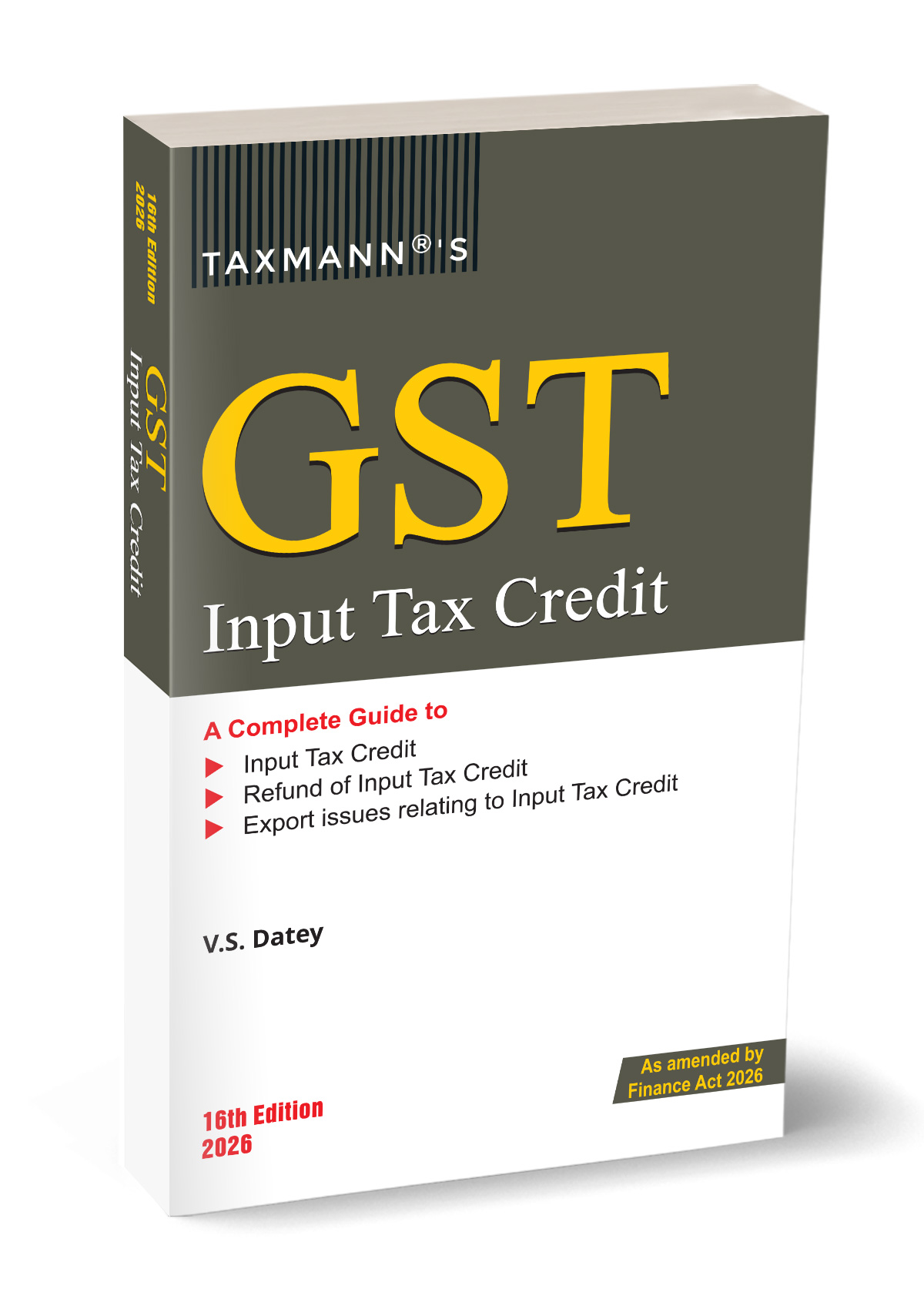
GST Input Tax Credit by V.S. Datey is the most granular, practice-oriented single-subject treatise available on the Input Tax Credit regime under India’s Goods and Services Tax law. Now in its 16th Edition, this title has been updated annually since the inception of GST and has established itself as the authoritative practitioner reference on a subject that is simultaneously the core economic mechanism of GST—the instrument through which its non-cascading, value-added character is realised—and the single greatest source of compliance disputes, departmental litigation, and blocked cash flow across the Indian business ecosystem.
The book is built on the premise that ITC law cannot be understood or applied through statutory text alone. It integrates the CGST Act, IGST Act, CGST Rules, 2017, CBI&C circulars, departmental clarifications, Advance Ruling Authority decisions, CESTAT precedents, and High Court and Supreme Court judgments into a unified, topic-wise treatment that reflects the operational complexity of ITC compliance as it is actually experienced by practitioners and businesses. Where the law is unsettled or contested, or where advance rulings have produced conflicting outcomes across states, the book identifies those conflicts and offers the author’s own calibrated assessment of the defensible position—a dimension that distinguishes it from a bare commentary.
This is an advanced practitioner text, not an introductory guide to GST. The reader is assumed to have working knowledge of GST law and its procedural architecture. Specifically, this book is suited for:
Tax Professionals and Advisors — Chartered Accountants, Cost Accountants, and Company Secretaries engaged in GST advisory, compliance, audit, and litigation who need authoritative, granular analysis of ITC eligibility, reversal mechanics, blocked credit positions, and refund procedures
GST Litigators and Advocates — Legal practitioners handling ITC disputes, show cause notices, appeals before the GST Appellate Authority, GST Appellate Tribunal, and High Courts. The book’s deep integration of case law—including decisions under the pre-GST CENVAT regime cited where principle remains applicable—makes it directly useful for constructing and defending positions
Finance and Indirect Tax Heads in Business — Senior executives in manufacturing, trading, export-oriented units, real estate, infrastructure, banking, and services who need to operationalise ITC optimisation strategies, manage GSTR-2B reconciliation, and handle departmental audits
Exporters and Merchant Exporters — Businesses engaged in zero-rated supply, LUT execution, IGST refund on exports, accumulated ITC refund, and inverted duty structure situations. The book’s Chapter 8 (Exports and Imports) and the refund provisions in Chapter 9 are particularly detailed for this audience
Banks, NBFCs, and Financial Institutions — Entities governed by the special proportionate credit rule under Rule 38 (50% ITC option), which is addressed in a dedicated section covering the procedure for credit claim and the specific calculation methodology applicable to this sector
Real Estate Developers — The proportionate ITC calculation for residential real estate projects (RREP) versus other real estate projects—including the distinct calculation under Rules 42 and 43 as applicable to incomplete contracts and mixed-use projects—is covered with full clarity on the mandatory reversals and year-end adjustments specific to this sector
Companies with Multi-State Operations — The mandatory Input Service Distributor framework, operational from 1st April 2025, requires businesses with branches across states to register as ISDs and distribute common input service credits through a defined mechanism. This book is the most comprehensive current reference for implementing ISD compliance
Tax Authorities and Quasi-Judicial Officers — Officers adjudicating ITC-related demands, processing refund claims, and deciding show cause notices will find the statutory provisions, rules, and procedural framework assembled at one place
The Present Publication is the 16th Edition | 2026, amended by the Finance Act 2026. This book is authored by V.S. Datey with the following noteworthy features:
[Finance Act 2026—Fully Integrated] All amendments are woven into the substantive discussion at the point of relevance, with the author’s commentary on whether each change is in force or pending notification—including post-sale discount liberalisation, 90% provisional refund for inverted duty structure, IGST refund below ₹1,000 for small exporters, and the intermediary place-of-supply correction after nine years
[Mandatory ISD—Both Regimes Covered] The transition from optional to mandatory ISD from 1st April 2025 is addressed in two distinct sections, enabling practitioners to advise on legacy cross-charge positions and current compliance in parallel
[Section 17(5)—Exhaustive with Conflicting Rulings Assessed] Every blocked credit category is analysed with precision. Where AAR and AAAR decisions across states conflict—as is frequent—the book identifies the disagreement and flags the more defensible position rather than leaving the reader to reconcile conflicting rulings independently
[Author’s Own Views—Clearly Flagged] V.S. Datey consistently identifies interpretive positions that are his own—including where he disagrees with advance rulings, departmental practice, or anomalous drafting. This practitioner candour is rare in reference texts and directly useful in contested matters
[CBI&C Circulars—Embedded] Circular clarifications appear at the precise sub-section they govern, making the book usable as a standing desk reference without parallel access to a circular repository.
[Case Law—Selectively and Critically Applied] Landmark decisions—Thirumalakonda Plywoods, Landmark Cars East, Troikaa Pharmaceuticals, CMS Info Systems—are referenced where they actually drive the legal position, not cited for volume. Pre-GST CESTAT precedents are included where the principle survives into the GST regime
[ITC Flow Diagram] A clear diagram mapping credit flow from imports, inter-state, and intra-state procurement through to IGST, CGST, and SGST/UTGST utilisation—including the mandatory utilisation sequence—anchors the statutory discussion with a visual reference
[Refund Forms and Timelines—Operationally Complete] Every refund category is covered with the applicable formula, GST RFD form reference, timeline, and post-adjudication procedure, including PFMS bank account validation mechanics and interest computation on delayed refunds
The coverage of the book is as follows:
Chapter 1 — GST | An Overview
The structural foundation—dual GST model, destination-based consumption character, rates, GSTN’s role (with the author’s candid observation on its high-handed functioning), and all Finance Act 2026 changes, including the Compensation Cess abolition from 1st February 2026
Chapter 2 — Highlights of GST Law
The operational GST framework—taxability, reverse charge tables, time and place of supply, value, composition scheme, registration, invoicing, e-way bill, returns architecture, and a panoramic overview of ITC, refunds, demands, and appeals. Sets the compliance context for the ITC-specific analysis that follows
Chapter 2A — VAT Concept and Its Application in GST
The intellectual origins of ITC—the cascading tax problem, the meaning of ‘value added’, zero-rated versus exempt, and a revenue-neutral rate. Explains why ITC is structured the way it is before the statutory mechanics are engaged
Chapter 3 — Input Tax Credit (ITC)
The core of the book. Statutory definition of input tax across CGST, SGST, IGST, UTGST, and reverse charge variants; conditions under Section 16(2); GSTR-2B-based availment; the November time limit and its validity jurisprudence; ITC during registration cancellation and revocation under Sections 16(5) and 16(6); 180-day reversal under Rule 37; process losses; instant credit; and an exhaustive treatment of blocked credit under Section 17(5) with case law
Chapter 4 — ITC: Other Issues
Capital goods ITC—the depreciation bar, pipeline and telecom tower ineligibility, and removal calculations. Transfer of ITC on merger, demerger, amalgamation, and business transfer. ITC at first registration on opening stock. ITC on exit from the composition scheme or when the exemption is withdrawn. Reversal on cancellation of registration. Recovery of wrongly-taken credit
Chapter 5 — ITC When Exempted as Well as Taxable Supplies Are Made
Proportionate credit under Rules 42 and 43—the proration formula, exempt supply value calculation, year-end reconciliation. Special 50% regime for banks, FIs, and NBFCs. Distinct calculation methodology for Residential Real Estate Projects (RREP) versus other real estate projects, including the commercial portion formula and multi-project input assignment
Chapter 6 — Input Service Distributor (ISD)
Mandatory ISD framework from 1st April 2025—registration, distribution procedure under new Rule 39, pro-rata allocation, IGST and CGST/SGST distribution across the same-state and different-state branches, ISD invoice and credit note, recovery of excess distributed credit. The pre-April 2025 optional regime and why the cross-charge flexibility no longer applies. Employee services remain outside ISD even post-April 2025
Chapter 7 — Utilisation of ITC for Payment of Output Tax
Electronic ledger architecture (ECL, ECRL, ELR). The mandatory ITC utilisation sequence under Section 49. GSTR-2B matching restrictions. Departmental blocking under Rule 86A—conditions, judicial scrutiny, and restoration. The 1% mandatory cash payment requirement. Unutilised ITC at year end. Interest on delayed payment
Chapter 8 — Exports and Imports
Zero-rated versus exempt supply—the critical distinction for ITC entitlement. Export under LUT/bond, the merchant exporter 0.1% IGST chain, IGST refund on exports (shipping bill as deemed application, value mismatch treatment, export proceeds realisation condition), export of services, Nepal/Bhutan, deemed exports, FTP 2023 scrips, duty-free airport shops. Import of goods—IGST computation post-Cess abolition, bill of entry as ITC document, high seas sales, bonded warehouse sales, third-country shipments, import of services under reverse charge, and associated exemptions
Chapter 9 — Refund in GST
The most operationally detailed chapter. Covers every refund category—IGST on exports, unutilised ITC on zero-rated supplies (Rule 89(4) formula), inverted duty structure (Rule 89(5) formula), deemed exports, SEZ supplies, intra/inter-state reclassification, TDS/TCS excess, UN/embassy refunds, Canteen Stores Department—with applicable forms, timelines, provisional refund mechanics, deficiency memo procedures, SCN adjudication, PFMS disbursement, adjustment against outstanding demand, interest on delayed refunds, and the doctrine of unjust enrichment including practical precautions for refund claimants
The structure of the book is as follows:
Pedagogical Sequence — Opens with the GST framework and conceptual foundation (Ch. 1, 2, 2A) → moves to ITC availability, conditions, and restrictions (Ch. 3, 4, 5) → covers distribution and utilisation (Ch. 6, 7) → concludes with exports and refund monetisation (Ch. 8, 9)
Numbered Sub-Paragraphs — Each chapter is divided into granular numbered paragraphs (e.g., 3.3-1A, 9.20-4), enabling surgical cross-referencing during assessment proceedings, refund adjudication, or legal opinion work
Case Citations — Standardised citation format throughout—court/tribunal, year, and citation reference included for every case
Eight Appendices — Reproduce the primary statutory material: relevant CGST Act sections, IGST Act sections, CGST Rules 2017, LUT conditions notification, and four key CBI&C circulars on refunds, ITC entitlement, interest under Section 50(3), and electronic refund process
Reference Apparatus — Subject index and full GST acronym glossary included