Description
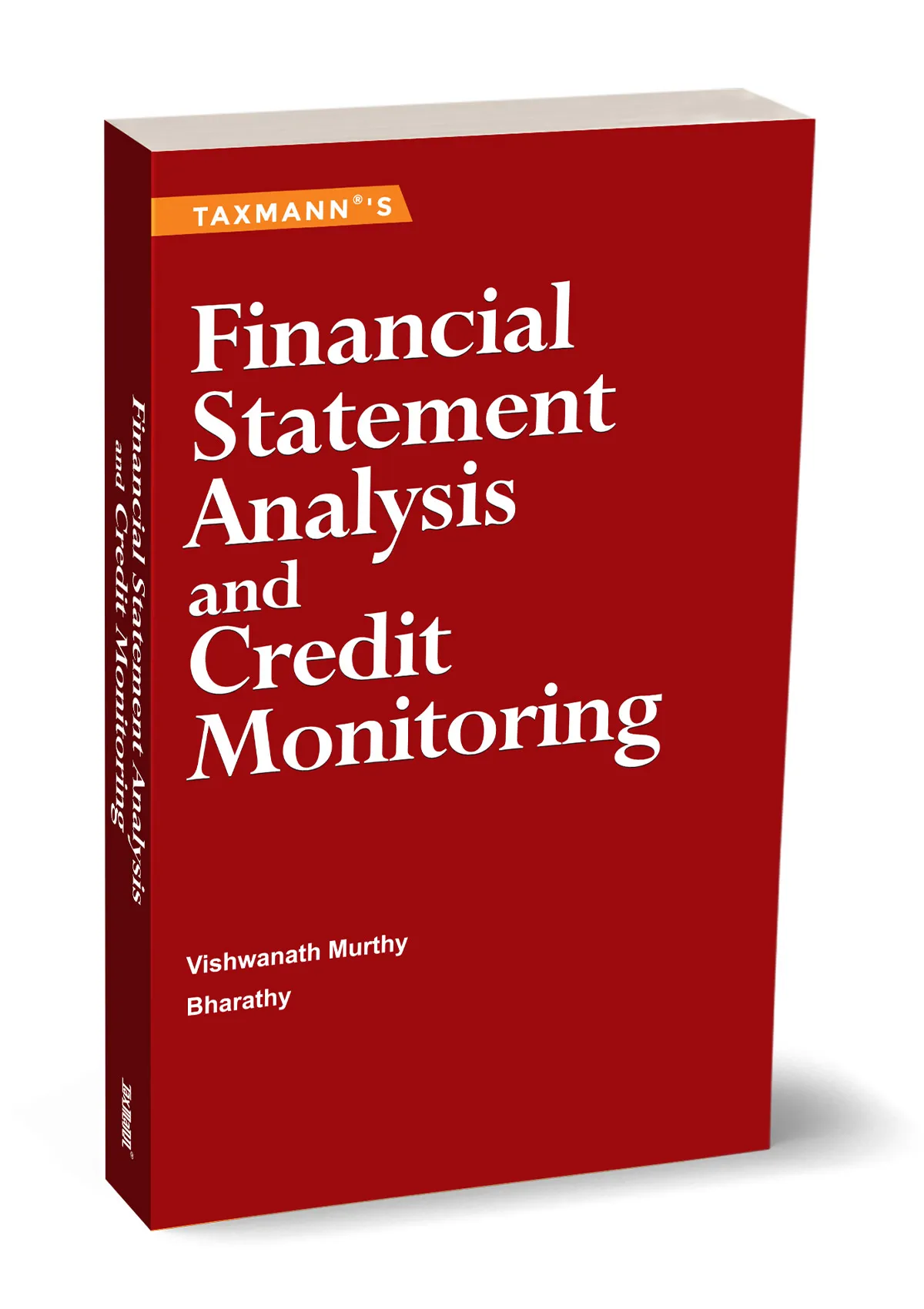
Financial Statement Analysis & Credit Monitoring is a practical guide to monitoring a loan after it is sanctioned, spotting stress early and resolving it when it sets in. Many books treat financial statement analysis, credit monitoring, banking regulation and insolvency resolution as separate subjects. This book brings them together in one framework, with stressed asset resolution as the natural next step after monitoring.
The book takes a lifecycle approach to credit: project appraisal, ongoing performance tracking, early warning signals, NPA management and, finally, resolution. It opens with the tools lenders use to follow up a project. It then shows how to read a borrower’s balance sheet, profit and loss statement, cash flow statement and ratios as monitoring tools, how to spot early warning signals, why loans turn into NPAs, and how stressed assets are resolved through Asset Reconstruction Companies (ARCs) under the SARFAESI Act and under the Insolvency and Bankruptcy Code (IBC). It closes with proposals to stop stress at its source.
The analysis is built on the published financial statements of real companies. In the analysis chapters, Bajaj Hindusthan Sugar Ltd. is studied in depth, often against its sugar-industry peers, so readers can follow one set of figures through several tools.
It answers questions that lenders and analysts actually face, such as:
- Should a lender monitor a borrower on its standalone or its consolidated statements?
- Can a company report a profit and still run short of cash?
- Has the borrower used short-term funds for long-term assets?
- Are fresh term loans being raised only to repay old ones?
- When can a nominee director be held personally liable?
- Which warning signs show up before an account turns NPA?
- Who finally bears the cost of bad loans?
- How much do creditors really recover under the IBC?
This book is intended for the following audience:
- Bankers and Credit Officers, for follow-up, early warning signals and the handling of stressed accounts
- Chartered Accountants and Financial Analysts, for reading, regrouping and analysing published financial statements
- Company Secretaries and Directors, including nominee directors, for board-level monitoring and the liability of nominee directors
- Promoters and Boards of Borrowing Companies, since the book holds that follow-up is their job too, not only the lender’s
- Insolvency Professionals and Others working on stressed assets, for the SARFAESI Act, ARCs and IBC processes
- Students and Researchers in commerce, management, law and finance
The Present Publication is the 1st Edition. The law stated in the book is updated till 10th November 2026. It is authored by Vishwanath Murthy and Bharathy. They bring a combined experience of over eight decades in project development, project appraisal, risk management, follow-up and stressed asset resolution. The noteworthy features of the book are as follows:
- [Real Companies, Lender’s Questions] The financial statement analysis is built as a toolkit for monitoring, not as an accounting exercise. The techniques are tied to a lender’s questions, such as whether the borrower can repay, whether cash is being diverted and whether the security is being diluted. The analysis uses the published statements of real companies, mostly for 2024-25, so each example works as a case study readers can check for themselves. The main peer group is from the sugar industry: Bajaj Hindusthan Sugar, Balrampur Chini Mills, Bannari Amman Sugars and Triveni Engineering & Industries. Companies such as Jagatjit Industries, Manali Petrochemicals, The Lakshmi Mills Company, EID Parry (India), Adani Green Energy, Ester Industries and Majestic Auto add more cases, including a loss-making company that still generates cash and a profitable one that does not
- [One Borrower, Many Tools] Bajaj Hindusthan Sugar is followed as the ‘candidate company’. The book starts with plain questions. Is it relying too much on debt? Is it delaying payments to suppliers? Is it carrying too much inventory? Has it diverted funds into investments? It then tests these questions with peer comparison and common-size, comparative, trend and index analysis, and finally with the notes to accounts. The notes change the picture. For example, a large rise in investments turns out to come from write-backs, reclassifications, loans converted into investments and fair-value changes, with no cash going out
- [From Statutory Format to Analysis] The Schedule III formats are explained item by item for Ind AS companies (Division II), with the differences for other companies (Division I) set out separately. Examples come from the accounts of companies such as Tata Coffee, Hindustan Unilever and National Aluminium Company. A box works through five tricky items with simple numbers: debt and equity instruments through OCI, cash flow hedges, revaluation reserve, foreign currency translation differences and the share options outstanding account. The book then regroups all three statements for a lender’s use:
- A rearranged balance sheet that separates core and other intangibles, receivables from Government, quasi-equity, free and non-free reserves, and contingent liabilities and commitments
- A regrouped profit and loss statement that separates government grants and incentives, dividends, interest and capital gains, and non-cash items, so that cash profit allows for all non-cash items, not just depreciation
- A regrouped cash flow statement that splits long-term and short-term sources and uses, and measures operating cash after tax, finance costs, loan repayments and dividends
- [Cash Flow Tests that Catch Trouble] Chapter 6 turns the cash flow statement into a set of lender’s tests:
- Is cash from operations enough to meet tax, interest, loan repayments and dividends?
- Have short-term funds been used for long-term assets?
- Has the lenders’ security been diluted?
- How were new fixed assets financed?
- Are fresh loans being raised to repay old ones?
- Has borrowed money gone into investments or loans to subsidiaries and other companies?
- A box on IL&FS shows a company whose net operating cash flow, after tax, interest, loan repayments and dividends, was negative for five years in a row, while its ratings stayed at investment grade until weeks before its first default
- [Ratios the Way Rating Agencies Use Them] Chapter 7 explains 18 ratios in the five groups that rating agencies use: profitability, leverage, coverage, liquidity and turnover. The book compares how agencies such as CRISIL, ICRA and CARE treat net worth, total outside liabilities and the debt service coverage ratio, and explains when to use year-end and when to use average figures. It also covers predictive models: Altman’s Z-Score and Srivastava and Yadav’s Y-Score for spotting distress, and Beneish’s M-Score for spotting earnings manipulation
- [Follow-Up Tools from the Field] Chapter 2 covers periodical progress reports, plant visits and nominee directors. It quotes actual clauses from loan agreements, including IREDA’s General Conditions. It sets out six key issues for a plant visit, explains how to analyse a nominee director’s report, and shows what board-meeting behaviour can signal stress, such as vague answers from management or important items repeatedly tabled without notice
- [Warning Signals at Every Stage] Chapter 8 traces early warning signals from the loan application to the operation stage. At the operation stage, it sorts them into quantitative signals (from the balance sheet, profit and loss statement, cash flow statement, ratios and predictive models) and six groups of qualitative and operational signals, from borrower conduct and account operations to legal and regulatory compliance. It also explains how AI and machine-learning systems can monitor accounts daily or in near real time, and where they fall short
- [The Real Cost of Bad Loans] Chapter 9 explains why loans turn bad through real cases, such as the location and technology problems of Hindustan Fertilizer Corporation, the Rishi Ganga hydropower project destroyed in the 2021 floods, and the ANRAK Aluminium refinery that could not start after its bauxite supply agreement was cancelled. It puts the cost of NPAs to scheduled commercial banks over eight years, through write-offs, provisions and interest not recognised, at roughly ₹26,000 billion. It then traces who ends up paying: depositors, investors, the general public and the wider economy. A box on PMC Bank tells the depositors’ side of the story
- [Resolution, Step by Step] Chapter 11 explains the six resolution measures the SARFAESI Act provides for ARCs and how the RBI’s directions govern them. One of them, the sale or lease of the borrower’s business, cannot yet be used because the RBI has not issued the guidelines it needs. The chapter also reviews ARCs abroad, such as KAMCO in Korea, Danaharta in Malaysia and Securum in Sweden. Chapter 12 takes the main IBC processes stage by stage, from the corporate insolvency resolution process and its pre-packaged version for MSMEs to liquidation and the insolvency and bankruptcy of personal guarantors
- [Case Law] The bibliography lists 30 judgments: 15 of the Supreme Court, 8 of High Courts and 7 of the NCLT and NCLAT. They include Mardia Chemicals, Swiss Ribbons, Essar Steel, K. Sashidhar, Vidarbha Industries, Lalit Kumar Jain and Celir LLP, along with High Court rulings on the liability of nominee directors, ‘as is where is’ auction sales and the withdrawal of a one-time settlement.
- [An Independent View] The authors look behind headline figures. Drawing on the RBI’s own reports, they show that the fall in NPAs owes more to write-offs (₹15,687 billion over eight years) than to recoveries and upgrades (₹11,435 billion). They test, case by case, the RBI’s figure that IBC realisations stand at 161.1% of liquidation value, and find that only 266 of 1,046 cases, about a quarter, recovered at least the liquidation value. They also show how a reported debt service coverage ratio of 3.24x falls to 0.39x once overdue and currently due debenture payments are counted
- [A Plan to Prevent Stress] Chapter 13 sets out a five-pronged strategy to keep loans sound from the start:
- Stronger project appraisal
- Documentation by experienced external solicitors, with a security agent, registered mortgages in place of equitable ones, share pledges, debt service reserve accounts and direct agreements
- Disbursement requests checked by a facility agent with a technical expert, and purpose-specific sub-accounts
- Performance monitoring that uses the financial model as a benchmark for the project’s wider economic and developmental performance, not just debt service, with attention to environmental and social risks
- A fresh look at directed credit
- It also shows where AI can help at each stage of project lending.
- [Amended & Updated] The book covers recent changes, including:
- The Insolvency and Bankruptcy Code (Amendment) Act 2026, with the creditor-initiated insolvency resolution process and group insolvency
- The RBI (Asset Reconstruction Companies) Directions 2025, as updated to 10th March 2026
- The RBI’s 2026 Directions on asset classification, provisioning and income recognition, which take effect on 1st April 2027
- Ind AS 118, the coming Indian counterpart of IFRS 18, in an annexure on what it means for analysts
- The Supreme Court’s February 2026 ruling that telecom spectrum is outside the reach of the IBC, and its October 2026 ruling on the YES Bank AT-1 bond write-down
- IBC and ARC figures up to June 2026
The coverage of the book is as follows:
- Chapter 1 | Credit Monitoring and Follow-up
- The shift from security-based to cash flow-based lending
- What follow-up is, who does it, and when it should begin
- The need for follow-up and its objectives: schedule, cost, output, profit, cash generation and the use of cash
- Follow-up tools, including those named by the RBI
- Chapter 2 | Monitoring Mechanisms
- Periodical Reports: Authority, periodicity, content (implementation stage, completion report, operation stage) and analysis
- Plant Visits: Authority, periodicity, content and analysis
- Nominee Directors: Genesis, appointment, removal, rights, responsibilities, liabilities, reports and their analysis
- Nominee directors and observers
- Chapter 3 | Financial Statements: Regulatory Framework
- Financial statements and the documents attached to them under the Companies Act 2013
- Quarterly results and half-yearly statements under the SEBI (LODR) Regulations
- Standalone versus consolidated statements, and which to use for monitoring
- Chapter 4 | Balance Sheet Analysis
- The Division II and Division I formats, and the terms used for assets, equity and liabilities
- Regrouping the balance sheet for analysis
- Net worth, tangible net worth and capital employed
- Peer comparison on absolute figures and in common-size form
- Comparative, trend (horizontal), index and common-size analysis
- Chapter 5 | Profit and Loss Statement Analysis
- The format and the terms used, from revenue from operations to other comprehensive income
- A regrouped format for analysis
- Peer comparison, comparative, trend, index and common-size analysis
- Quarterly statements
- Annexure: Ind AS 118 and what it means for financial statement analysis
- Chapter 6 | Cash Flow Statement Analysis
- The Format and the Terms Used: Operating, investing and financing cash flows
- Preliminary Analysis: Net and activity-wise cash generation
- Detailed Analysis: Profit versus cash generation, adequacy of cash generation, diversion, security dilution, financing of fixed assets, evergreening and investment
- Trend analysis
- Annexure: Cash flow statements of select companies for 2024-25
- Chapter 7 | Financial Ratio Analysis
- The concept, merits and demerits of ratios, and average versus year-end figures
- Profitability, leverage, coverage, liquidity and turnover ratios
- Peer comparison and trend analysis
- Predictive ratios
- Chapter 8 | Early Warning Signals in Credit Monitoring
- Signals at the application, evaluation, and documentation and disbursement stages
- Quantitative, qualitative and operational signals at the operation stage
- AI and machine learning-based early warning systems
- Chapter 9 | Non-Performing Assets: Causes and Economic Implications
- How the NPA framework evolved, and the extant definition
- Causes: Location, technology failure, raw material shortage, natural disaster, labour problems, power shortage, volatile government policy, management deficiency and the role of financial institutions
- Quantification of NPAs
- Implications for depositors, investors, the general public and the wider economy, and the spread and demonstration effects
- Chapter 10 | Past Institutional Efforts
- Early Efforts: The Industrial Reconstruction Corporation of India, the H.N. Ray Committee, rehabilitation cells, State Level Co-ordination Committees, the Tiwari Committee and BIFR
- The Narasimham Committees and the Andhyarujina Committee, DRTs, the Credit Information Bureau, compromise settlements, Lok Adalats and the SARFAESI Act
- Restructuring Schemes: CDR, JLF and CAP, flexible structuring, SDR and S4A
- The Bankruptcy Law Reforms Committee, the IBC and Project Sashakt
- Chapter 11 | The SARFAESI Act and Asset Reconstruction Companies
- The Scope of the Act: Enforcement of security interest, securitisation, asset reconstruction, ARCs and the Central Registry
- Why ARCs are needed, the experience of other countries and the models they follow
- ARCs in India: Modus operandi and resolution measures
- The Report of the Committee to Review the Working of ARCs
- Annexure: Organisational aspects of ARCs
- Chapter 12 | The Insolvency and Bankruptcy Code
- Objectives, Amendments and Institutional Infrastructure: Insolvency professionals, information utilities, the Adjudicating Authority and the IBBI
- The corporate insolvency resolution process
- The pre-packaged process for MSMEs, the creditor-initiated process and group insolvency
- Liquidation and voluntary liquidation of corporates
- Insolvency resolution and bankruptcy of personal guarantors to corporate debtors
- Chapter 13 | The Way Forward
- Project appraisal, documentation, disbursement and performance monitoring
- AI and project lending
- Revisiting directed credit
- End note
The chapters share a common build:
- Chapter Summary — Each chapter opens with a boxed summary of what it covers
- Numbered Paragraphs — The text runs in numbered paragraphs and sub-paragraphs. The running heads show the paragraph number, so topics are easy to find
- Tables and Boxes — Tables are numbered within each chapter and carry notes and sources where needed. Boxes take up side topics and case stories, such as IL&FS and PMC Bank
- Footnotes — Footnotes, numbered within each chapter, give sources, quote orders and letters, and work through side examples
- Annexures — Three chapters end with an annexure: on Ind AS 118 (Chapter 5), the cash flow statements of select companies (Chapter 6) and the organisational aspects of ARCs (Chapter 11)
- Closing Section — Several chapters end with a Summing Up, Conclusion or End Note