
Description
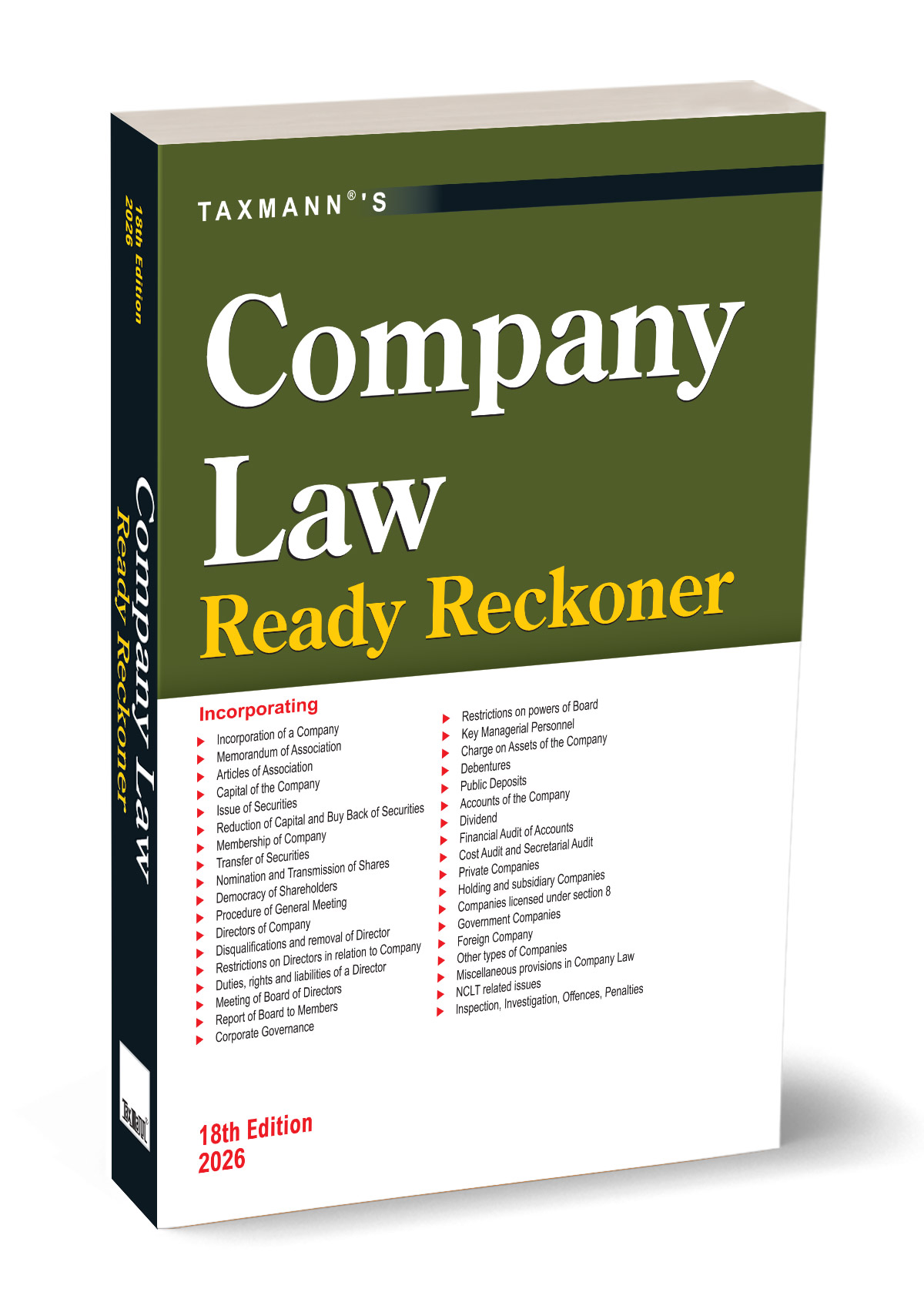
Company Law Ready Reckoner is a comprehensive, practice-oriented reference work designed to serve as a single-volume operational manual for Indian company law under the Companies Act 2013. It is expressly conceived as a ready reckoner—a book to be consulted repeatedly in the course of daily professional work—rather than as a purely academic or theoretical treatise. The editorial philosophy of this book is grounded in practical necessity. It focuses primarily on routine, recurring, and compliance-critical issues faced by companies, directors, and professionals in corporate functioning. Matters that are not typically encountered on a day-to-day basis—such as detailed NCLT litigation or public issues of securities (largely governed operationally by SEBI)—are covered at a foundational level, thereby preserving the book’s usability, clarity, and speed of reference. The Edition reflects the mature, enforcement-oriented phase of Indian corporate regulation, in which governance standards, management accountability, procedural discipline, and electronic compliance systems play a central role.
This publication is intended for readers who apply company law in practice, including:
Practising Company Secretaries, Chartered Accountants, Cost Accountants, Advocates, and corporate consultants
In-House Legal, Secretarial, Compliance, & Governance Teams
Directors, Independent Directors, Key Managerial Personnel, and senior management
Professionals engaged in ROC filings, board and general meetings, corporate governance, and statutory compliance
Students of CS, CA, CMA, & Law, seeking a procedural and application-oriented understanding of company law beyond bare provisions
The Present Publication is the 18th Edition | 2026, and is updated till 20th December 2025. This book is authored by Taxmann’s Editorial Board with the following noteworthy features:
[Ready-reckoner Design] Focused on routine, practical company law issues encountered in everyday corporate operations
[Integrated Treatment of Law and Procedure] Explains not only statutory provisions but also approval routes, compliance steps, and filing realities
[Governance-centric Coverage] Strong emphasis on shareholder democracy, board functioning, directors’ duties, and managerial accountability
[Procedural & E-Governance Alignment] Extensive coverage of MCA-21, electronic filings, registers, records, and returns
[Compliance-at-a-Glance Tools] Use of structured summaries and tabular presentations to enable quick decision-making
[Drafting and Practical Guidance] Includes drafting-oriented discussion where customisation is commonly required (e.g., Articles of Association)
[Clear Scope Delimitation] NCLT matters and public issue mechanisms are addressed at a basic level, maintaining focus on day-to-day compliance
[Comprehensive Indexing] Section-wise and subject indexing ensure fast and precise navigation
The book is structured as a complete company-law operating system, covering the entire lifecycle and regulatory ecosystem of a company through 42 logically sequenced chapters, including:
Foundations & Incorporation
Concept and evolution of company law
Separate legal entity, limited liability, and lifting of the corporate veil
Incorporation process, name approval, ROC filings, and certificate of incorporation
Memorandum and Articles of Association—drafting, alteration, and legal effect
Capital & Securities Framework
Share capital and its alteration
Issue and further issue of securities
Reduction of capital and buy-back
Debentures and public deposits
Public issue of securities (foundational coverage)
Membership & Shareholder Democracy
Membership and register of members
Transfer, nomination, and transmission of securities
Voting rights and shareholder decision-making
Procedure of general meetings, including the Secretarial Standards linkage
Board, Directors & Governance
Appointment, qualifications, disqualifications, and removal of directors
Duties, rights, liabilities, and fiduciary responsibilities
Restrictions on directors and board powers
Meetings of the Board, committees, circular resolutions, and virtual meetings
Corporate governance principles aligned with regulatory expectations
Key Managerial Personnel & Management
Appointment, role, remuneration, and cessation of KMP
Managerial accountability and statutory controls
Finance, Audit & Reporting
Accounts and financial statements
Declaration and payment of dividend
Financial audit
Cost audit and secretarial audit
Special Classes of Companies
Private companies
Holding and subsidiary companies
Section 8 companies
Government companies
Foreign companies
NBFCs, Nidhis, Chit Fund companies
Other specialised forms (OPC, Small Companies, Dormant Companies, Producer Companies, Start-ups, etc.)
Regulatory Oversight & Enforcement
Inspection and investigation
Offences, penalties, compounding, and relief provisions
Overview of NCLT-related issues
Administration of company law by the Central Government, ROC, Regional Directors, SEBI, and courts
E-Governance & Procedural Compliance
MCA-21 framework and electronic governance
Digital signatures, e-filing mechanics, SRN tracking
Registers and records (physical and electronic)
Periodic statutory returns and ongoing compliance requirements
The structure of the book is as follows:
Chapter-Based Architecture – 42 chapters arranged in a functional, lifecycle-oriented sequence
Procedure-led Sub-headings – Emphasis on approvals, compliance steps, and execution pathways
Index-driven Navigation – Section-wise index maps statutory provisions to practical discussion; subject index enables issue-based access
Designed for rapid consultation, not prolonged theoretical reading

![Bharat's Company Law Ready Reckoner 2026 [2 Vols.]](https://hindlawhouse.com/wp-content/uploads/2021/03/9789347779176-300x300.png)