
Description
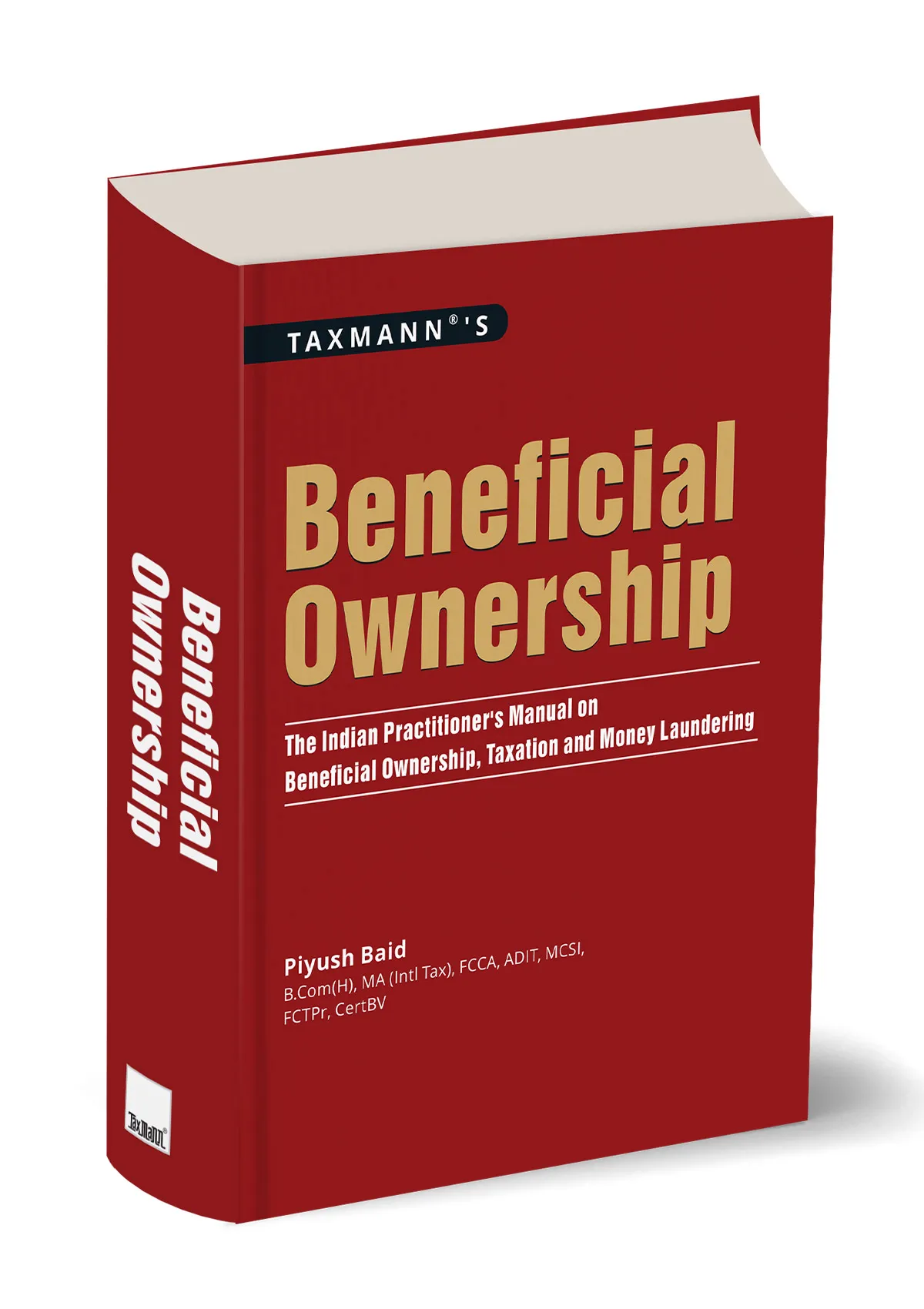
Beneficial Ownership is a practitioner’s manual on beneficial ownership, taxation and money laundering in India. It starts from one question: who really owns the asset? Indian law gives not one answer but five. Each sits in a different statute, is run by a different authority and attaches a different consequence to the same facts.
The book brings the five regimes into one working framework: the Companies Act 2013, the PMLA 2002, the Benami Act 1988, the Income-tax Act 1961 and FEMA 1999. Its 26 chapters are built around three themes: disclosure, gatekeeping and confiscation. The opening chapter sets the five definitions side by side. Chapter 2 deals with tax evasion and avoidance, treaties and GAAR, and Chapters 3 to 8 take the five regimes in turn. The rest of the book covers investigation, compliance, international standards, sanctions, asset recovery and litigation. It then applies the analysis area by area, from real estate and virtual digital assets to family offices, financial services and pooled funds. The final chapter draws the three themes together.
The book is written first for practitioners who must answer the ownership question on a live matter, and equally for postgraduate and professional students of the subject. A practitioner may be advising on a structure, running client due diligence, defending an attachment or preparing a disclosure. In each case, the five regimes, the rulings on them and the practical steps are in one place.
This book is intended for the following audience:
- Tax Counsel and Advocates appearing before the original and appellate authorities, the NCLT, the PMLA Special Courts and Appellate Tribunal, and the Benami Adjudicating Authority
- Chartered Accountants, Company Secretaries and Cost Accountants, who are now PMLA reporting entities for notified client transactions
- Compliance Officers and Money Laundering Reporting Officers in banks, NBFCs and other RBI-regulated entities
- Authorised Dealer Banks handling foreign investment
- Forensic and Investigation Professionals
- Family-Office, Wealth-Structuring and Cross-Border Tax Advisers
- Regulators and Adjudicating Authorities
- Academics, and Postgraduate and Professional Students
The Present Publication is the 1st Edition. The law stated in it is updated till 10th November 2026. It is authored by Piyush Baid, with the following noteworthy features:
- [Convergences and Divergences] Each regime is read against the other four, not in isolation. The book maps where they meet, where they part and how they connect, so one set of facts can be tested against all five. For example, it shows why the same ten per cent figure catches more people under the PMLA rules than under the SBO Rules
- [Constitution and Global Standards] The statutes are read against Articles 14, 19(1)(g), 20(3), 21 and 300A of the Constitution, the FATF Recommendations and India’s 2024 FATF Mutual Evaluation. The book also takes up the Article 300A question that the Supreme Court left open in Manjula: whether applying benami confiscation to pre-2016 transactions satisfies the Article 300A property guarantee
- [Updated for 2026] The book covers the Foreign Exchange Management (Non-debt Instruments) (Amendment) Rules 2026. From 2nd May 2026, these rules define ‘beneficial owner’ for FEMA’s rule on investment from countries that share a land border with India, drawing on the PMLA rules. Income-tax provisions are cited by their 1961 Act numbers, as in the case law, with the 2025 Act sections given at key points. A concordance in Chapter 4 maps the sections discussed there to the Income-tax Act 2025, in force since 1st April 2026
- [Leading Rulings] The book discusses the rulings that decide ownership, confiscation and prosecution. These include Ganpati Dealcom and its 2024 recall, Manjula v. D.A. Srinivas (8th May 2026), Vijay Madanlal Choudhary and Tiger Global (2026), along with the key rulings on bail, reassessment and search
- [Disclosure and Due Diligence] The book shows how to work out, layer by layer, who is a significant beneficial owner, and how the BEN-1 and BEN-2 filings follow. It sets this beside customer due diligence under rule 9(3) of the PML (Maintenance of Records) Rules. It also covers the reporting duties that CAs, CSs and cost accountants have carried since May 2023.
- [Cross-border Structures] The book follows ownership across borders: treaty claims and the proof of substance they now need, inbound FDI under the NDI Rules, outbound ODI and OPI under the OI Rules 2022, and round-trip structures. A six-step sequence sets out the checks to run on each inbound investment under the new rule 6(a)
- [Confiscation and Enforcement] The book explains how section 37A FEMA seizure, PMLA attachment, benami confiscation and Black Money Act proceedings interact. It covers which forum hears each, who has to prove what, and how a matter moves from one regime to another
- [Red-flag Framework] An eight-indicator red-flag framework helps identify the real owner behind a structure. Each flag opens a specific line of inquiry. The flags include a treaty entity with no real business, back-to-back funding, and nominee directors shared across unrelated structures. A four-phase workflow then takes the engagement from scoping to reportable output and record-keeping
- [Practice-oriented Approach] The book treats every ownership question as, in the end, a question of documents. It shows how to build one consistent record, kept as events happen, that holds up across every regime and every jurisdiction. It also flags where thresholds, forms and penalty figures change often, so the reader checks the current position before advising
The coverage of the book is as follows:
- Chapter 1 | The Nexus of Beneficial Ownership, Taxation and Money Laundering
- The five definitions, India’s ten per cent threshold, how concealment works, and the leak era from HSBC to Pandora
- Chapter 2 | Tax Evasion, Avoidance and Beneficial Ownership
- The case law from McDowell to Vodafone, the Mauritius and Singapore treaty settlements, GAAR in operation, and the burden of proof
- Chapter 3 | Money-laundering Typologies and Beneficial Ownership
- The offence and proceeds of crime, typologies of concealed ownership, bail and the twin conditions, the 2023 gatekeeper perimeter, and arrest
- Chapter 4 | The Income-tax Act
- Unexplained credits under sections 68 to 69D, reassessment after 2021, search assessments, cash rules and attribution, and the burden and standard of proof
- Chapter 5 | Benami Property
- The definition and its exceptions, the retrospectivity debate, and the machinery from notice to vesting
- Chapter 6 | The Significant Beneficial Owner Regime
- The Explanations to the SBO Rules that decide cases, the company’s duty to seek disclosure, enforcement of the control limb, and holdings in concert
- Chapter 7 | FEMA, Cross-border Capital Flows and the Beneficial-ownership Inquiry
- The constitutional basis, inbound FDI and the beneficial-owner test in rule 6(a), outbound investment and round-tripping, and penalties, compounding and section 37A
- Chapter 8 | FEMA Contraventions
- Technical, substantive and wilful contraventions, RBI Master Directions, section 13 penalties, the 2024 Compounding Rules, and the escalation ladder to a PMLA scheduled offence
- Chapter 9 | Tools and Techniques for Beneficial Ownership Investigation
- Indian and international databases, intelligence and information-exchange platforms, forensic accounting, network analysis and open-source intelligence
- Chapter 10 | International Cooperation
- Evidence through MLATs and letters rogatory, extradition and the Fugitive Economic Offenders Act, and cross-border asset recovery
- Chapter 11 | International Regulatory Frameworks
- The FATF Recommendations, evaluation and lists, India’s alignment with the FATF, the OECD’s CRS and CARF, and the EU and UK frameworks
- Chapter 12 | Compliance Architecture
- CDD and the beneficial-owner determination, screening, monitoring and STRs, a detailed map of the KYC Master Direction, and governance and records
- Chapter 13 | Jurisdictional Comparison
- India, the UAE, Singapore and Mauritius compared on thresholds, registers and access, grey lists and treaty resets, and GIFT City
- Chapter 14 | Five Framework Failures
- A critical look at fragmentation, the verification gap, the supervision of gatekeepers, delay, and the blind spot on trusts and similar arrangements
- Chapter 15 | Sanctions and Designated-person Regimes
- Freezing under section 51A UAPA, proliferation finance, autonomous sanctions regimes and the ownership doctrines, and challenging a freeze
- Chapter 16 | Asset Recovery and Confiscation
- The five confiscation machineries compared, the collision with insolvency, and the restoration and return of assets
- Chapter 17 | Trusts, Estate Planning and the Beneficial-ownership Inquiry
- Tax, settlement and clubbing, Schedule FA, CRS and the Black Money Act, and the line between fiduciary and benami holdings
- Chapter 18 | Litigation Architecture
- The forum map, standards of proof and how admissions made in one forum are used in another, and interim protection and settlement
- Chapter 19 | Virtual Digital Assets
- The tax regime, the AML perimeter and the FIU’s reach, and tracing ownership on-chain
- Chapter 20 | Real Estate
- Cash and value at registration, benami holdings in the land records, and RERA and the developer’s records
- Chapter 21 | Family Offices and Private Wealth
- Structures, succession and disclosure
- Chapter 22 | Banking, Insurance and the Securities Markets
- Sector practice and the conglomerate’s consolidated view
- Chapter 23 | Professional Services
- The gatekeeper perimeter, legal privilege and its limits, and engagement risk, reporting and self-protection
- Chapter 24 | Partnerships, LLPs and Alternative Investment Funds
- The closed LLP gap, the AIF look-through, and GIFT City and fund migration
- Chapter 25 | Technology, Data and Artificial Intelligence
- The State’s analytics, regulated entities’ models, and the balance between privacy and transparency
- Chapter 26 | Synthesis
- The three movements, the calendar ahead, and the file as the practitioner’s core tool
- Appendices A to D
- Statutory definitions of beneficial ownership compared, a table of principal cases, a select bibliography and source note, and a five-limb master matrix
- Appendices E to K
- A limitation and filing-deadline reckoner, a forms index, a watchlist of questions awaiting resolution, a professional liability map for CAs and advocates, a penalty and interest quick-reference, an appeal and filing-fee reckoner, and a worked example that follows one transaction through five regimes
Each chapter is built from the following parts:
- In Brief — A boxed summary opens each chapter, setting out its argument and what it covers
- Figures — Every chapter has at least one figure, such as a flowchart, decision tree or comparison chart. There are 29 in all
- Worked Examples — Short fact patterns run through the text, each worked through to an answer. There are over 150 in all
- Practitioner’s Notes — Every chapter has boxed practical tips, such as what to record on the file
- Analytical Commentary — The author’s own critical reading of the subject follows the main text in every chapter except Chapter 8
- Multiple-Choice Questions — Every chapter has ten MCQs with solutions
- Case Studies and Scenarios — Chapters 1 to 20 close with case studies. Except in Chapter 8, a global case is paired with an Indian one, each set out as facts, questions, judgment and analysis. Chapter 8 has a single worked case study. Chapters 21 to 25 close with two hypothetical scenarios each, and Chapter 26 with two concluding scenarios