
Description
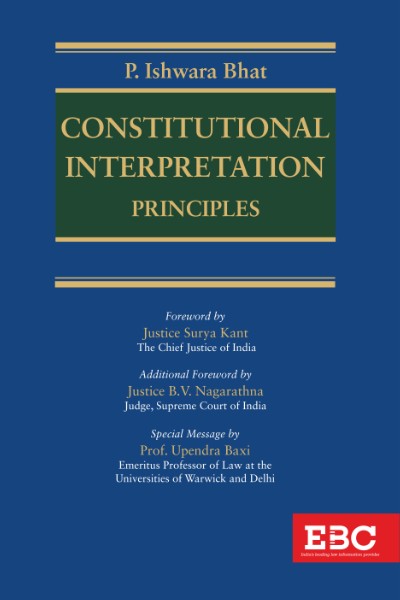
This book is a valuable treatise on the subject, which provides a comprehensive insight into all the principles of constitutional interpretation. With special reference to India. It systematically presents the doctrines, theories, and principles developed by the judiciary for interpreting the Constitution, supported by leading case law, academic views, and comparative constitutional perspectives.
The work examines internal and external aids to interpretation, text-based, structural, and value-based approaches, and the expanding toolkit of constitutional interpretation in light of transformative constitutionalism. It identifies and analyses both traditional tools such as textualism and doctrinalism, and emerging approaches like structuralism, pragmatism, consequentialism, moral reading, feminism, contextualism, and eclecticism.
Key Features:
Exclusive and exhaustive treatise devoted solely to constitutional interpretation in India
All doctrines and principles compiled in one volume, with systematic classification
Covers traditional and modern interpretative tools – textual, structural, purposive, moral, pragmatic and contextual approaches
Extensive case law coverage, including landmark Supreme Court decisions
Comparative constitutional insights drawing from foreign jurisdictions
Clear distinction between statutory interpretation and constitutional interpretation
This book is intended for advocates, judicial officers, law professors and researchers, as well as undergraduate and postgraduate law students studying constitutional law. It is also a valuable reference for constitutional law libraries, law universities, and academic institutions, and will interest general readers seeking to understand constitutional governance and judicial interpretation.
![Financial Reporting [for November 2022]](https://hindlawhouse.com/wp-content/uploads/2022/07/SW-300x300.jpg)

![Bharat's Company Law Ready Reckoner 2026 [2 Vols.]](https://hindlawhouse.com/wp-content/uploads/2021/03/9789347779176-300x300.png)

Reviews
There are no reviews yet.