
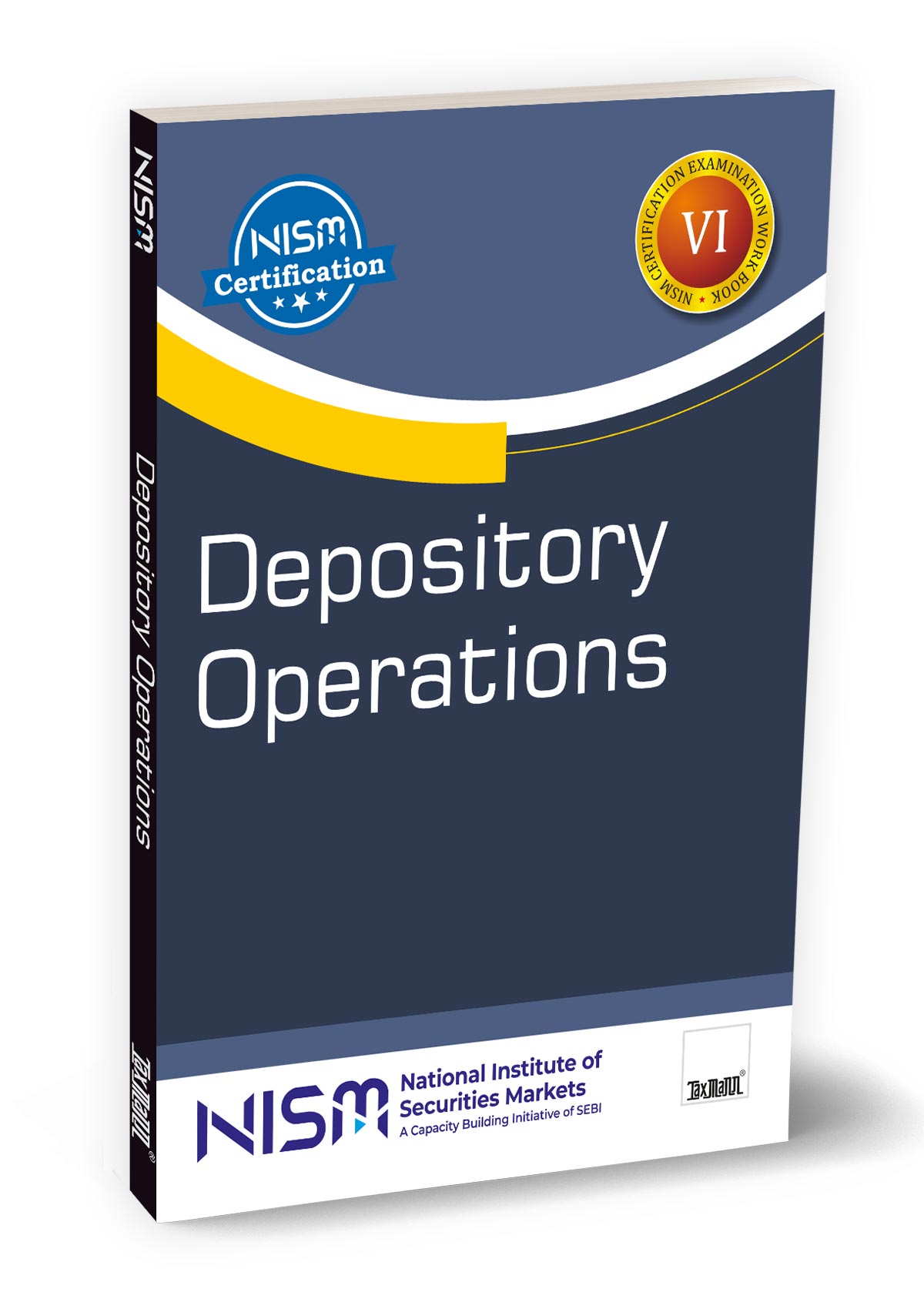
Description
Depository Operations is an authoritative, pedagogically refined text that equips readers with a comprehensive, practical understanding of India’s depository ecosystem. It explains the institutional architecture of depositories, the legal and regulatory framework governing their functioning, and the full operational lifecycle of securities in electronic form—from account opening and KYC compliance to dematerialisation, trading, settlement, pledging, corporate actions, and investor servicing. It translates complex procedures into accessible explanations, providing a structured learning path that supports examination preparation and day-to-day operational proficiency within the securities market.
This book is intended for the following audience:
Depository Participants (DPs) & Market Intermediaries – Professionals working with NSDL/CDSL who need compulsory certification or deeper operational clarity
Compliance Officers & Operations Personnel – Those engaged in back-office operations, compliance reporting, account servicing, and settlement obligations
Students of Securities Markets, Finance & Capital Markets – Ideal for NISM aspirants, market trainees, MBA/Finance students, and learners preparing for advanced certifications
Traders, Analysts & Market Support Staff – Those seeking technical knowledge of dematerialisation, rematerialisation, pledge/hypothecation, and security settlement
Regulators & Policymakers – Professionals referring to procedural insights and regulatory frameworks governing depository operations
The Present Publication is the September 2025 Workbook Version, developed in collaboration with the NISM Certification Team and industry expert Mr R. Karthikeyan, and enriched by contributions from the NSDL and CDSL committee members. It is published exclusively by Taxmann, with the following noteworthy features:
[Comprehensive Coverage of the Depository Ecosystem] Explains the conceptual foundations of Indian capital markets, the need for dematerialised securities, and the integrated role of depositories, DPs, clearing corporations, issuers, and RTAs
[Step-by-Step Operational Guidance] Provides granular explanations of processes such as:
Opening and maintaining demat accounts
Dematerialisation and rematerialisation
Transmission and nomination
Off-market and on-market settlements
Pledge, hypothecation, and margin repledging
Corporate action processing and entitlement management
[Up-to-Date Regulatory Insights] Covers eligibility norms, rights and obligations, inspection and audit requirements, investor protection mechanisms, and the supervisory framework governing depositories and DPs
[Examination-oriented Structure] Includes clearly defined learning objectives, chapter-wise syllabus alignment, topic weightages, and sample illustrations to help candidates prepare effectively for the NISM-Series-VI certification examination
[Practical & Real-world Orientation] Explains workflows in a manner that mirrors actual market practice, making the book equally valuable for both exam takers and professionals managing DP operations
The workbook delivers a structured, end-to-end perspective of depository operations through ten meticulously organised chapters:
Introduction to the Securities Market
Explains the structure of Indian capital markets, including primary and secondary markets
Describes key intermediaries such as stock exchanges, brokers, custodians, and clearing corporations
Provides clarity on financial instruments like equity, debt, derivatives, and mutual funds
Outlines the regulatory landscape, highlighting SEBI’s oversight, investor protection norms, and systemic safeguards
Depository System – Conceptual & Legal Framework
Introduces the evolution from physical certificates to electronic securities
Defines key concepts such as depository, beneficial owner, dematerialisation, and record maintenance
Explains the core functions of depositories: safekeeping, settlement facilitation, transfer of securities, and corporate action processing
Covers the legal and regulatory framework governing depositories, including Acts, Regulations, bye-laws, and SEBI directives
Depository Business Partners
Details the role of Depository Participants (DPs) as intermediaries between investors and depositories
Explains how clearing corporations ensure trade settlement, risk management, and fund security movement
Describes the responsibilities of issuers in creating securities and coordinating corporate actions
Outlines the functions of registrar & transfer agents (RTAs) in reconciliation, verification, and corporate action execution
DP Functions – Account Opening
Explains all types of demat accounts: Beneficial Owner (BO), Clearing Member (CM), joint accounts, and BSDA eligibility
Covers detailed KYC norms, documentation standards, in-person verification, and account activation requirements
Describes processes like freezing/unfreezing accounts, modification of client information, and account closure
Explains investor accreditation, eligibility requirements, and mapping of UCC (Unique Client Code) with demat accounts
Highlights compliance obligations and internal controls necessary for secure onboarding
DP Functions – Account Operations
Outlines operational rules for joint accounts, mandates, and operating instructions
Details the features and benefits of Basic Services Demat Accounts (BSDA)
Explains how NSDL and CDSL online systems support instruction submission, statements, alerts, and service requests
Covers modification procedures for client data, such as address, signature, KYC updates, and contact details
Describes mechanisms for transaction statements, standing instructions, account monitoring, and risk controls
Transmission & Nomination
Defines the transmission of securities upon the death of an account holder
Explains the differences between nomination-based transmission and legal heir processes
Lists documentation required for various scenarios: with nomination, without nomination, joint holdings, etc.
Details DP responsibilities for verification, due diligence, and investor protection
Explains nomination mechanics, registration procedures, and rights of the nominee
Dematerialisation & Related Activities
Explains the structure, purpose, and format of the International Securities Identification Number (ISIN)
Describes step-by-step dematerialisation procedures using DRFs, including verification, rejection handling, and reconciliation
Outlines rematerialisation procedures and situations in which investors may request physical certificates
Details the conversion of mutual fund units from SOA to demat and reconversion back to SOA
Covers demat of units of Alternative Investment Funds (AIFs) and how units are credited electronically
Trading & Settlement in the Depository Environment
Explains the flow of market trades from exchange execution to settlement through clearing corporations
Covers off-market transaction procedures, such as gifts, transfers, and inter-depository transfers
Details the interoperability between clearing corporations and their impact on settlement cycles
Explains mutual fund subscription and redemption flows through depositories
Outlines the mechanism for stamp-duty collection through exchanges, clearing corporations, and depositories
Pledge, Hypothecation & Margin Repledging
Describes how securities are pledged as collateral, including creation, confirmation, invocation, and closure of pledges
Explains hypothecation and how it differs from pledging in operational terms
Details the process of recording a Non-Disposal Undertaking (NDU)
Covers margin repledge frameworks introduced for transparency in collateral management
Outlines regulatory controls and compliance requirements governing collateralised positions
Corporate Actions
Defines corporate actions and categorises them: mandatory, voluntary, and mandatory with choice
Explains how benefits such as dividends, bonuses, rights, splits, consolidations, mergers, and demergers are processed through the depository
Describes entitlement determination, allocation, and credit procedures
Covers reconciliation steps between issuers, RTAs, and depositories to ensure accuracy
Highlights investor rights, timelines, and disclosure requirements associated with corporate actions
The Workbook is designed to ensure progressive learning:
Foundational Concepts – Markets, regulators, and rationale for demat systems
Institutional Architecture – Depositories and their ecosystem of partners
Operational Framework – Account lifecycle, custody, settlements, and instructions
Specialised Processes – Pledges, corporate actions, mutual fund units, AIF units
Regulatory Compliance – Obligations, inspections, risk management, investor rights
Examination Support – Clear objectives, skill benchmarks, and topic weightages
This layered structure enables learners to integrate conceptual understanding with functional application, culminating in mastery over DP operations


![Financial Reporting [for November 2022]](https://hindlawhouse.com/wp-content/uploads/2022/07/SW-300x300.jpg)
Reviews
There are no reviews yet.