
Description
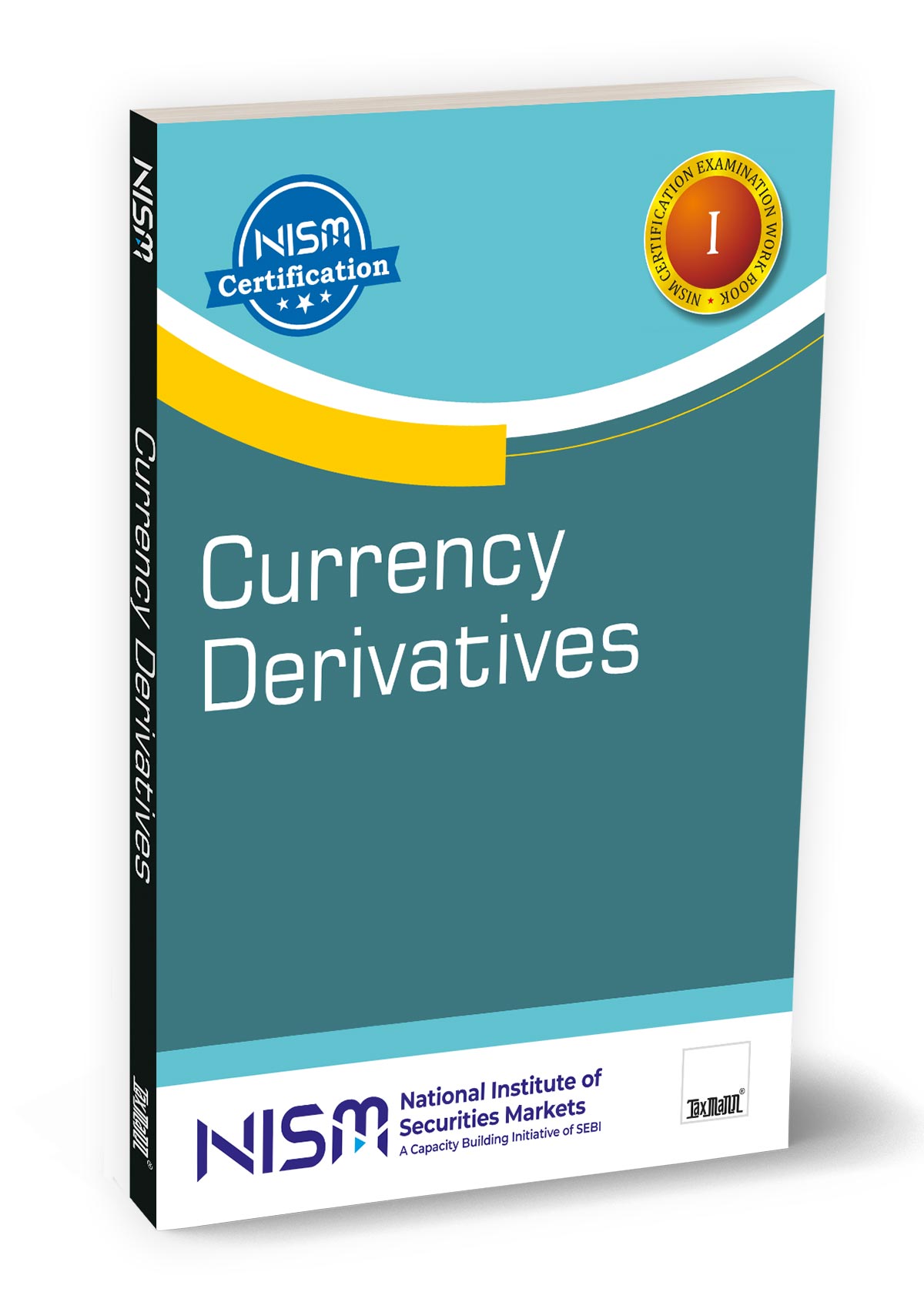
Currency Derivatives is an authoritative workbook to establish the mandated common minimum knowledge benchmark for individuals working in India’s exchange-traded currency derivatives segment. The workbook is designed to support capacity building across the securities markets by simplifying complex concepts in foreign exchange markets, derivative instruments, trading mechanisms, pricing models, clearing and settlement systems, and the regulatory architecture governing currency derivatives in India. The text offers a unique blend of conceptual clarity, practical illustrations, regulatory guidance, and exam-oriented structure, ensuring that learners acquire theoretical understanding and practical competence in market operations, trading behaviour, hedging applications, risk controls, and compliance frameworks. With ten comprehensive chapters, the workbook presents a structured, progressive curriculum covering everything from currency market fundamentals to advanced derivative strategies, risk management systems, and investor protection mechanisms, making it an essential reference for anyone operating or aspiring to operate within India’s currency derivatives ecosystem.
This book is intended for the following audience:
Associated Persons of Market Intermediaries, including dealers, traders, authorised persons, and operations staff handling currency derivatives
Treasury and Forex Desk Professionals in banks, NBFCs, and corporates engaged in hedging or trading currency exposures
Risk Managers, Compliance Officers & Internal Auditors overseeing operational controls, risk mitigation systems, and regulatory compliance
Students, Job Aspirants & Academicians pursuing careers in financial markets, derivatives analytics, treasury operations, or capital market regulation
Trainers & Educational Institutions delivering courses on derivatives, trading strategies, and financial market operations
The Present Publication is the September 2025 Workbook Version, developed in collaboration with the Certification Team of NISM in coordination with Mr Amit Singhal of Cube Edugains Pvt. Ltd., and reviewed by Ms Aparna Bhat, NISM Empanelled Subject Matter Expert (SME). It is published exclusively by Taxmann, with the following noteworthy features:
[Aligned to Currency Derivatives Examination] Covers prescribed learning outcomes and objectives, including currency market basics, derivatives pricing, trading processes, and regulatory norms
[Comprehensive Multi-chapter Structure] Ten detailed chapters spanning foundational concepts to advanced regulatory and operational frameworks
[Practical Illustrations & Payoff Charts] Futures and options payoffs, hedging strategies, arbitrage techniques, and spread-trading examples provide applied understanding
[Full Coverage of India-specific Market Structure] Unique features of Indian FX markets, exchange systems, clearing corporations, interoperability, margins, position limits, and risk controls
[In-depth Regulatory Guidance] Extensive content on SEBI, RBI, FEMA, SC(R)A, participation guidelines, member eligibility norms, and investor protection measures
[Operational & Accounting Focus] Dedicated chapters on order management, trading costs, settlement obligations, accounting disclosures, and taxation of ETCDs
[Investor Protection & Code of Conduct] Emphasises ethical conduct, grievance handling, PoA execution norms, risk disclosures, and investor safety standards
The workbook provides a structured deep dive into:
Introduction to Currency Markets – This chapter builds the foundation by exploring:
The evolution of global FX markets, the transition from fixed to floating exchange regimes, and key historical milestones
Major global currencies and currency pairs, conventions for quoting exchange rates, and market participants across geographies
Peculiarities of the Indian currency market, including regulatory restrictions, market segmentation, permitted instruments, and trading windows
Exchange rate arithmetic, including cross-rate computations—an essential skill for pricing, arbitrage, and valuation
Macroeconomic determinants of currency movements, such as interest rates, inflation, GDP trends, trade balances, and geopolitical factors
Key economic indicators and how they influence currency prices—critical for traders and analysts
Foreign Exchange Derivatives – This chapter deepens the conceptual understanding of derivatives in the currency space. It covers:
Definitions, types, and economic functions of derivatives, including risk transfer, price discovery, and market efficiency
Derivative products such as forwards, futures, options, and swaps, with differences in structure, settlement, and use cases
Categories of Market Participants – hedgers, speculators, arbitrageurs, trading members, and institutional players
Comparison between OTC vs exchange-traded derivatives, highlighting counterparty risks, standardisation, transparency, and settlement flows
The policy rationale behind introducing exchange-traded currency derivatives in India
Exchange-Traded Currency Futures – A comprehensive technical chapter covering:
Definitions and mechanics of currency futures contracts
Payoff charts for long and short futures positions, enabling graphical understanding of profit/loss under varying price scenarios
Detailed contract specifications for INR pairs and other permitted currency futures
Computing contract value and understanding tick sizes, quote conventions, and margin requirements
Advantages and limitations of futures vs forwards in terms of liquidity, marking-to-market, and counterparty risks
Interest Rate Parity (IRP) and the pricing model for currency futures—core to valuation and arbitrage opportunities
Exchange-Traded Currency Options – This chapter transitions to options and covers:
Key terminology, including premium, strike, expiration, intrinsic and time value
Differences between European and American styles, and their relevance to Indian exchanges
Understanding moneyness—ITM, OTM, ATM classifications
Basics of option pricing, including factors that influence premium valuation
Introduction to options Greeks—delta, gamma, theta, and vega—to understand sensitivity-based risk measures
Comparison between ETCD options and OTC options, with emphasis on standardisation and risk mitigation mechanisms
Strategies Using Exchange-Traded Currency Derivatives – A standalone strategy chapter that delves into:
Roles and motives of various market participants—hedgers, traders, arbitrageurs, and corporate treasuries
Hedging strategies using futures and options, such as long hedge, short hedge, protective puts, and covered calls
Option trading strategies, including straddles, strangles, spreads, and synthetic positions—explained through detailed payoff diagrams
Speculative uses of currency derivatives, explaining how traders build directional positions
Arbitrage strategies, including cash-and-carry and reverse cash-and-carry opportunities
Spread trading techniques, including calendar, inter-currency, and inter-exchange spreads
Limitations of ETCDs for hedgers, such as basis risk and rollover costs
Trading Mechanism in Exchange-Traded Currency Derivatives – This operational chapter describes:
The ecosystem of entities involved in trading—exchanges, clearing corporations, trading members, custodians, and depositories
Detailed functioning of exchange trading systems, order matching algorithms, and execution rules
Order management processes, including order types, validity instructions, and execution control parameters
Risk management tools such as order-level risk checks, price bands, and circuit filters
Understanding trading costs, including exchange fees, brokerage, statutory charges, and margins
Clearing, Settlement & Risk Management – A deeply technical and system-driven chapter covering:
Full clearing and settlement mechanism for ETCD transactions
Roles and responsibilities of clearing members, custodial participants, and clearing corporations
Interoperability of clearing corporations, enabling cross-CC risk sharing and efficiency
Daily and final settlement obligations, MTM (mark-to-market) process, and settlement cycles
Position limits, both client-level and member-level, and their regulatory purpose
Risk management frameworks—SPAN margins, exposure margins, extreme loss margins, and peak margin collection
Core topics like the Settlement Guarantee Fund, cyber security guidelines, and resilience frameworks
Regulatory Framework for ETCD – A regulatory deep dive covering:
The Securities Contracts (Regulation) Act 1956, governing derivatives as securities
The RBI–SEBI Standing Technical Committee and its role in harmonising derivative markets
Provisions of FEMA 1999 relevant to currency risk management
Comprehensive SEBI regulations and guidelines, including risk disclosures, participation norms, and capital adequacy
RBI regulations governing currency market participation by banks, exporters, importers, and other entities
Eligibility criteria and compliance obligations for derivative members and clearing members
Accounting & Taxation – An essential chapter for finance professionals, explaining:
Accounting entries for mark-to-market gains and losses
Disclosure requirements for derivative exposures under accounting standards
Taxation of ETCDs, including treatment under business income, speculative income, and applicable tax rules
Code of Conduct & Investor Protection Measures – A governance and ethics-focused chapter covering:
SEBI’s Code of Conduct for Brokers emphasising integrity, fairness, and diligence
Processes for investor grievance redressal, including escalation mechanisms
Handling investor claims in the event of default by a trading/clearing member
Overview of the Investor Protection Fund and its scope
Guidance on Power of Attorney execution, KYC norms, and mandatory risk disclosures
The workbook is crafted in a pedagogically sound sequence—starting with fundamental concepts, then advancing through instruments, strategies, trading mechanisms, risk frameworks, regulatory environments, and ethical considerations. Each chapter includes:
Topic-wise subdivisions for granular learning
Numerical examples and payoff charts
Tables, diagrams, and conceptual frameworks
Exam-oriented material aligned with NISM’s assessment structure
A Syllabus Outline with weightages is also provided for targeted preparation


Reviews
There are no reviews yet.