
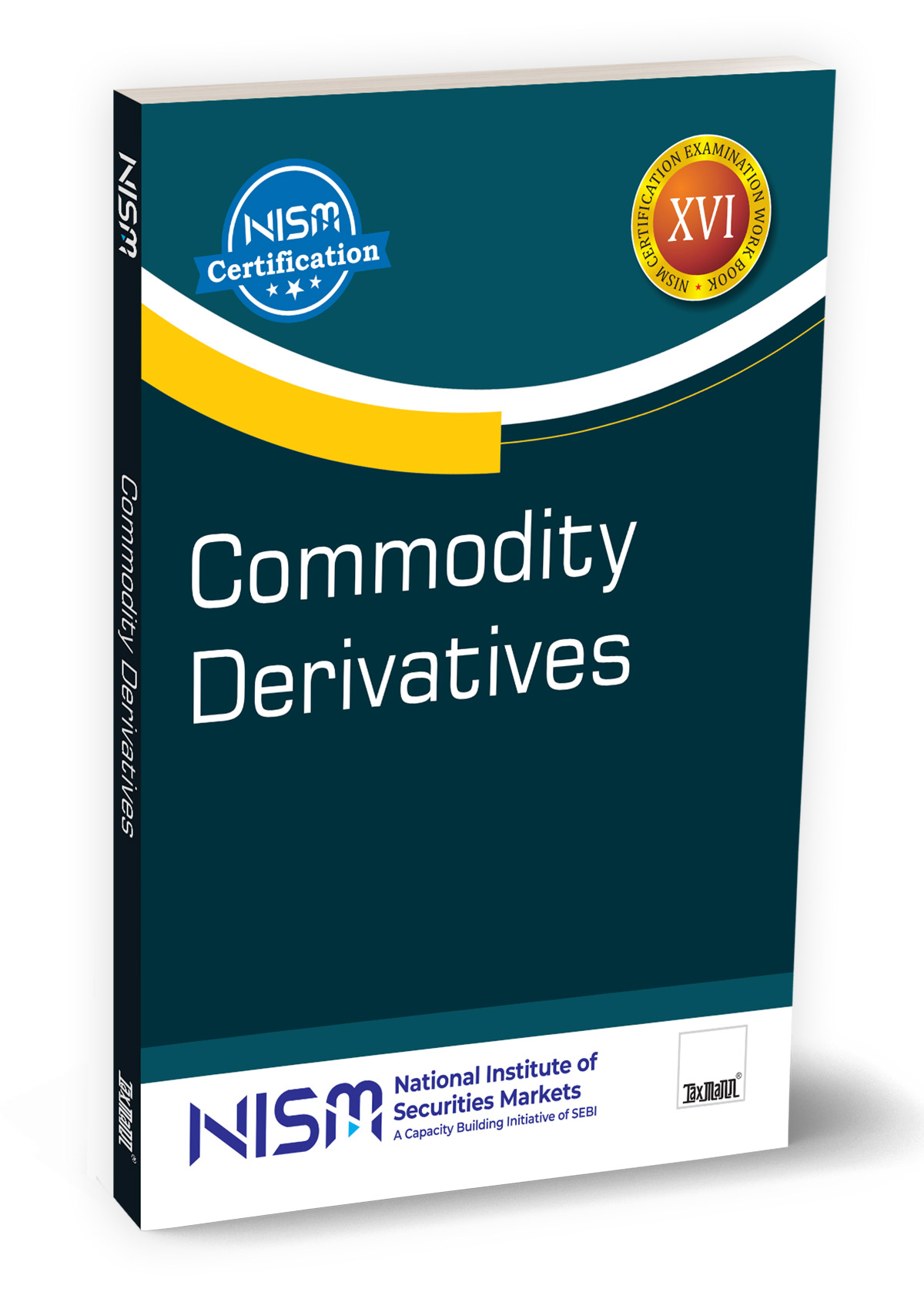
Description
Commodity Derivatives is an authoritative workbook, developed by the National Institute of Securities Markets (NISM) in accordance with its statutory mandate under the SEBI (Certification of Associated Persons in the Securities Markets) Regulations 2007. This workbook provides a comprehensive, end-to-end understanding of India’s exchange-traded commodity derivatives markets, integrating conceptual foundations with operational, regulatory, and compliance-oriented perspectives. It systematically explains how commodity derivatives function as instruments for price discovery, risk transfer, and risk management, while also detailing the institutional infrastructure that supports trading, clearing, settlement, delivery, and investor protection. It is designed not merely as an examination manual, but as a foundational professional reference for participants in India’s commodity derivatives ecosystem.
This book is intended for the following audience:
Commodity Brokers, Dealers, and Sales Personnel involved in futures, options, and index-based commodity products
Employees of Commodity Exchanges, Clearing Corporations, and Warehousing Institutions
Risk Management, Operations, and Compliance Professionals in commodity market intermediaries
Students and Job Aspirants seeking structured entry into commodity and derivatives markets
Academicians and Trainers engaged in securities and derivatives market education
The Present Publication is the September 2025 Workbook Version developed in collaboration with subject-matter experts and reviewed by Mr Venkatachalam Shunmugam (Former Adjunct Faculty, NISM). It is published exclusively by Taxmann, with the following noteworthy features:
[Comprehensive Coverage of Commodity Derivatives Markets] Provides an end-to-end understanding of India’s commodity derivatives ecosystem, covering market structure, products, participants, pricing mechanisms, trading, clearing, settlement, delivery, and investor protection
[Strong Conceptual Foundation with Practical Orientation] Explains core concepts such as cost-of-carry, convergence, convenience yield, futures and options pricing, payoff profiles, and risk management, supported by market-relevant illustrations and applied explanations
[Detailed Coverage of Commodity Futures, Options & Indices] Covers futures contracts, options on commodity futures, options on goods, and commodity indices, including index construction methodology, trading, and settlement frameworks
[Trading, Clearing & Risk Management Framework] Provides in-depth insight into exchange trading mechanisms, contract specifications, margining systems, position limits, default management, settlement guarantee mechanisms, and delivery processes
[Regulatory, Compliance & Governance Focus] Explains the legal and regulatory environment governing commodity derivatives in India, including the role of SEBI, exchanges, clearing corporations, and applicable statutory and regulatory provisions
[Accounting, Taxation & Disclosure Aspects] Covers accounting treatment of commodity derivatives, hedge accounting principles, commodity transaction tax (CTT), stamp duty regime, and compliance-oriented disclosure requirements
[Investor Protection & Code of Conduct] Details investor rights and obligations, code of conduct for intermediaries, grievance redressal mechanisms (including SCORES and ODR), and prescribed dos and don’ts for market participants
The workbook is organised into ten logically sequenced chapters, covering the full lifecycle of commodity derivatives markets:
Introduction to Commodity Markets
Explains the evolution of commodity trading from spot and forward markets to modern exchange-traded derivatives. Covers spot vs derivatives trading, major commodities traded in India, market participants, ecosystem structure, price drivers, and an introduction to commodity options and index futures
Commodity Indices
Provides a detailed understanding of commodity indices, index construction methodologies, constituent selection, and regulatory safeguards. Explains trading and applications of index futures and index options, highlighting their role in portfolio hedging and benchmarking
Commodity Futures
Covers futures contract design and economics, forwards vs futures, cost-of-carry model, spot-futures convergence, contango and backwardation, fair value computation, convenience yield, tick size impact, payoff profiles, and final settlement price determination
Commodity Options
Explains option concepts, terminology, payoff asymmetry, determinants of option premium, and pricing models. Includes detailed treatment of options on commodity futures and options on goods, reflecting the unique delivery-based nature of commodity options in India
Uses of Commodity Derivatives
Focuses on practical applications such as hedging (long and short hedges), speculation, arbitrage, spread trading, basis and basis risk, option strategies, and index-based hedging, along with hedging disclosure norms
Trading Mechanism
Details the exchange trading framework, membership categories, trading systems, order types, contract specifications, trading hours, price dissemination, algorithmic trading controls, and transaction cost components
Clearing, Settlement and Risk Management
Provides in-depth coverage of clearing corporation functions, margining systems (including SPAN and additional margins), mark-to-market settlement, delivery processes, warehousing and assaying, default management, settlement guarantee mechanisms, and cyber resilience
Legal and Regulatory Environment
Explains the regulatory architecture governing commodity derivatives, including the role of SEBI, exchanges, and the Central Government, with reference to the Securities Contracts (Regulation) Act, SEBI Act, and related regulations and policy initiatives
Accounting and Taxation
Covers accounting treatment of commodity derivatives, hedge accounting principles, accounting for options, commodity transaction tax (CTT), stamp duty regime, and relevant tax considerations for market participants
Code of Conduct and Investor Protection Measures
Details the code of conduct for intermediaries, client onboarding and risk disclosures, investor rights and obligations, grievance redressal mechanisms (including SCORES and ODR), and practical dos and don’ts for investors
The Workbook is designed to ensure progressive learning:
Designed in a Progressive Learning Format, moving from foundational concepts to advanced operational and regulatory topics
Each chapter is divided into Clearly Numbered Sub-Topics for focused study and revision
Emphasises Conceptual Clarity, Logical Reasoning & Applied Understanding, rather than rote learning
Suitable for self-study, classroom instruction, and professional reference


![G. M. Divekar's Practical Guide to Deeds & Documents [In 2 HB Vols. 2025]](https://hindlawhouse.com/wp-content/uploads/2021/03/9788196887384-300x300.jpeg)
Reviews
There are no reviews yet.