Description
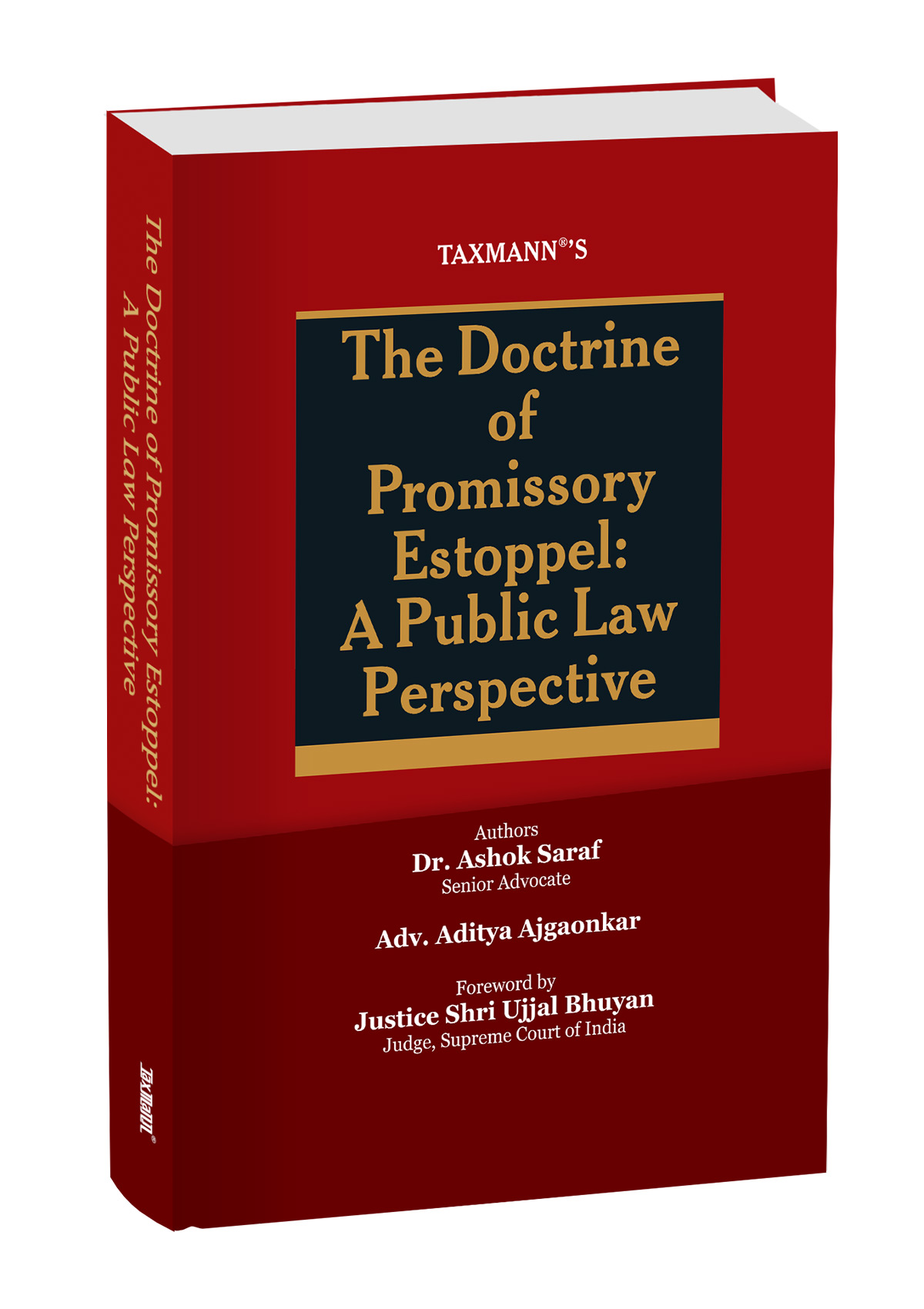
The Doctrine of Promissory Estoppel: A Public Law Perspective provides a thorough and careful analysis of the doctrine as it has developed and been applied within Indian public law. Authored by two practitioners with extensive backgrounds in taxation, commercial law, and constitutional litigation, the work intentionally moves away from the traditional view of promissory estoppel as solely a private contract law tool or a loose equitable remedy. Instead, it considers the doctrine as a fully developed principle of administrative and constitutional law—one that operates at the junction of governmental promises, executive power, citizen reliance, and judicial oversight.
The doctrine, as the authors describe it, is neither an unconditional weapon against the State nor just a moral appeal. It is an equitable principle that has been examined, shaped, and refined through decades of Supreme Court jurisprudence—starting with UOI v. Indo-Afghan Agencies Ltd. and established in Justice Bhagwati’s landmark ruling in Motilal Padampat Sugar Mills Ltd. v. State of U.P.—into a distinctive tool of constitutional accountability. The book traces this history: from the doctrine’s roots in English equity and its transition into Indian law as what the authors call a ‘colonial stowaway,’ to its modern application in areas such as fiscal policy, land reform, government incentives, and political promises.
With a foreword by Justice Ujjal Bhuyan, Judge of the Supreme Court of India, the book is characterised, in his words, by ‘doctrinal discipline and sustained engagement with public law principles. ‘ It is a work that invites practitioners, judges, scholars, and policymakers alike to seriously engage with one of the most complex and important doctrines in Indian public law.
The book is designed for a professional and academic audience with substantive engagement with Indian public and administrative law. Its primary readership includes:
Advocates and Senior Counsel practising in constitutional, administrative, taxation, and commercial law who regularly invoke or resist promissory estoppel claims before High Courts and the Supreme Court
Tax Practitioners and Consultants dealing with governmental incentive schemes, exemption notifications, and retrospective legislative changes, where the doctrine is frequently litigated
Judges and Judicial Officers who must weigh equitable claims against the backdrop of statutory mandates and public interest
Legal Academics and Researchers working in public law, administrative law, or equity who require a doctrinal account of the Indian jurisprudential arc
Policymakers and Government Counsel seeking to understand the legal consequences of executive representations and the limits of sovereign discretion
The writing is accessible in tone without sacrificing depth, making it useful to a practising advocate preparing a brief as much as to a scholar mapping the evolution of the doctrine.
The Present Publications is the Latest Edition, authored by Dr Ashok Saraf (Senior Advocate) and Adv. Aditya Ajgaonkar, with the following noteworthy features:
[Public Law-First Lens] Unlike typical treatises on estoppel that primarily view the doctrine as a matter of contract or evidence law, this work examines promissory estoppel solely within the realm of public law. It explores how it functions when one party is the State or a public authority, and where private reliance intersects with governmental discretion
[Historical Depth Combined with Doctrinal Precision] The book goes beyond merely cataloguing cases; it reconstructs the intellectual history of the doctrine—tracing from Lord Denning’s formulations in Central London Property Trust v. High Trees House and Moorgate Ltd. v. Twitchings, to the Indian Supreme Court’s innovative adaptations in Indo-Afghan Agencies and Motilal Padampat. It carefully analyses why the doctrine developed differently in India compared to England
[Landmark Case Analysis Throughout] Key rulings from the Supreme Court and various High Courts are not only cited but are examined in context and critically evaluated. The discussion of Hero Motocorp Ltd. v. Union of India, CCE v. Bal Pharma Ltd., State of Gujarat v. Arcelor Mittal Nippon Steel (India) Ltd., and others demonstrates how the doctrine has been applied, misapplied, and refined
[Robust Engagement with Competing Doctrines] The book clearly maps the relationship between promissory estoppel and the doctrine of legitimate expectation—drawing on constitutional principles under Article 14, tracing both doctrines to their shared origins in Lord Denning’s work, and analysing their points of convergence and divergence in relation to the State
[Critical Perspective] The final chapter offers an honest and critical reflection, raising pointed questions about inconsistency in the Supreme Court’s rulings, the conflation of promissory estoppel with judicial estoppel, and the overarching need for certainty and predictability in public law
[Foreword by a Sitting Supreme Court Judge] Justice Ujjal Bhuyan’s foreword lends the book institutional authority and situates it within the broader framework of constitutional governance and administrative accountability
The book covers the following core substantive themes:
The definitional architecture of promissory estoppel—distinguishing it from common law estoppel by conduct, proprietary estoppel, equitable estoppel, and judicial estoppel
The statutory treatment of estoppel under the Indian Evidence Act 1872 and the Indian Contract Act 1872, and the gap left by the absence of any codified rule for promissory estoppel
The transplantation of the doctrine from English equity into Indian jurisprudence—the role of Lord Denning, the High Trees case, and the Indian Supreme Court’s initial resistance before eventual adoption
The contribution of judicial activism to the birth and expansion of the doctrine in India, examined honestly alongside the tension between judge-made law and the separation of powers
The foundational schism in Indian case law regarding whether the doctrine can operate against the government and, if so, under what conditions
The cardinal rule that there can be no estoppel against a statute—its scope, rationale, and the cases that have tested its limits
The doctrine of executive necessity and how governmental representations may be validly withdrawn when public interest or changed circumstances supervene
The intersection of electoral and political promises with promissory estoppel—what happens when a government makes representations on the strength of which industries or individuals act, and then changes policy
The public interest exception—when the State may legitimately resile from a representation without incurring equitable liability
The comparative analysis of legitimate expectation and promissory estoppel—their shared equitable roots, their divergent normative footing in Indian constitutional law, and the circumstances in which each operates as a more effective remedy
The demand for certainty and consistency in Indian public law, including a critical examination of judicial inconsistencies in applying the doctrine to tax statutes
The book draws extensively on case law spanning taxation, land law, export incentive schemes, industrial policy incentives, and governmental grants—the domains in which the doctrine has been most actively litigated
The book is organised into ten chapters, each introduced with a carefully chosen judicial epigraph that frames the chapter’s central inquiry. The authors describe the jurisprudence of promissory estoppel as ‘a ball of wool, tightly jumbled up and knotted,’ and the structure of the book is designed to unravel that tangle methodically.
Chapter 1 — Introduction sets out the doctrinal landscape, defines the components of the phrase ‘promissory estoppel,’ situates the doctrine within Indian statutory and equitable frameworks, and establishes the book’s public law focus
Chapter 2 — A Colonial Stowaway narrates the entry of the doctrine into Indian jurisprudence from English equity—examining its origins in Lord Denning’s formulations, its initial reception by Indian Courts, and the contribution of judicial activism to its adoption
Chapter 3 — A Product of Judicial Activism examines the relationship between the growth of promissory estoppel in India and the phenomenon of judicial activism, engaging directly with questions about the legitimacy of judge-made law in a constitutional democracy
Chapter 4 — A Schism in the Law analyses the competing strands of Supreme Court jurisprudence that have, at different points, taken fundamentally different views on whether and when the doctrine operates against the government
Chapter 5 — No Estoppel against the Statute deals with one of the most frequently litigated limitations of the doctrine—the rule that promissory estoppel cannot compel the government to act contrary to a statutory mandate — and examines the contours of this rule through case law
Chapter 6 — Executive Necessity and Promissory Estoppel addresses the circumstances under which the government may validly withdraw a representation by invoking supervening public interest, executive necessity, or a change in policy
Chapter 7 — Promises and the Political Circus is the book’s most colourful chapter—engaging with the question of whether political statements, election promises, and representations made by the highest executive functionaries can give rise to enforceable estoppel
Chapter 8 — The Public Interest Exception examines the equitable limitations on the doctrine when its enforcement would prejudice the larger public good, and analyses how Indian Courts have balanced individual reliance against collective interest
Chapter 9 — Legitimate Expectation vis-à-vis Promissory Estoppel provides a detailed comparative analysis of the two doctrines—their shared equity roots, their divergence in constitutional grounding, and the circumstances in which legitimate expectation affords a stronger or more certain remedy than promissory estoppel
Chapter 10 — A Case for Certainty in the Law serves as an extended epilogue—a candid, reflective, and at times pointed commentary on the inconsistencies in judicial application of the doctrine, the confusion between promissory estoppel and judicial estoppel in some Supreme Court decisions, and the broader imperative of certainty and predictability in public law