Description
Tax prosecution has ceased to be a residual enforcement tool. As India’s tax administration has grown more data-driven, more assertive, and increasingly intolerant of wilful default, prosecution under the Income-tax Act, GST law, and the Black Money Act 2015 has moved from the margins to the mainstream of tax litigation.
The 5th Edition of Tax Prosecution arrives at a particularly consequential moment: the new Income-tax Act 2025 has come into force, and prosecution provisions have been realigned from the 1961 Act framework to the 2025 Act’s simplified language—yet the two regimes will coexist in practice for years, as a vast body of pending cases and evolved jurisprudence continues to draw from the 1961 Act.
This book is the only comprehensive, practitioner-grade treatise in India dedicated exclusively to the law and procedure governing tax prosecutions. It covers the entire lifecycle—from the legislative and policy origins of prosecution, through the specific offences under Chapter XXII of the Income-tax Act, to complaint filing, trial court proceedings, bail, cross-examination, compounding, and appellate remedies—alongside detailed treatment of GST prosecution and the Black Money Act. This Edition is the definitive reference for practitioners navigating the dual-regime transition period.
This book is addressed to every professional whose practice intersects with criminal tax liability—whether in an advisory, defence, judicial, or compliance capacity:
Tax Advocates and Litigation Counsel handling criminal complaints, bail applications, discharge applications, quashing petitions under Section 528 of the BNSS (formerly 482 CrPC), and appellate proceedings—the book provides the full procedural roadmap from sanction to Sessions Court appeal
Chartered Accountants and Tax Consultants advising clients facing TDS defaults, search and seizure proceedings, wilful evasion allegations, or non-filing notices—with particular guidance on what constitutes ‘reasonable cause’ and when to apply for compounding
Company Directors, CFOs, Key Managerial Personnel, and Independent Directors who need to understand the precise conditions under which they are personally arraigned for corporate tax defaults, including the critical distinction between Managing Directors, Executive Directors, and Independent/Non-Executive Directors
Insolvency Professionals and Resolution Applicants dealing with the intersection between prosecution exposure and IBC proceedings, including whether directors of companies under CIRP or liquidation remain personally liable
GST Practitioners and Indirect Tax Counsel dealing with arrest, bail, and compounding under the CGST Act, including the constitutionality of arrest without assessment
Revenue Department Officers—Assessing Officers, Commissioners, and Prosecution Counsel—involved in sanctioning, processing, and conducting prosecutions; the CBDT’s own threshold circulars and the collegium-approval mechanism are reproduced and explained in full
Magistrates and Sessions Court Judges dealing with cognizance, framing of charges, bail, and the mechanics of summons and warrant cases under the BNSS
Law Students and Legal Academics engaged in research on white-collar crime, fiscal statutes, or the application of criminal procedure to tax enforcement
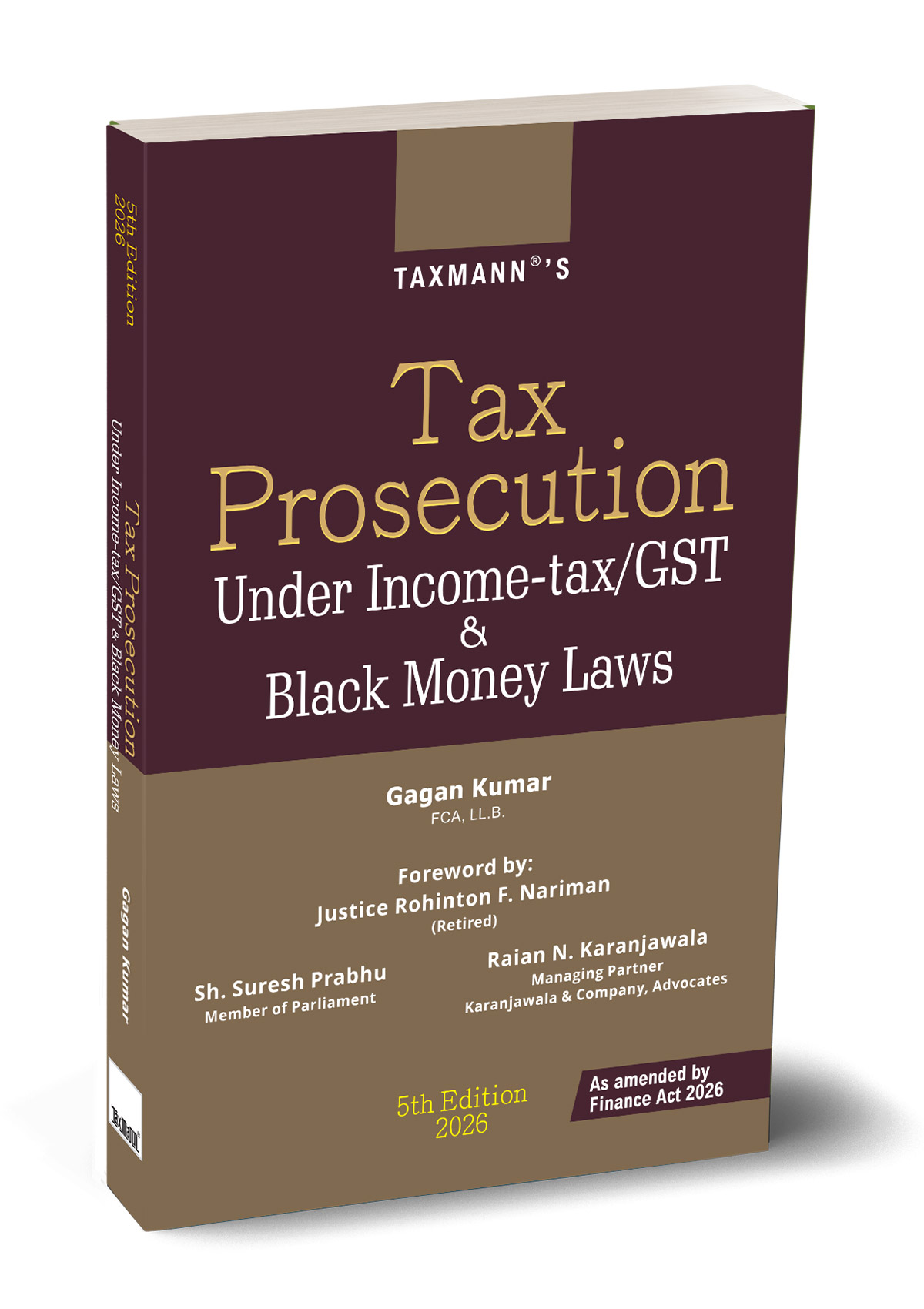
The Present Publication is the 5th Edition, amended by the Finance Act 2026. This book is authored by Gagan Kumar, with the following noteworthy features:
[Dual-Act Cross-Referencing] Every provision is cross-referenced across both the Income-tax Act 1961 and the 2025 Act, with a complete section-mapping table covering all 26 prosecution provisions (Secs. 473–498 of the 2025 Act alongside their 1961 Act equivalents)
[Finance Act 2026 Currency] The law reflects all amendments under the Finance Act 2026, including updated prosecution thresholds, compounding charges, and the CBDT’s prosecution-identification circular—with the ₹25 lakh threshold below which prosecution ordinarily requires collegium approval
[Complete Procedural Lifecycle—Fully Updated for the BNSS] From sanction and complaint filing through cognizance, charge framing, cross-examination, discharge, quashing, compounding, and all appellate tiers—Magistrate to Supreme Court. All procedural references are current under the Bharatiya Nagarik Suraksha Sanhita 2023, which replaced the CrPC—covering discharge (Sec. 268), quashing (Sec. 528), revision (Sec. 438), and appellate provisions (Chapter XXXI)—making the book immediately operative for proceedings initiated under the new code
[Reasonable Cause and Culpable Mental State] Chapter 7 maps what courts have actually accepted as reasonable cause across real factual scenarios, and analyses the reverse presumption of culpable mental state under Section 278E/490, including when and how it is rebutted, through the leading Supreme Court and High Court decisions
[Corporate Liability and the ‘Person in Charge’ Test] Chapters 4 and 5 map personal prosecution liability across every director category: Managing Directors (automatically liable), Whole-time Directors (on specific averment), Independent/Non-Executive Directors (not liable absent knowledge or connivance), Nominee Directors, and professional directors. The Kalanithi Maran decision—a Non-Executive Chairman holding 50%+ shares held not prosecutable for TDS default—is examined in detail
[IBC–Prosecution Intersection] Whether directors of companies under CIRP or liquidation remain personally exposed to prosecution for pre-insolvency tax offences, analysed through the IBC moratorium provisions and key decisions including Kingfisher Airlines and Ajay Kumar Radheyshyam Goenka
[Prosecution Mitigation | Discharge, Quashing, and Compounding] A practitioner guide to all three exit routes. Covers why discharge is rarely available once the culpable mental state presumption applies; the High Court cases directing compounding over quashing; and the full compounding framework including charge computation (with 1.2x–1.6x multipliers for repeat offenders), the Footcandles Film ruling that CBDT guidelines cannot override Section 279(2) jurisdiction, and the 2024 CBDT clarification that compounding is not an admission of guilt
[GST Prosecution] Standalone treatment covering the full punishment matrix under Section 132 CGST Act, constitutional validity of arrest powers, delegation of ‘reason to believe’, arrest without assessment, bail jurisprudence, and the complete compounding framework including Forms GST CPD-01 and CPD-02
[Black Money Act Prosecution] Section-by-section analysis of the BMA’s prosecution provisions (Secs. 49–53), carrying mandatory rigorous imprisonment of 6 months to 7 years. Includes the significant ruling that revised-return disclosure under Section 139(5) bars prosecution under Section 50, and the retrospective-operation question through Union of India v. Gautam Khaitan
[CBDT Guidelines and Landmark Rulings] Appendix 1 reproduces the full compounding guidelines—jurisdiction rules, procedure, charge computation, co-accused provisions, and the NRI misconception clarification. Appendix 2 consolidates the landmark rulings underpinning the treatise, in reference format for courtroom use
[Author’s Practical Annotations] At several points, the author inserts an ‘Author’s Note’, commentary on a judgment’s unstated factual implications, a gap in judicial reasoning, or a question left open by the court. These annotations reflect the perspective of a practitioner who has appeared in these proceedings, not merely studied them
The coverage of the book is as follows:
Chapter 1 — Genesis of Prosecution
Traces the legislative journey from the Income-tax Act 1922 through the Wanchoo Committee, the Law Commission’s 47th Report, the Taxation Laws (Amendment) Act 1975, and the 2025 Act—establishing why India shifted from a penalty-centric to a prosecution-centric enforcement model
Chapter 2 — Offences | A Snapshot
Taxonomises all offences under both Acts, defines key criminal procedure terms under the BNSS (cognizable, bailable, summons case, warrant case), and tabulates the cognizability classification of each offence across both the 1961 and 2025 Acts
Chapter 3 — Offences Under Chapter XXII
The analytical core. Each offence is examined section-by-section covering statutory text, punishment, mens rea, the relationship between concurrent penalty and prosecution, and leading judicial precedents, including Madhumilan Sintex (late deposit does not absolve), Kingfisher Airlines (prosecution independent of recovery proceedings), and Firoz Abdul Gafar Nadiadwala (financial difficulty must be evidenced, not merely asserted)
Chapter 4 — Offences by Corporate Assessees
Maps corporate criminal liability drawing from K.K. Ahuja v. V.K. Vora and SEBI v. Kishore R. Ajmera, with the specific rule that in TDS defaults, personal liability attaches only to the ‘Principal Officer’ under Section 2(35)/2(85)—not to every director
Chapter 5 — Directors in Liquidation and Insolvency
Examines the IBC moratorium’s effect on prosecution, whether tax recovery suits fall within it, and when directors of insolvent companies remain personally exposed—through Ajay Kumar Radheyshyam Goenka (Supreme Court, 2023) and related decisions
Chapter 6 — Offences by Other Persons
Covers prosecution liability for individuals, firms, LLPs, HUFs, and trusts, including the basis for prosecuting a managing partner who did not sign the return
Chapter 7 — Reasonable Cause and Culpable Mental State
Examines what courts have accepted as reasonable cause across real scenarios, and explains the statutory presumption of culpable mental state under Sections 278E/490, including why it renders discharge applications largely unavailable at the pre-charge stage
Chapters 8–12 — Initiation to Cross-Examination
The complete procedural guide: CBDT prosecution-identification procedure and collegium approval; mandatory prior sanction under Section 279/491; the settled rule that no show-cause notice is required before sanction (Union of India v. Banwarilal Agarwal); complaint filing; bail; pre-charge and post-charge proceedings; charge framing; and cross-examination rights
Chapter 13 — Mitigating Framing of Charges
Covers all three exit routes. Discharge: why the culpable mental state presumption makes it rarely available. Quashing: the grounds that have succeeded and the competing line directing compounding over writ petitions. Compounding: the full framework, including Footcandles Film (compounding permissible post-conviction), the conflicting Ramesh Jain view, directorial disqualification avoidance under Section 164 Companies Act, and the 2024 NRI-misconception clarification
Chapter 14 — Appeal, Revision, and Writ
The complete appellate map from Magistrate to Supreme Court, when revision under Section 438 BNSS is barred (interlocutory orders), and when Article 226 writ jurisdiction is available despite appellate remedies
Chapter 15 — Prosecution Under GST
A standalone module covering the 9 offence categories and punishment matrix under Section 132 CGST Act; Finance Act 2023 decriminalisation; constitutional validity of arrest powers; delegation of ‘reason to believe’; arrest without assessment; bail jurisprudence; admissibility of statements; and the complete compounding framework including Forms GST CPD-01 and CPD-02
Chapter 16 — Offences Under the Black Money Act 2015
Section-by-section analysis of Secs. 49–53 BMA, with punishment ranging from 6 months to 10 years RI. Covers the ruling that revised-return disclosure bars prosecution under Section 50, and the retrospective-operation question through Union of India v. Gautam Khaitan
Appendix 1 — CBDT Guidelines and Circulars
The complete 2024 compounding guidelines, including the charge computation matrix, jurisdiction rules for multi-TAN defaults, co-accused provisions, extension timelines up to 24 months, and the NRI misconception clarification
Appendix 2 — Landmark Rulings
Curated Supreme Court and High Court decisions forming the bedrock of tax prosecution jurisprudence, in reference format for courtroom use
The structure of the book is as follows:
Block 1; Chapters 1–7 | Substantive Law — History and policy of prosecution, taxonomy of offences under both Income-tax Acts, and the two principal defences of reasonable cause and culpable mental state
Block 2; Chapters 8–14 | Procedural Law — The complete criminal proceeding from sanction through complaint, trial, mitigation, and appeal. Functions as a standalone criminal procedure manual for tax cases under the BNSS framework
Block 3; Chapters 15–16 | Ancillary Statutes — GST and Black Money Act prosecution, each as a self-contained module with its own offence matrix, procedural framework, and case law
Structural Note — Dual-Act cross-referencing across the 1961 and 2025 Acts runs through Blocks 1 and 2 as a structural feature, not a footnote. The book simultaneously serves as a guide to current law under the 2025 Act and a transition reference for the large body of pre-April 2026 cases still governed by the 1961 Act
Goods and Services Tax | GST | Income Tax
![Financial Reporting [for November 2022]](https://hindlawhouse.com/wp-content/uploads/2022/07/SW-300x300.jpg)