
Description
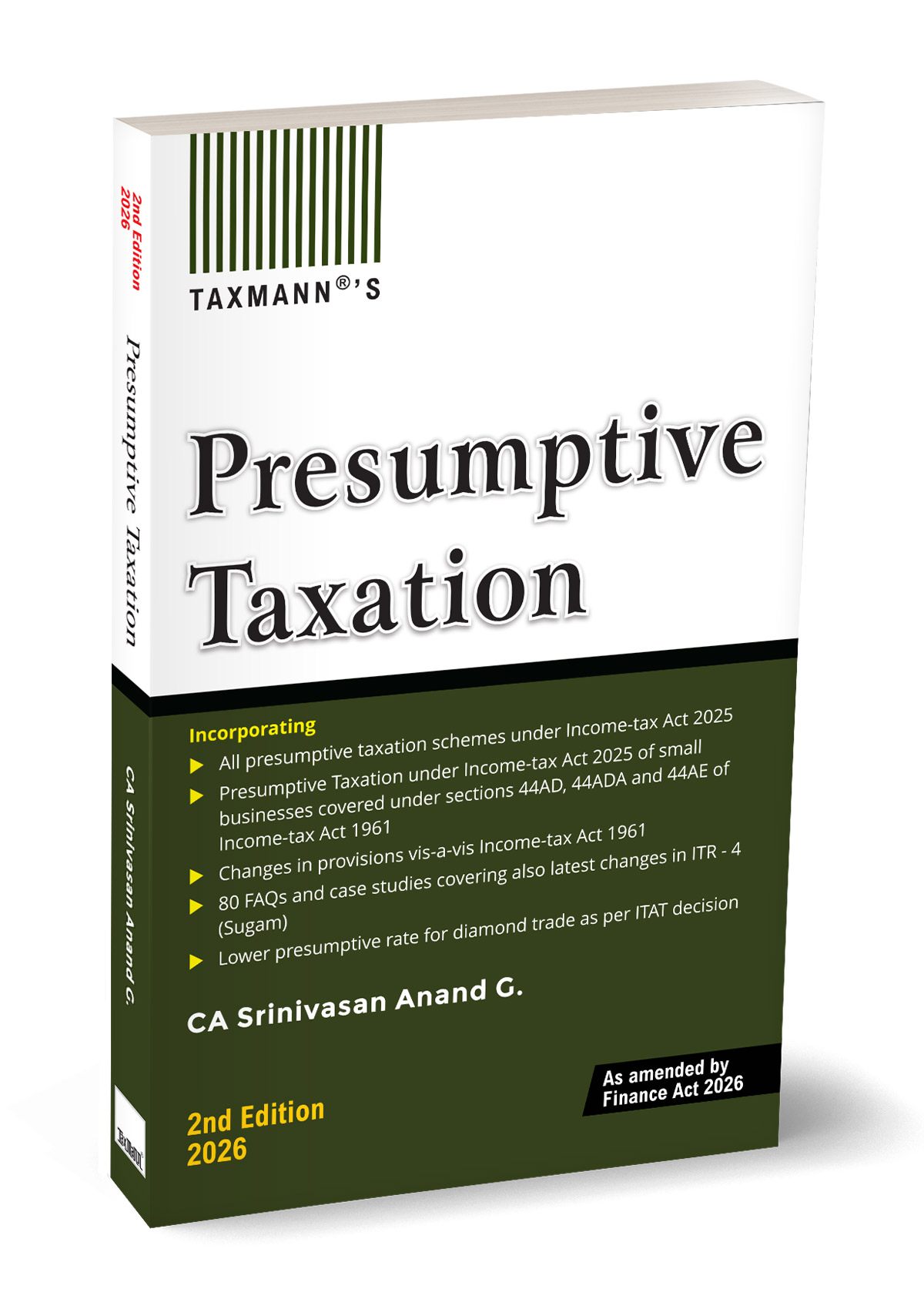
Presumptive Taxation is a comprehensive, section-wise treatise covering the entire framework of presumptive taxation as codified under the Income-tax Act 2025, read with the Income-tax Rules 2026, and as amended by the Finance Act 2026. It represents the first full-length authored commentary that reconciles the complete collapse and re-statement of the erstwhile scheme of presumptive taxation under ITA 1961 (Sections 44AD, 44ADA, 44AE, 44B, 44BB, 44BBA, 44BBB, 44BBC, 44BBD and Chapter XII-G) into two unified, table-based provisions of ITA 2025—Section 58 (residents) and Section 61 (non-residents)—alongside a re-numbered Tonnage Tax Scheme now housed in Sections 225 to 235.
The author has adopted a strict comparative methodology throughout the book. Every chapter opens with a ‘Comparative study vis-a-vis ITA 1961’ that isolates the textual and substantive changes between the new provision and its ITA 1961 predecessor. Within each chapter, the analysis follows a consistent template covering the nature of the provision (computation vs. charging), the specified assessee, the specified business, the presumptive regime applicable, the nature of the presumption (rebuttable or irrebuttable), includibility of TDS and GST in gross turnover/receipts, Section 277/ICDS interplay, compliance requirements, opting in and opting out mechanics, maintenance of books of account, tax audit consequences, and the position where actual income is more or less than presumptive income. Practitioners transitioning their compliance workflows from the 1961 Act to the 2025 Act will find this side-by-side treatment particularly useful.
The book distils the law into practical guidance through Division 5, which contains 81 FAQs and worked case studies spanning every major category of assessee and transaction type, and closes with four appendices reproducing the relevant sections of ITA 2025 and ITA 1961 and the relevant rules of IT Rules, 2026 and IT Rules, 1962 for ready cross-reference.
This book is intended for the following audience:
Chartered Accountants, Company Secretaries, Cost Accountants and Tax Consultants advising small businesses, professionals, transporters and non-residents on presumptive taxation and associated tax audit exposure
Tax Advocates and Litigators handling scrutiny assessments, limited scrutiny on presumptive income, Section 287 rectification proceedings, and appellate matters under the new ITA 2025 framework
Assessing Officers, CIT(A) staff and ITAT Practitioners dealing with Section 58, Section 61 and Sections 225–235 of ITA 2025
Small Business Owners, Retail Traders, Manufacturers, Coaching Institute Proprietors, Doctors, Lawyers, Architects, Engineers, Company Secretaries, Film Artists and Technical Consultants filing ITR-4 (Sugam) under the presumptive regime
Goods Carriage Operators and Transport Firms availing the tonnage-per-truck regime in Sl. No. 2 of Section 58(2)
Non-Resident Shipping, Cruise, Airline, Mineral Oil Exploration, Turnkey Power Project, and Electronic Goods Manufacturing Services/Technology Providers availing Section 61 schemes
Indian Shipping Companies opting for, renewing, or exiting the Tonnage Tax Scheme under Sections 225–235
Corporate Tax Teams and In-House Counsel mapping legacy Section 44AD/44ADA/44AE-linked compliance policies to the new Section 58 framework
Diamond Trade Assessees and their Advisors, given the dedicated treatment of the 1.5%–4.5% lower rate and the Oopal Diamond precedent
Students of CA, CS, CMA and LL.B. pursuing advanced direct taxation papers and preparing for the transition to the ITA 2025 regime
Authors, Trainers and Faculty building curriculum content on the new Section 58 and Section 61 framework
The Present Publication is the 2nd Edition | 2026, amended by the Finance Act 2026. It is authored by CA. Srinivasan Anand G., with the following noteworthy features:
[Complete ITA 2025 Framework] Full coverage of every presumptive taxation scheme under the Income-tax Act 2025—both resident (Section 58, six Sl. Nos.) and non-resident (Section 61, six Sl. Nos.)—together with the Tonnage Tax Scheme (Sections 225–235) for qualifying Indian shipping companies
[Chapter-by-Chapter Comparative Analysis] Each chapter identifies every textual and substantive change from Sections 44AD, 44ADA, 44AE, 44B, 44BB, 44BBA, 44BBB, 44BBC, 44BBD and 115V–115VZC, including the new overriding effect of Section 61 over Sections 26–54 (wider than Section 44BB’s override of Sections 28–41 and 43A)
[Section 58 Table De-Constructed] Column-by-column analysis of Section 58(2)—Column B (specified business/profession), Column C (eligible/specified assessee), Column D (turnover/gross receipts thresholds of ₹2/3 crore, ₹50/75 lakh) and Column E (8%/6% and 50% computation rates)—with each column tied back to the enabling conditions and judicial tests
[Section 61 Table De-Constructed] Parallel treatment of Section 61(2)—six non-resident business activities (shipping, cruise, aircraft, turnkey power, mineral oil, electronic goods)—with rate and rebuttable/irrebuttable characterisation summarised in a consolidated matrix
[New Bar on Loss Set-Off] Detailed treatment of Section 58(4) and Section 61(4), which for the first time prohibit set-off of losses from any other head or business against presumptive income—a restriction that did not exist under Sections 44AD, 44ADA or 44AE of ITA 1961
[Expanded 5-Year Lock-In and Cooling-Off] Analysis of the tighter Section 58(7) regime under which irregular exit from Sl. No. 1 now bars the assessee from availing Sl. No. 2 and Sl. No. 3 as well during the 5-year cooling-off period (under Section 44AD(4), the bar was confined to Section 44AD alone)
[Rule 48 and CBDC Inclusion] Full treatment of the nine prescribed electronic modes under Rule 48 of the Income-tax Rules, 2026—including the newly added Tier III Full KYC Central Bank Digital Currency Wallets, P-CBDC, and Wholesale/Cross-border CBDC in clause (i)—that qualify for the lower 6% presumptive rate in place of the default 8%
[Redefined ‘Commission or Brokerage’] Dedicated analysis of Section 66(3) read with Section 402(7) of ITA 2025, which for the first time statutorily defines ‘commission or brokerage’ for presumptive purposes—resolving the ambiguity under Section 44AD(6) of ITA 1961 by codifying the Kotak Securities Ltd. approach
[Section 62 and Section 63 Interplay] Clear mapping of the new book-keeping thresholds under Section 62(2)—₹1,20,000/₹2,50,000 PGBP and ₹10,00,000/₹25,00,000 gross receipts—and the tax audit triggers under Section 63(1)/(2), including the harsh new Condition 2 that brings lower-than-presumptive declarations within tax audit regardless of turnover
[80+ FAQs and Case Studies] Division 5 contains 81 FAQs and worked case studies covering practical scenarios—builders and developers, stamp duty valuation interplay (Section 53 of ITA 2025/Section 43CA of ITA 1961), partnership firm nursing homes, coaching institutes, stamp vendors, airline agents, lottery agents, tanker hire, JCB hire, combination of proprietary practice and partnership firm receipts, Aadhaar-PAN goods carriage declarations, unexplained cash deposits (Section 104 read with Section 195 of ITA 2025, formerly Section 69A read with Section 115BBE), bogus purchase additions, and the specific disclosure requirements of ITR-4 (Sugam) for AY 2026-27
[Diamond Trade Lower Rate] Detailed discussion of the 1.5%–4.5% presumptive rate range for diamond manufacturers and traders based on the Task Force Report of the Ministry of Commerce and Industry (February 2013) and the ITAT ruling in Oopal Diamond v. ACIT [2022] 144 taxmann.com 184 (Mumbai – Trib.), which endorses a 3% estimation for combined trading-and-manufacturing assessees
[New ‘Tax Year’ Concept] Explanation of the shift from dual ‘Previous Year’ and ‘Assessment Year’ to a single unified ‘Tax Year’ from TY 2026-27 onwards, and the transitional handling of FY 2025-26 (AY 2026-27) under the last year of Section 44AD/44ADA/44AE
[Scope of CA Profession] Exhaustive treatment of what does and does not constitute ‘gross receipts’ of a CA in practice for Sl. No. 3, covering Section 2(2) of the CA Act 1949, Regulation 191, Council resolutions on Management Consultancy Services, permitted occupations not counting as professional receipts (life insurance renewal commission, authorship of books and articles, part-time tutorship, notary work, surveyorship, etc.), and the implications for issuing valuation reports under Rule 11 and Form No. 4 certificates under Rule 12 of the Income-tax Rules, 2026
[Medical Profession Depth] Treatment of salaried vs. independent medical practitioners applying Dr. Mathew Cherian and Sankarnaryanasamy Selvanarayanan, including anesthesiologists visiting several hospitals on monthly retainers, doctors combining salary with clinic practice, nursing home businesses and their interplay with Sl. No. 1 and Sl. No. 3
[Tonnage Tax Scheme – Full Treatment] Chapter-length coverage of the tonnage tax framework: qualifying company and ship tests, daily tonnage income slabs, joint-operation formulas, core activities (pooling, affreightment, slot/space/joint charters, feeder services, container box leasing) vs. incidental activities, MAT book profit adjustments under Section 206(1)(c), the tonnage tax reserve account (20% of book profit, 8-year utilisation window), minimum training requirements under the Director-General of Shipping guidelines, the 49% charter-in limit, amalgamation/demerger treatment, exclusion for abuse under Section 234, and the 10-year option validity
[Judicial Support] Liberal citation of Supreme Court, High Court and ITAT decisions including Kotak Securities Ltd. v. Dy. CIT, CIT v. Nitin Soni, The Chief Inspector of Mines v. Lala Karam Chand Thapar, Vivek Narayan Sharma v. Union of India, Banwarilal Agarawalla v. State of Bihar, Raj Kumar Shivhare v. Assistant Director (ED), CIT v. Bhagwan Broker Agency, Anandkumar v. ACIT, Krishna Kumar Agrawal v. ITO, CIT v. Vantage International Management Co., CIT v. Transocean Offshore International Ventures Ltd., CIT (International Taxation) v. Schlumberger Asia Services Ltd., State of AP v. Vasudeva Rao, CIT v. A.M. Fazil and Mukesh Vasantkumar Chandan v. ITO
[Ministry of Finance Clarifications] Reproduction and analysis of the Select Committee clarification on single-scheme vs. business-wise option, CBDT Circulars (No. 2/2018 on cash transactions, No. 10/2017 on ICDS applicability to presumptive taxpayers), and the Finance Minister’s 2017 Budget speech rationale for the reduced 6% rate
[Statutory Appendices] Four appendices provide the relevant sections of ITA 2025 (Appendix 1), the corresponding sections of ITA 1961 (Appendix 2), the relevant rules of Income-tax Rules 2026 (Appendix 3) and the relevant rules of Income-tax Rules 1962 (Appendix 4)—a ready cross-reference pack for the transition
The book provides end-to-end coverage across five analytical divisions:
Conceptual Foundation
Concept, definition, purpose and jurisprudential basis of presumptive taxation
Regular computation vs. presumptive computation of taxable income
Rebuttable vs. irrebuttable presumption—structure, proof tests, burden-shifting
Policy purpose of presumptive taxation—ease of doing business for SMEs, international competitiveness for shipping
The ITA 2025 applicability matrix across Section 58 Sl. Nos. 1, 2, 3 and Section 61 Sl. Nos. 1 to 6 covering depreciation, other deductions, loss set-off, lower-than-presumptive claim, tax audit and book-keeping
Resident Presumptive Taxation (Section 58)
Defining ‘business’ vs. ‘profession’ under Section 2(20) and Section 2(86) of ITA 2025
The ‘any business’ test and the judicially expanded interpretation of the word ‘any’
Businesses eligible and ineligible for presumptive taxation (agency business exclusion under Section 58(11)(a)(v))
‘Specified profession’ under Section 62(4) read with sub-rules (2) and (5)(c) of Rule 46 of IT Rules, 2026—Accountancy, Architectural, Authorised representative, Company Secretary, Engineering, Film artist (with itemised list of on-set roles), Information Technology, Interior decoration, Legal, Medical practitioners of any system, and Technical consultancy
Eligible assessee definition under Section 58(11)(a)—residency, entity form, agency business bar, commission/brokerage bar
Sl. No. 1 scheme (formerly Section 44AD)—₹2 crore/₹3 crore turnover thresholds, 5% cash-receipts test, 8%/6% rate, single-scheme-for-all-businesses rule, aggregation of turnovers
Sl. No. 2 scheme (formerly Section 44AE)—tonnage-based monthly rate per heavy goods vehicle, 10-goods-carriage ceiling test at any time during the tax year, ownership vs. registration certificate test, firm-partner cross-ownership scenarios, partners’ salary and interest deductibility under Section 35(e)
Sl. No. 3 scheme (formerly Section 44ADA)—₹50 lakh/₹75 lakh gross-receipts thresholds, 50% presumptive rate, non-deductibility of partners’ remuneration and interest from presumptive income, advance tax relief under Section 408(2) (15 March single instalment)
Compliance Consequences Under Section 58
Implications of declaring PGBP as per Column E—deemed allowance of depreciation, deemed disallowances under Sections 26 to 54, non-applicability of Section 37(2)(g) disallowance for MSMED delayed payments, non-applicability of Section 53 stamp duty value addition (Mukesh Vasantkumar Chandan)
Manner of exercising the option—no separate form required, ITR-4 (Sugam) filing, belated and revised return treatment, Section 263(1)/(5) interaction
Consequences of declaring profit lower than presumptive rate—the expanded Section 58(7) bar that now extends across all three Sl. Nos., 5-year lock-in, 5-year cooling-off
Tax audit triggers under Section 63—Condition 1 thresholds (₹1 crore/₹10 crore business, ₹50 lakh non-specified profession), Condition 2 (lower-than-presumptive with total income exceeding basic exemption)
Book maintenance triggers under Section 62—the ₹1,20,000 / ₹2,50,000 PGBP and ₹10,00,000/₹25,00,000 gross receipts thresholds
Opting out—voluntary vs. irregular exit, opt-out during lock-in, opt-out without violating Section 58(7), delayed e-filing of tax audit report (which does not invalidate opt-out)
Non-Resident Presumptive Taxation (Section 61)
Section 61(1) overriding effect over Sections 26 to 54 (wider than Section 44BB’s ambit under ITA 1961)
Sl. No. 1—shipping (non-cruise)—5% of (A+B), irrebuttable presumption, formerly Section 44B
Sl. No. 2—cruise ship operation—formerly Section 44BBC, with its specific conditions for specified assessees
Sl. No. 3—aircraft operation—5% of (A+B), irrebuttable presumption, formerly Section 44BBA
Sl. No. 4—civil construction in turnkey power projects—10% of (A+B), formerly Section 44BBB
Sl. No. 5—mineral oil prospecting/extraction/production services—10% of (A+B), rebuttable presumption, formerly Section 44BB, non-applicability where Section 54/Section 59/Section 207/Section 527 apply
Sl. No. 6—services or technology for electronic goods manufacturing in India to resident company—formerly Section 44BBD
For each: includibility/excludibility of TDS (Section 396(a), formerly Section 198) and GST (following Vantage International, Transocean Offshore and Schlumberger Asia), Section 277/ICDS relevance, and the ‘View 1/View 2′ analysis on inclusion of GST
Tonnage Tax Scheme (Sections 225–235)
Qualifying Indian shipping company tests under Section 235(h)—Indian company, place of effective management in India, ownership of at least one qualifying ship, main object of operating ships
Qualifying ship tests under Section 235(i)—15 net tons or more, registration under the Merchant Shipping Act 1958 (or foreign-registered with DG Shipping licence under Sections 406/407), valid tonnage certificate; with the itemised list of excluded vessels (fishing vessels, factory ships, pleasure crafts, harbour/river ferries, offshore installations, dredgers)
Inland vessels and the Inland Vessels Act, 2021 interface
Daily tonnage income slabs—₹70 for each 100 tons up to 1,000 tons; ₹700 plus ₹53 per 100 tons from 1,000–10,000; ₹5,470 plus ₹42 per 100 tons from 10,000–25,000; ₹11,770 plus ₹19 per 100 tons above 25,000
Deemed tonnage for slot charter, space charter and break-bulk vessel sharing under Rule 146 of IT Rules, 2026
Joint operation computations under Section 227(7) and (8)
Core activities under Section 228(3)—pooling arrangements, contracts of affreightment, on-board/on-shore passenger ship activities, slot charters, space charters, joint charters, feeder services, container box leasing
Incidental activities cap at 0.25% of turnover from core activities
MAT book profit exclusion under Section 206(1)(c)
Depreciation bifurcation formulas under Section 229—allocating existing block WDV between qualifying assets and other assets in the ratio of book WDVs
Exclusion of deductions, losses and set-offs under Section 230—no carry-forward of business losses, speculation losses, specified business losses or capital losses attributable to operating qualifying ships; no Chapter VIII deductions
Method and time of opting—Form No. 80 application to Joint Commissioner within three months of incorporation/qualification, three-month disposal period, 10-year validity, renewal
Tonnage tax reserve account under Section 232(1)—20% of book profit from core activities, 8-year utilisation window for acquiring new ship/inland vessel, consequences of shortfall and non-creation for two consecutive years
Minimum training requirements under Director-General of Shipping/Inland Waterways Authority guidelines, certificate filing with ITR under Section 263, consequences of non-compliance for five consecutive tax years
Charter-in limit of 49% of net tonnage, averaging methodology, consequences of exceeding for two consecutive tax years
Maintenance of separate accounts and CA audit report under Section 232(21)
Amalgamation and demerger treatment under Section 233
Avoidance of tax and exclusion from the scheme under Section 234—tax advantage test, show-cause procedure, Principal CCIT/CCIT prior approval, appellate remedy
Temporary cessation vs. permanent cessation under Section 232(22)/(23)
81 FAQs and Case Studies (Chapter 16)
Free opt-in/opt-out between presumptive schemes across tax years
Real estate developers and builders—turnover vs. stamp duty value, Section 53 interplay, challenging stamp duty valuation
Partnership firms—deed clauses requiring audit, registered vs. unregistered firms under the Indian Partnership Act 1932, oral partnerships, interest/remuneration to partners, deductibility under Section 35(e) (formerly Section 40(b)), TDS under Sl. No. 7 of Section 393(3) Table (formerly Section 194T) on partner payments, disallowance under Section 36(4) (formerly Section 40A(3)) for cash payments exceeding ₹10,000
Nursing homes (business vs. profession characterisation), coaching classes, stamp vendors, lottery agents, airline ticket agents
MSMED delayed payment disallowance under Section 37(2)(g) (formerly Section 43B(h))—applicability to presumptive assessees
Resident individual partners of business LLPs claiming Section 58 in respect of salary/interest received
Tanker operators and JCB operators—classification under Sl. No. 1 vs. Sl. No. 2
Life insurance agents and their HUF—karta-HUF eligibility interaction
Limited scrutiny of presumptive returns—AO’s power to apply Sl. No. 1 when assessee declares under Sl. No. 2, rectification under Section 287 (formerly Section 154)
Truck sale/purchase timing at year-end and its effect on the 10-goods-carriage limit
Partnership firms holding trucks in partners’ names rather than firm’s name—RC test and its dilution
Tax audit and lower-than-presumptive declaration under Sl. No. 2—whether AO can apply Sl. No. 1 instead
Unexplained cash deposits and Section 104 read with Section 195 (formerly Section 69A read with Section 115BBE) additions in presumptive returns
Bogus purchase additions in presumptive returns
CA professional practice scenarios—full-time vs. part-time COP holders, partner remuneration from CA firms (Anandkumar), monthly-retainer internal/concurrent audit fees (salary vs. professional fees classification), royalty from books and article-writing receipts
Doctors’ scenarios—lady MBBS/MD with salary and evening clinic, doctor running nursing home and clinic, doctor as partner in nursing home firm
Ayurveda, Siddha, dentists, pathologists under Sl. No. 3
Gross receipts scope for CAs under Section 2(2) of the CA Act 1949 and Regulation 191—what counts, what does not
Impact of showing artificially lower gross receipts on eligibility to issue valuation reports under Rule 11, Form No. 4 under Rule 12 and safe harbour certificates under Rule 89(2) of IT Rules, 2026—and the 60-tax-audit annual limit for CAs effective 2026-27
Goods carriage owners furnishing PAN/Aadhaar declarations under Sl. No. 8 of Section 393(4) Table—PAN validity and deductor verification responsibility
ITR-4 (Sugam) disclosure requirements for AY 2026-27—the new Financial Particulars of the Business section, individual vs. firm disclosure obligations, when to use ITR-3 with Schedule AL instead of ITR-4 Sugam for capturing personal investments in equity, gold, silver, etc.
The book is organised into five analytical divisions followed by four appendices:
Division 1 – Concept and Purpose of Presumptive Taxation | Chapter 1 introduces the concept, distinguishes regular from presumptive taxation, defines rebuttable and irrebuttable presumption, articulates the policy purpose, and lays out the complete ITA 2025 applicability matrix in tabular form for residents and non-residents
Division 2 – Presumptive Taxation of Business or Profession of Resident Individuals, HUFs and Firms | Chapters 2 to 8 cover: definitions of ‘business’ and ‘profession’ (Chapter 2), businesses eligible for presumptive taxation (Chapter 3), specified professions of residents (Chapter 4), resident taxpayers who can opt for presumptive taxation (Chapter 5), Sl. No. 1 scheme (Chapter 6 – 13 sub-sections), Sl. No. 2 scheme (Chapter 7 – 13 sub-sections), and Sl. No. 3 scheme (Chapter 8 – 13 sub-sections)
Division 3 – Presumptive Taxation of Certain Business Activities of Non-Residents | Chapters 9 to 14 cover the six non-resident presumptive schemes in Section 61—shipping (Chapter 9), cruise (Chapter 10), aircraft (Chapter 11), mineral oil exploration (Chapter 12), turnkey power projects (Chapter 13) and electronic goods manufacturing services/technology (Chapter 14)—each following a uniform 12–16 sub-section template
Division 4 – Tonnage Tax Scheme for Qualifying Indian Shipping Company | Chapter 15 covers the tonnage tax regime as now contained in Sections 225 to 235 of ITA 2025 across 21 sub-sections, from the basic tonnage income slabs through amalgamation, demerger and exclusion for tax avoidance
Division 5 – FAQs and Case Studies on Presumptive Taxation | Chapter 16 contains 81 numbered FAQs and worked case studies
Appendices | Appendix 1 reproduces the relevant sections of ITA 2025 (Sections 58, 61, 225–235 and related provisions); Appendix 2 reproduces the corresponding sections of ITA 1961 (44AD, 44ADA, 44AE, 44B–44BBD, 115V–115VZC); Appendix 3 reproduces the relevant rules of Income-tax Rules 2026 (notably Rule 46, Rule 48, Rule 146); Appendix 4 reproduces the relevant rules of Income-tax Rules 1962 (Rule 6F, Rule 6ABBA and related)
Every chapter dealing with a specific presumptive provision follows a uniform analytical template that makes the book equally navigable for first-time readers and experienced practitioners, and the extensive cross-referencing between chapters and FAQs allows the reader to move seamlessly between statutory analysis and practical application
![Financial Reporting [for November 2022]](https://hindlawhouse.com/wp-content/uploads/2022/07/SW-300x300.jpg)

![G. M. Divekar's Practical Guide to Deeds & Documents [In 2 HB Vols. 2025]](https://hindlawhouse.com/wp-content/uploads/2021/03/9788196887384-300x300.jpeg)