Description
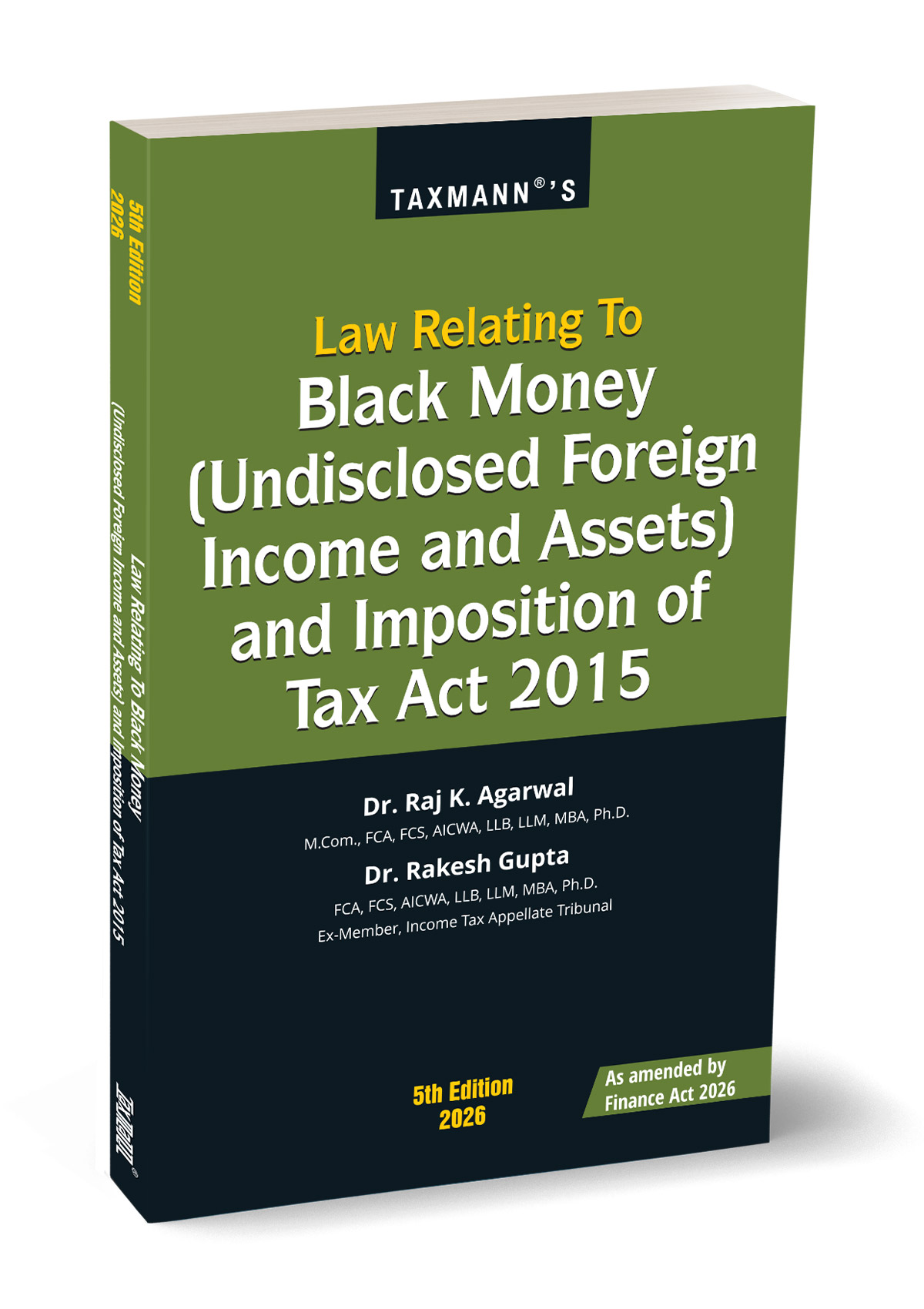
Law Relating to Black Money (Undisclosed Foreign Income and Assets) and Imposition of Tax Act 2015 is the most comprehensive practitioner’s-level commentary. It is updated to include all amendments made by the Finance Act 2026. The book offers a section-by-section analysis of every provision of the Act, supported by the authors’ considered opinions on over 200 critical interpretive issues—most of which are either still pending before the constitutional courts or have been settled only by ITAT decisions subject to further challenge. Additionally, the book features, for the first time, a dedicated chapter on the Foreign Assets of Small Taxpayers Disclosure Scheme 2026 (FAST-DS 2026), introduced by the Finance Act 2026 under Sections 130 to 144.
This book is intended for the following audience:
Chartered Accountants, Tax Advocates, and Company Secretaries advising clients with cross-border assets, foreign bank accounts, overseas trusts, or financial interests in foreign entities
Judicial and Quasi-Judicial Officers including ITAT Members, CIT(A)s, and Assessing Officers handling proceedings under the Act
Senior Litigation Counsel appearing before High Courts and the Supreme Court in Black Money Act matters
High Net Worth Individuals, NRIs Returning to India, and persons with historical foreign asset positions who need to understand their exposure and compliance obligations
Academic Researchers and Law School Faculty engaged in the study of anti-black money legislation and international tax enforcement
The Present Publication is the 5th Edition | 2026 and has been amended by the Finance Act 2026. This book is authored by Dr Raj K. Agarwal & Dr Rakesh Gupta, with the following noteworthy features:
[No-Time-Limit Assessment Regime Fully Analysed] The Black Money Act prescribes no time-barring limit for initiating assessment or reassessment—proceedings can be initiated even 30 or 40 years after the fact. The book examines the constitutional validity, practical operation, and litigation risks arising from this provision in granular detail
[Section-By-Section Commentary with Full Text] Every section of the Act is reproduced along with original Notes on Clauses from the legislative record, followed by a structured analysis of salient features and significant issues—making the commentary self-contained as a working reference
[Over 200 Critical Issues Identified and Opined Upon] Each chapter lists the significant issues of litigation arising from its sections and provides the authors’ considered opinion. These opinions cover interpretive gaps, constitutional challenges, procedural ambiguities, and questions not yet resolved by courts
[Authors Openly Disagree with the CBDT Where Warranted] On whether pre-1st July 2015 assets are assessable under the Act, the authors directly challenge the CBDT’s aggressive FAQ position—citing the Supreme Court’s Ganpati Dealcom ratio—and state their considered opinion that such interpretation is legally untenable and constitutionally problematic. This intellectual honesty is a defining feature of the book’s value to litigation counsel
[Tracks Legislative Evolution Across Five Finance Acts] Every amendment—the 2019 retrospective expansion of ‘assessee’, the 2024 prosecution threshold revision, the 2026 prosecution amendments, and the introduction of FAST-DS 2026—is placed in historical context with analysis of what changed, why, and what litigation consequences follow
[Cross-Referenced to Both the Income-Tax Act 1961 And the Income-Tax Act 2025] All references to income-tax provisions appear in dual form—citing both the corresponding section of the Income-tax Act 1961 and its equivalent in the newly enacted Income-tax Act 2025—ensuring the book remains fully current as India’s direct tax statute transitions
[Schedule FA Treated as a Substantive Legal Obligation] The book documents what Schedule FA requires across all asset categories and draws a precise distinction between disclosures that immunise against BMA proceedings and those that merely furnish the Assessing Officer with a trigger to initiate them
[Practical Roadmap for NRIs and Persons with Historical Foreign Positions] The book systematically maps obligations for persons who acquired foreign assets as non-residents and have since become resident—covering Schedule FA disclosure timing, the NOR status window, and the documentary evidence that must be preserved indefinitely against a future Section 10 notice
[Structured Treatment of the BMA–PMLA Interplay] The book addresses the parallel enforcement architecture arising from the Act’s scheduled offence status under PMLA—including the PMLA’s independent arrest powers that the BMA itself does not confer—and the consequences for clients facing simultaneous exposure under both statutes
[Covers FAST-DS 2026 in its Entirety] Chapter 10A provides a complete treatment of the Foreign Assets of Small Taxpayers Disclosure Scheme 2026, including statutory text (Sections 130–144), the Memorandum Explaining Objects, and a structured analysis of salient features—a significant addition exclusive to this Edition
[Valuation Chapter with Rule-level Analysis] Chapter 12 sets out the full valuation framework under the Act, including the fair market value methodology for different asset classes, valuation by foreign valuers, the significance of the valuation date, the treatment of assets no longer in existence as on the valuation date, and re-rolling scenarios
[Comprehensive Appendices] Four appendices reproduce all prescribed forms (Forms 1–8), key CBDT circulars from 2015 through 2024, all material CBDT notifications, and extracts from other laws cross-referenced in the Black Money Act, including the CPC, IPC/BNS, Companies Act, LLP Act, and Constitution of India
The coverage of the book is as follows:
Chapter 1 — Introduction and Legislative Background
The preamble, full Statement of Objects and Reasons from the original Bill, the Act’s operative date (1st July 2015 — itself a product of an executive order under Section 86 upheld in Union of India v. Gautam Khaitan), scope, salient features including the eleven distinguishing characteristics of the Act (no time bar, no separate return, fair market value taxation, supersession of Income-tax Act, no DTAA credit, no arrest power, PMLA linkage), the rationale for a separate statute, and a detailed list of probable issues of litigation across assessment, interest, penalty, and prosecution dimensions
Chapter 2 — Applicability and Definitions (Sections 1 & 2)
Full analysis of the definition of ‘assessee’ including the retrospective amendment made by the Finance Act 2019 with effect from 1st July 2015—expanding coverage to non-residents and NORs who were resident in the year the income was earned or the asset was acquired. The book analyses the ambiguity this creates: a person who was NR/NOR when the asset was acquired but has since become resident can be served notice, but retains the ability to establish non-chargeability by proving his status in the acquisition year. The definition of ‘undisclosed asset located outside India’ under Section 2(11) is analysed exhaustively—covering the requirement that the asset be located outside India (with a detailed location matrix for different asset classes drawn from Rule 8 of the Estate Duty Act as a guiding framework), the concept of ‘financial interest in any entity’, the distinction between registered owner and beneficial owner (with analysis of the contradictory ITAT decisions on whether ITAT or income-tax Act definitions of ‘beneficial owner’ govern), and the treatment of fiduciary capacity—including the landmark Krishna Das Agarwal decision where the Jaipur ITAT deleted an addition of ₹146.42 crore by finding that assets of a UAE company did not belong to the Indian settlor
Chapter 3 — Charge, Scope and Computation (Sections 3, 4 and 5)
The 30% flat tax rate on total undisclosed foreign income and assets. The key distinction between undisclosed foreign income (taxed in the year earned) and undisclosed foreign assets (taxed in the year the Assessing Officer receives information—regardless of when the asset was acquired). Section 5’s prohibition on all deductions, allowances, and loss set-offs—with the authors’ nuanced observation that this should not be taken to mean taxation of income on a gross basis. The proportionate deduction mechanism for partially explained assets under Section 5(1)(ii) with the statutory illustration. The authors’ analysis of 26 significant issues, including: the contested question of whether assets acquired before 1st July 2015 are assessable (the authors’ considered opinion is that the constitutional validity of such assessment is legally untenable, referencing the Supreme Court’s ratio in Ganpati Dealcom on the Benami Act); whether assets not existing as on 1st July 2015 or even as on the date of the AO’s notice can be taxed (addressed in Rule 3(2) but constitutionally problematic); the absence of DTAA relief; the treatment of income disclosed in updated returns under the Income-tax Act; and double jeopardy between the Income-tax Act assessment and BMA assessment for the same income
Chapter 4 — Tax Authorities (Sections 6 to 9)
The jurisdictional framework, summons power under Section 8, the absence of search and survey powers under the Act (unlike the Income-tax Act), whether non-residents can be summoned, and the time limits—or absence thereof—for issuing summons and seeking information relating to pre-commencement years
Chapter 5 — Assessment and Reassessment (Sections 10 to 14)
The mechanics of assessment initiated on information coming to the Assessing Officer’s notice—without any requirement to record satisfaction (unlike Section 148A of the Income-tax Act 1961), without prior approval of higher authorities, and without any time bar. The absence of faceless assessment applicability under this Act. The question of whether CRS/DTAA information alone suffices as the trigger—and judicial guidance that such information must be corroborated. Section 11’s provision for fresh assessment after set-aside or cancellation by the Tribunal (including the distinction between Sections 11(2) and 11(3)). Assessment of beneficial owners under Section 14 and the anomaly of section 14 extending coverage to beneficiaries who are not beneficial owners (a position that creates tension with the definition in Section 2(11)). The book addresses 19 significant issues under this chapter
Chapter 6 — Appeal and Revision (Sections 15 to 29)
The appellate hierarchy under the Act—First Appeal before the Commissioner (Appeals), Second Appeal before the ITAT, and further appeals to the High Court and Supreme Court on substantial questions of law. Key issues: whether the right to appeal extends to persons aggrieved but not assessed; whether the CIT(A) can enhance penalty; whether the one-year limit on condonation of delay by the appellate authority is justifiable; and the scope of admissibility of additional evidence
Chapter 7 — Recovery of Tax and Interest (Sections 30 to 40)
Recovery of tax demands from domestic assets where foreign assets are unreachable. The powers and role of the Tax Recovery Officer versus the Assessing Officer. Provisional attachment before assessment. The personal liability of company managers under Section 35, and who qualifies as ‘Manager’. Recovery from foreign-situated assets under Section 38 through the bilateral agreement framework. The interest provisions under Section 40—which mirror Sections 234A, 234B, and 234C of the Income-tax Act—including the question of whether interest for late filing of return applies when a return was filed under the Income-tax Act but foreign income was undisclosed. The authors identify an anomaly: no equivalent to Sections 220 and 221 of the Income-tax Act (Sections 411 and 412 of the ITA 2025) exists under the Black Money Act for interest on tax demands and penalties for default in payment
Chapter 8 — Penalties (Sections 41 to 47)
The most detailed penalty chapter in any commentary on this Act. Section 41—the core penalty at 90% of the value of undisclosed foreign income and assets, imposed in addition to tax. Sections 42 and 43—the ₹10 lakh flat penalty for failure to furnish return of income in relation to foreign assets and for furnishing inaccurate particulars, respectively, applicable even where the quantum of the asset is negligible and even where no assessment proceedings have been initiated. The authors critically examine whether the imposition of ₹10 lakh irrespective of the asset’s quantum is constitutionally justifiable. Section 44—penalty for failure to pay tax. Section 45—miscellaneous penalty provisions, including the burden of proof and the quantum question (per year or cumulative). The book examines 14 significant issues, including: whether all five penalty provisions are mandatory or discretionary; what defences are available under Section 41 (reasonable cause specifically pleadable); and whether penalties under Sections 42 and 43 can be imposed independently for each year of default—an issue with enormous financial implications for multi-year non-disclosure cases
Chapter 9 — Prosecution (Sections 48 to 58)
Criminal liability under the Act is addressed with unusual thoroughness. Section 48—wilful attempt to evade tax, with rigorous imprisonment of three to ten years. Section 49—failure to furnish return in respect of foreign assets. Section 50—furnishing inaccurate particulars. Section 51—wilful attempt to evade tax. Section 52—false statement in verification. Section 53—abetment. Sections 54 to 58—enhanced punishment for second and subsequent offences, presumption of wilful default, offences by companies, and punishment for falsification of accounts. The book analyses: whether prosecution can be initiated without a prior assessment or penalty order; whether parallel prosecution under the BMA and the Income-tax Act or PMLA is permissible for the same offence; the absolute bar on compounding of offences under the Act; look-out notices; the alignment of prosecution threshold amounts with penalty threshold amounts (or lack thereof, in the pre-Finance Act 2026 position); and the newly inserted provision requiring Income Tax Clearance Certificates for persons leaving India
Chapter 10 — Declaration Scheme (Sections 59 to 72)
The one-time compliance window that was available from 1st July 2015 to 30th September 2015, permitting declaration of all undisclosed assets located outside India with payment of tax at 30% and penalty at 25% (effectively 7.5% and 7.5% respectively of fair market value). The legal consequences of non-declaration—Section 72(c)’s deeming fiction that treats the year of notice issuance as the year of acquisition for pre-commencement assets not declared under the scheme. The authors’ constitutional critique of this deeming provision and its interaction with the Supreme Court’s Ganpati Dealcom ratio. The bar on use of declared information as evidence
Chapter 10A — FAST-DS 2026 (Sections 130 to 144)
New to this Edition. Full text of all 15 sections of the Foreign Assets of Small Taxpayers Disclosure Scheme 2026, the Memorandum Explaining Objects, and a structured feature-by-feature analysis. This chapter will be the primary point of reference for practitioners advising clients considering whether to avail the scheme in the first year of its availability
Chapter 11 — General Provisions (Sections 73 to 88)
Service of notices, authentication of documents, agreement with foreign countries for exchange of information and recovery of tax (Section 73), rounding off, power to make rules, power to remove difficulties (Section 86—the provision under which the Act’s commencement date was preponed from 1st April 2016 to 1st July 2015 by executive order), and transitional provisions
Chapter 12 — Valuation
The complete valuation framework—rules for 14 asset categories using the location matrix methodology, Rule 3 fair market value determination, valuation by foreign valuers (including the requirement to obtain a valuation report and its evidentiary value before the AO), the higher-of-cost-or-FMV rule for transferred assets, re-rolling of assets under Rule 3(3), and the bank account cumulative deposits methodology under Rule 3(1)(e) with the ITAT endorsement from Rashesh Manhar Bhansali
The structure of the book is as follows:
Full Statutory Text — Every section reproduced verbatim as the foundation of analysis
Notes on Clauses — Drawn from the original Bill to establish legislative intent at the source
Salient Features — Structured as numbered analytical points covering each provision’s operative mechanics
Significant Issues — Each framed as a precise legal question followed by the authors’ considered opinion, supported by statutory interpretation, CBDT circulars, valuation rules, and judicial decisions
This architecture makes the book equally usable as an immediate reference tool and as a source of prepared litigation arguments.
The cross-reference tables map every BMA section to both versions of the Income-tax Act and to all other laws referenced, functioning as a navigation system for practitioners who encounter the Act in proceedings that also involve the Income-tax Act, PMLA, FEMA, or CPC.
The four appendices are integrated into the substantive analysis by cross-references within the chapters:
Appendix 1 — All 8 prescribed forms under the Act
Appendix 2 — 5 CBDT Circulars (2015–2021), including the critical FAQ Circular No. 13 of 2015 on retroactivity, NR/NOR coverage, and consequences of non-declaration, and the two Covid-19 residential status relaxation circulars
Appendix 3 — 15 CBDT Notifications (2017–2024), including the valuation rules notification and all rule amendments
Appendix 4 — Extracts from 9 other statutes cross-referenced in the Act
![Bharat's Companies Act with Rules [Royal Edition]](https://hindlawhouse.com/wp-content/uploads/2021/03/9789347779169-300x300.jpg)