
Description
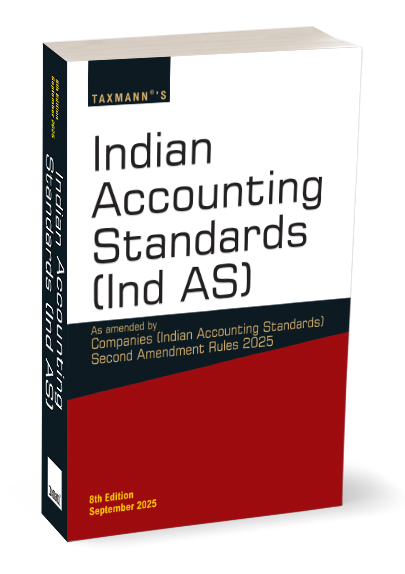
Indian Accounting Standards (Ind AS) is a comprehensive, up-to-date reference that consolidates the full text of Ind AS as notified under the Companies (Indian Accounting Standards) Rules 2015, as amended by the Companies (Ind AS) Second Amendment Rules 2025. This Edition blends legislation with practical orientation: an introductory Guide to Ind AS (roadmap, first-time adoption, formats, and conceptual framework), the complete set of Ind AS 1–117, and the Rules/Annexures governing applicability, exemptions, and presentation. It is purpose-built to help readers implement Ind AS with clarity, including recent changes on Material Accounting Policy Information (MAPI), financial instruments, leases, revenue, consolidation, and Ind AS–IFRS differences (‘carve-ins/carve-outs’).
This book is intended for the following audience:
CFOs, Controllers, Finance Leaders implementing/overseeing Ind AS compliance across listed and large unlisted entities
Auditors & Assurance Professionals performing Ind AS audits, first-time adoption reviews, and complex accounting assessments
Corporate Accounting & Reporting Teams preparing standalone/consolidated financial statements and interim reporting
Investment Bankers, Analysts & Valuation Professionals needing authoritative references on consolidation, fair value, and instruments
Students & Faculty (CA/ACCA/M.Com./MBA) seeking an authentic, exam-oriented statutory text with clear scaffolding and cross-references
The Present Publication is the 8th Edition, updated till 1st September 2025. This book is edited by Taxmann’s Editorial Board, with the following noteworthy features:
[Authoritative & Complete Text] Full, unabridged Ind AS 1–117 with Rules, Applicability, Obligations, and Exemptions under the 2015 Rules
[First-time Adoption (Ind AS 101)] Clear guidance on transition date, opening Ind AS balance sheet, comparatives, mandatory exceptions and elective exemptions
[Presentation & Disclosure] Deep coverage of Ind AS 1 (Presentation), Schedule III (Division II) framework, MAPI requirements, and third balance sheet triggers
[High-impact Topics] End-to-end treatment of Financial Instruments (Ind AS 32/107/109), Fair Value (Ind AS 113), Revenue (Ind AS 115), Leases (Ind AS 116), Consolidation (Ind AS 110/111/112), and EPS/Interim/Impairment
[Policy/Framework Orientation] Conceptual Framework, materiality, judgments/estimates, and policy design where standards are silent (Ind AS 8)
[Ind AS vs AS & IFRS Mapping] Focused comparisons, carve-ins/carve-outs, and India-specific reliefs (e.g., deemed cost, LTCFCMI policy continuation, common-control combinations, bargain purchase gain to OCI/equity)
[Governance-ready] Emphasis on reconciliations on transition, restatements, and policy choices that affect analytics and assurance
[Designed for Compliance & Review] The compilation facilitates audit-ready documentation, board/audit-committee reporting, and peer review by anchoring disclosures to the latest Rules and interpretive framework
The coverage of this book is as follows:
Guide to Indian Accounting Standards
Ind AS roadmap, applicability thresholds & phase-wise implementation (including group-level adoption rules, irreversibility)
First-time adoption under Ind AS 101—transition date, opening Ind AS balance sheet, mandatory exceptions & optional exemptions, reconciliations
Presentation Framework – Division II to Schedule III; complete set of financial statements and note architecture
Conceptual Framework – Objectives, qualitative characteristics, recognition/measurement, capital maintenance
High-impact differences vs AS – OCI & Statement of Changes in Equity, prior-period errors (retrospective restatement), third balance sheet, balance-sheet approach to deferred tax, actuarial gains/losses in OCI, functional vs presentation currency, impairment & goodwill reversals, constructive obligations, business combinations at fair value, consolidation based on control (Ind AS 110)
FAQs on MAPI (Ind AS 1) – Scope, definition and examples; entity-specific policy information; when policy information is material; interaction with Ind AS 8; avoiding obscuration
Companies (Ind AS) Rules 2015
Short title, definitions, applicability, obligation to comply, exemptions
Annexure A & B – General Instructions; list of Ind ASs
Full Text of Ind ASs (select highlights)
Ind AS 101 First-time Adoption
Ind AS 102 Share-based Payment
Ind AS 103 Business Combinations (including common-control guidance)
Ind AS 107/109/32 Financial Instruments: Disclosures/Recognition & Measurement/Presentation
Ind AS 110–112 Consolidation, Joint Arrangements, and Disclosures of Interests
Ind AS 113 Fair Value Measurement
Ind AS 115 Revenue from Contracts with Customers
Ind AS 116 Leases
Ind AS 117 Insurance Contracts
Ind AS 1/7/8/12/19/21/23/33/34/36/37/38/40/41, etc.
Schedule – Statutory appendices and allied material
The structure of the book is as follows:
Front-matter Guidance
Introduction to Ind AS, convergence approach, scope & thresholds
First-time adoption blueprint: transition date, opening Ind AS balance sheet, exceptions/exemptions, reconciliations, and comparative information requirements
Schedule III presentation framework and cross-references
Primary Legislation & Annexures
Companies (Ind AS) Rules, 2015, including Applicability and Exemptions
The Standards – Full Text
Logical grouping (Framework & Presentation → Measurement & Performance → Instruments & Fair Value → Consolidation & Disclosures → Revenue/Leases → Industry/Special Topics)
Practice Enhancers
MAPI Explainer & FAQs with illustrative scenarios (policy choices, complex accounting, judgments, policy changes)
Ind AS vs AS and Ind AS vs IFRS comparative notes for fast reconciliation of differences and India-specific adjustments
Back-of-book Utilities
Tabular concordance of Ind AS with corresponding IFRS/IAS
Thematic pointers for quick navigation to key standards (e.g., instruments, combinations, leases, revenue)