Description
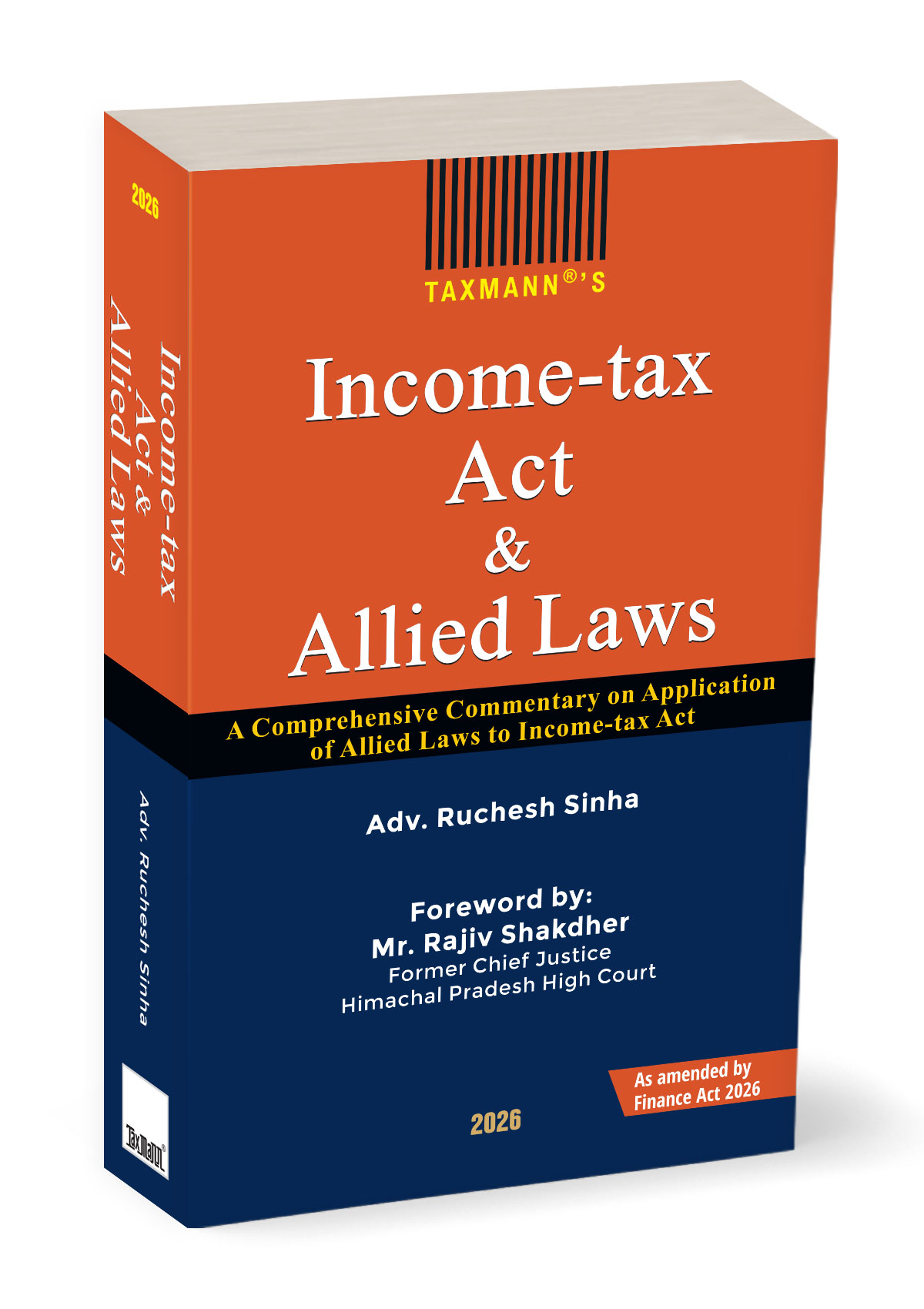
Income-tax Act & Allied Laws is a first-of-its-kind interdisciplinary legal commentary that maps, with statutory precision and courtroom depth, exactly where and how the Income-tax Act 2025 collides with, qualifies, supplements, and sometimes overrides ten other major Indian statutes. The premise of the book is both bold and self-evident: income, as the economic substratum of all human activity, permeates every field of law, and yet the legal profession has historically treated taxation as a discipline in isolation. Courts adjudicate matrimonial disputes, cheque dishonour cases, benami attachment proceedings, PMLA prosecutions, and corporate fraud matters with near-complete disregard for what the Income-tax Act has already established about the financial position of the parties—often to the material detriment of the outcome.
The commentary covers eleven distinct statutory intersections across twelve chapters, progressing from the foundational structure of the ITA 2025 through matrimonial law, evidentiary law, civil law, negotiable instruments law, benami law, GST, PMLA, black money law, cash regulation, and corporate law. Each chapter is built around verbatim reproduction of the key provisions of both the ITA and the allied statute, followed by the author’s detailed analytical notes, cross-statutory mapping, annotated case law with ratio extracted, and a structured FAQ section designed for deployment-ready use by practitioners in drafting, litigation, advisory, and adjudication.
The book is explicitly addressed to a multi-disciplinary readership that extends well beyond the conventional income tax audience:
Legal Practitioners in civil, criminal, family, corporate, and commercial domains who encounter financial evidence, income disclosures, or tax-linked claims in their matters
Tax Consultants and Chartered Accountants who need to understand the cross-statutory implications of their advisory work
Corporate Tax Managers, CFOs, and Finance Heads who must navigate simultaneous obligations under the ITA, CGST, PMLA, and Companies Act
International Tax Advisors and Wealth Management Advisors dealing with cross-border transactions, foreign asset disclosures, and double taxation frameworks
Revenue Officers and Departmental Representatives who handle prosecution, search, survey, and enforcement proceedings
Members of the Judiciary—Trial Court judges, ITAT Members, and High Court benches—who must assess the admissibility and weight of income tax records as evidence
Academicians and Law Students pursuing tax law, constitutional law, or interdisciplinary legal studies
The Present Publication is the First Edition, amended by the Finance Act 2026 and authored by Adv. Ruchesh Sinha, with the following noteworthy features:
[Verbatim Statutory Reproduction with Section-by-Section Author’s Notes] This is the defining structural feature of the book. Every key provision of both the Income-tax Act and the allied statute under discussion is reproduced verbatim, followed immediately by a detailed ‘Author’s Note’ that explains the provision’s legal principle, its operative scope, its limitations, and its cross-statutory implications. This approach is applied consistently across all chapters, transforming the book into both a primary text and an annotated commentary, eliminating the need to cross-reference bare acts. The Author’s Notes are substantive analytical paragraphs that identify the legislative intent, interpretive boundaries, evidentiary implications, and practical consequences of each provision
[Full ITA 2025 vs. ITA 1961 Cross-Reference Architecture] The book recognises that the Income-tax Act 2025 uses entirely renumbered sections. Since most ongoing litigation, assessments, appellate proceedings, and prosecutions continue to be governed by the 1961 Act, while new filings and returns fall under the 2025 Act, the book provides, in every instance, the precise correspondence: ‘Section X of the Income-tax Act 2025 (corresponding to Section Y of the Income-tax Act 1961).’ This dual-section cross-reference runs through every statutory citation, every case law reference, and every FAQ answer across the entire book, making it equally useful for matters arising under both versions of the statute
[Finance Act 2026 Amendments Integrated and Flagged] The book incorporates the Finance Act 2026 amendments, including the significant change to the tax rate on unexplained credits, investments, and expenditures under Section 195 of ITA 2025 (corresponding to Section 115BBE of ITA 1961)—reduced from 60% to 30% under the Finance Bill 2026—and the deliberate dilution of the prosecution rigour under Section 478 (corresponding to Section 276C). These legislative changes are not merely noted but contextualised within the broader anti-evasion framework of the statute
[Detailed Case Law with Structured Format and Extracted Principles] Each case covered in the book is presented in a rigorous, structured format: Court, Names of parties, Date of order, Full citation, Bench composition, whether the order is in favour of the assessee or the revenue, a keyword summary, a detailed statement of facts, the holding of the court, and, crucially, a discrete section titled ‘Principle(s) that emerge’ which distils the ratio into a deployable legal proposition. The case law spans from landmark Supreme Court decisions (some dating to the 1950s) to 2025 High Court and ITAT orders, ensuring both doctrinal depth and contemporary relevance.
[Chapter-End FAQs Designed for Practical Use] Every chapter closes with a Frequently Asked Questions section, typically 10–19 questions in length, built from the synthesis of statutory provisions, case law, and the author’s litigation experience. These are not textbook-style questions. They are structured as a professional would pose them in an advisory context; ‘Can penalties for violation of cash provisions be imposed automatically?’; ‘Does splitting cash receipts into smaller amounts avoid Section 186?’; ‘Whether prosecution can be initiated against a director without treating him as Principal Officer under Section 2(85)?’; ‘Does income tax law override civil laws such as contract or property law?’—with precise, citation-grounded answers that can be used directly in arguments, pleadings, and advisory opinions
[Illustrations and Practical Scenarios] The book includes concrete illustrations embedded within chapters—not relegated to footnotes or example boxes. A wholesale trader accepting ₹3.5 lakh in cash from a single buyer through split receipts during a festival season, triggering Section 186 and KYC reporting; a company issuing shares with premium to shell investor entities that lack creditworthiness under Section 102; a trader whose GST turnover exceeds income-tax disclosed turnover, triggering automated scrutiny—these worked scenarios demonstrate precisely how abstract statutory intersections play out in commercial and litigation reality
[First-of-Its-Kind Scope] Indian legal publishing has detailed commentaries on the Income-tax Act in isolation and equally detailed treatises on matrimonial law, evidence law, PMLA, and corporate law in their own silos. No resource has systematically mapped the ITA against the full spectrum of allied laws—personal, civil, criminal, economic, and corporate—in a single, structured work. This book occupies that gap
The coverage of the book is as follows:
Chapter 1 — Understanding the Essence of This Book
Establishes the conceptual foundation: why income, as the fulcrum of all financial activity, makes the Income-tax Act the most cross-cutting legislation in the Indian statute book. Covers the relevance of ITRs in loan applications, visa processing, matrimonial disputes, property transactions, negotiable instrument litigation, and criminal prosecution. Introduces all downstream chapters through a thematic overview
Chapter 2 — Basic Structure of the Income-tax Act 2025
A primer on the ITA 2025 for non-tax professionals. Covers the structure, key operative provisions, the effect of the repeal of ITA 1961, ITR forms (ITR-1 through ITR-7), e-filing mandates, Annual Information Statement, inter-department data sharing (Income Tax–CGST–ED), and the mechanism of financial surveillance. This chapter equips the non-tax reader before the cross-statutory analysis begins
Chapter 3 — Income Tax Law and Personal Laws (Matrimony Laws) | A Deep Dive
Covers the intersection of income tax provisions with the Hindu Marriage Act, Special Marriage Act, Muslim Personal Law, and related matrimony statutes. Analyses how maintenance claims, dowry allegations, and settlement quantum are tested against ITR disclosures. Includes case law from High Courts and the Supreme Court (notably Rajnesh v. Neha, Kiran Tomar v. State of UP, and multiple Delhi High Court decisions) and concludes with FAQs for practitioners handling matrimonial and family law matters
Chapter 4 — The Interface Between Income Tax Law and Evidentiary Standards
Perhaps the most technically dense chapter, covering the admissibility of income tax records, ITRs, assessment orders, and electronically seized data as evidence under the Indian Evidence Act (now Bharatiya Sakshya Adhiniyam), the Bankers’ Books Evidence Act, and the Information Technology Act. Addresses Section 65B certification requirements for digital evidence, the evidentiary value of unproven ITR copies, and the admissibility threshold in prosecution proceedings. Key cases include Anvar P.V. v. Basheer, Arjun Panditrao Khotkar, and CBI v. Shukla (V.C.) (Jain Hawala Case)
Chapter 5 — Where Income Tax Meets Civil Laws
Analyses the intersection of the ITA with the Transfer of Property Act 1882, the Specific Relief Act 1963, and the Indian Contract Act 1872. Covers capital gains implications in property suits, the tax significance of possession vs. title in specific performance proceedings, enforceability of contracts with tax-inconsistent financial terms, and the role of income disclosures in civil evidence. Includes RBANMS Educational Institution v. Gunashekar and related High Court decisions
Chapter 6 — Interplay Between Income Tax Act 2025 and Negotiable Instruments Act 1881
Addresses the fundamental question of how the financial capacity of the lender—as documented in ITRs—is increasingly treated by courts as a necessary element of proof in cheque dishonour cases under Section 138 NI Act. Analyses how undisclosed income or cash-based lending creates a trap that defeats both the creditor’s enforcement claim and the debtor’s defence. Key cases: Hari (P.C.) v. Shine Varghese, Prakash Desai v. Dattatraya Desai, Sanjabij Tari v. Kishore S. Borcar (SC, 2025)
Chapter 7 — How the Income Tax Act Intersects with the Benami Transactions (Prohibition) Act
A detailed analysis of the operative linkages between ITA and PBPT Act, including source-of-funds analysis, burden of proof, the interplay of ITA reassessment and Benami attachment proceedings, and the relevance of income disclosures in identifying beneficial ownership. Covers UOI v. Ganpati Dealcom (SC, 2022 and 2024), Smt. P. Leelavathi v. Shankarnarayana Rao, and the recent Hebes Electronics PBPT order of January 2026
Chapter 8 — The Impact of Income Tax Act on Goods and Services Tax Laws
Covers inter-departmental data sharing between Income Tax and CGST authorities, the admissibility of income tax assessment findings in GST proceedings, common provisions on books of account, search and seizure, and prosecution. Reviews CIT-III v. Kaypee Mechanical (Gujarat HC), JM Jain v. UOI (Delhi HC, 2025), CBI v. Shukla (V.C.), and the evidentiary crossover in tax fraud investigations
Chapter 9 — Where Tax Law Meets Money Laundering Law
Analyses the interface between the ITA and the Prevention of Money Laundering Act 2002 (PMLA). Covers the twin doctrines of ‘proceeds of crime’ and ‘scheduled offence,’ the mandatory referral and information-sharing obligations between the Income Tax Department and the Directorate of Enforcement, attachment proceedings, the Supreme Court’s landmark ruling in Vijay Madanlal Choudhary v. UOI, and prosecution overlap between ITA Chapters XXI and PMLA Section 3
Chapter 10 — Income Tax Law and Black Money Act | A Deep Dive
Covers the Black Money (Undisclosed Foreign Income and Assets) and Imposition of Tax Act 2015 in detail—its provisions for taxation and penalty on foreign assets not disclosed in ITRs, the link to prosecution under ITA, and the rigorous evidentiary requirements for proving undisclosed foreign income. Includes an extensive section of eight recent ITAT and High Court decisions from 2021–2025 on undisclosed foreign assets, search assessments, and Black Money Act prosecutions
Chapter 11 — Cash in Everyday Life and Income Tax Law | Use, Abuse and Regulation
A comprehensive review of all cash transaction restriction provisions under the ITA—Sections 269SS, 269T, 269ST, and related disallowance and penalty provisions. Covers cash-based property transactions, charitable receipts, loan repayments, and the systemic linkage between cash economy documentation and evidentiary sufficiency in civil and criminal disputes. Over 15 Supreme Court and High Court decisions are analysed, covering the threshold-based penalty framework and judicial interpretation of ‘reasonable cause’
Chapter 12 — Corporate Regulation and Taxation: A Study of the Income Tax Act and the Companies Act
Addresses the corporate veil, director liability, prosecution of corporate officers, and the significant overlap between Companies Act compliance obligations and ITA scrutiny provisions. Covers Salomon v. Salomon, Iridium India Telecom v. Motorola, Standard Chartered Bank v. Directorate of Enforcement, PCIT v. NRA Iron & Steel, and SMS Pharmaceuticals v. Neeta Bhalla in the context of officer liability and disregard of separate legal personality across both statutes
The book follows a consistent, replicable architecture across all twelve chapters that serves simultaneously as a reference text and a reading commentary:
Introduction — Establishes the practical stakes and the nature of the statutory intersection, typically with worked fact patterns and conceptual framing
Key Provisions of the Allied Statute — Verbatim reproduction of operative provisions with section-by-section Author’s Notes identifying legislative intent, scope, limitations, and cross-statutory implications
Key Provisions of the Income Tax Act (in relevant chapters) — Corresponding ITA provisions reproduced with the same depth of annotation, always with dual ITA 2025/ITA 1961 cross-references
Impact and Application Analysis — The core analytical section: how ITA provisions bear on the allied law, with worked examples, transactional scenarios, and doctrinal analysis
Case Law Analysis — Each case in the structured format: Court, Parties, Date, Citation, Bench, Party in whose favour, Keywords, Facts, Holding, and Principles that emerge
Concluding Note (in select chapters) — A synthesising paragraph drawing the chapter together with implications for practice
Frequently Asked Questions (FAQs) — Typically 10–19 questions with precise, citation-grounded answers, structured for direct use in professional practice