
Description
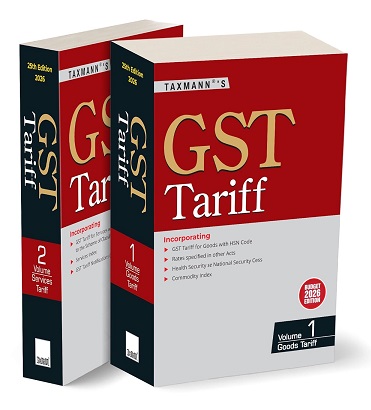
GST Tariff (Budget 2026 Edition) is India’s most comprehensive, execution-oriented GST classification and rate-determination manual, presented as a meticulously structured two-volume statutory tariff system covering Goods (HSN-based) and Services (Service Code-based) under the GST regime. This Edition captures the GST law exactly as it operates post-Budget 2026, including Finance Bill–linked changes, newly introduced cesses, amended rates, and the complete, contemporaneous notification architecture. Editorially, this publication is engineered as a classification-to-rate operating system, enabling professionals to determine—with statutory certainty, audit traceability, and litigation defensibility—the correct GST rate, exemption status, reverse charge applicability, and special levy implications for any supply of goods or services. By integrating tariff schedules, interpretative rules, explanatory notes, rate and exemption notifications, special cesses, and exhaustive indices into a single, navigable framework, the work functions as a day-to-day decision tool for practical GST application.
This publication is specifically intended for users who must apply GST tariffs accurately in live transactions and compliance environments, including:
Chartered Accountants, Cost Accountants, Company Secretaries, and GST Practitioners
Indirect Tax and Compliance Teams in corporates and multinational enterprises
Manufacturers, Traders, Importers, Exporters, and Supply-Chain Professionals
Service-sector Businesses requiring defensible Service Code classification
Tax Advisors and Litigators handling classification disputes, advance rulings, audits, and investigations
GST Departmental Officers, Auditors, and Assessment Authorities
Academicians and Advanced Students dealing with applied GST law
The Present Publication is the 25th Edition, updated till 1st February 2026. This book is edited by Taxmann’s Editorial Board, with the following noteworthy features:
[Budget 2026 ‘Change-First’ Architecture] The Goods volume opens with Finance Bill 2026 relevant extracts, Notes on Clauses, the Explanatory Memorandum, and TRU letter extracts, followed by notifications and corrigenda—allowing users to understand what has changed and why before applying the consolidated tariff framework
[Two-volume Functional Segregation] Separate, exhaustive treatment of Goods and Services preserves clarity, prevents interpretational overlap, and mirrors actual GST practice
[HSN-based Goods Classification with Interpretative Text] Complete chapter-wise goods tariff supported by the General Rules for Interpretation of the Schedule, enabling defensible classification in complex or disputed cases
[Service Code-based Services Tariff with Explanatory Notes] Services are presented with structured explanatory notes that define inclusions, exclusions, and scope boundaries—critical where classification determines taxability itself
[Integrated Rate, Exemption, and Notification Framework] Consolidates GST rates, exemption notifications, reverse charge provisions, e-commerce operator liabilities, and ‘no refund of unutilised ITC’ provisions into a unified reference system
[Inclusion of Allied Levies and New Cess Regimes] Incorporates rates specified under other Acts and the complete Health Security se National Security Cess framework, including the Act, Rules, amendments, and FAQs—positioning the set as a consolidated levy reference
[Practitioner-grade Indexing] Extensive Commodity Index and Services Index enable instant lookup by common descriptions, not just tariff literacy
[Notification Traceability] Structured ‘List of Notifications’ with amendment histories and page mapping ensures audit- and litigation-ready statutory traceability
The detailed coverage of the book is as follows:
Volume 1 | Goods Tariff (HSN) – Volume 1 is editorially structured as a complete GST goods tariff operating system. It includes:
Budget 2026 Changes – Finance Bill extracts, Notes on Clauses, Explanatory Memorandum, TRU letter extracts, notifications, corrigenda, and allied rule changes
GST Tariff for Goods with HSN Codes – Presented chapter-wise with rate columns for CGST, SGST/UTGST, and IGST in a transaction-ready table format
Arrangement of Chapters – Covering the full statutory classification spectrum—from agricultural and mineral products to chemicals, machinery, vehicles, precision instruments, and miscellaneous manufactures
General Rules for Interpretation – A dedicated interpretative framework for resolving classification overlaps and disputes
Rates Specified in Other Acts – Consolidated presentation of duties and cesses interacting with GST incidence
Health Security se National Security Cess – Act, Rules, amendments, and FAQs, including operational and compliance-level provisions
Commodity Index – A comprehensive description-to-HSN index for rapid identification during audits and assessments
Embedded Practical References – Chapter-level clarifications, case-law style mappings, and operational notes that enhance audit and litigation defensibility
Volume 2 | Services Tariff (Service Code) – Volume 2 presents a fully operational services tariff and notification system that addresses the inherent complexity of service classification. It incorporates:
GST Tariff for Services with Service Codes – Arranged heading-wise, group-wise, and code-wise across all service sectors
Separate CGST/SGST and IGST Tariffs – Ensuring accurate rate determination based on place of supply and transaction characterisation
Explanatory Notes to the Scheme of Classification of Services – Defining scope, inclusions, exclusions, and cross-references for each service code
Rate of Tax and Exemption Notifications – Consolidated and reproduced with amendment trails
Reverse Charge Mechanism – Separate coverage for intra-State and inter-State supplies
E-Commerce Operator Liabilities and Special Notified Categories – Integrated within the tariff framework
No Refund of Unutilised ITC Provisions – Clearly presented where applicable
Latest Clarifications and Case Laws – Supporting interpretative certainty
Services Index and List of Notifications – For fast navigation and statutory traceability
The GST Tariff follows a practice-oriented structure:
Classification – Identify the correct HSN or Service Code using structured chapter/heading arrangements and explanatory notes
Rate Identification – Apply CGST/SGST/UTGST or IGST rates directly from tariff tables
Notification Validation – Cross-check exemptions, conditions, reverse charge, and special mechanisms through integrated notification blocks
Compliance & Defence – Use indices, interpretative rules, and embedded clarifications for audit-ready and litigation-defensible application
This structure enables seamless movement from transaction analysis to statutory substantiation