Description
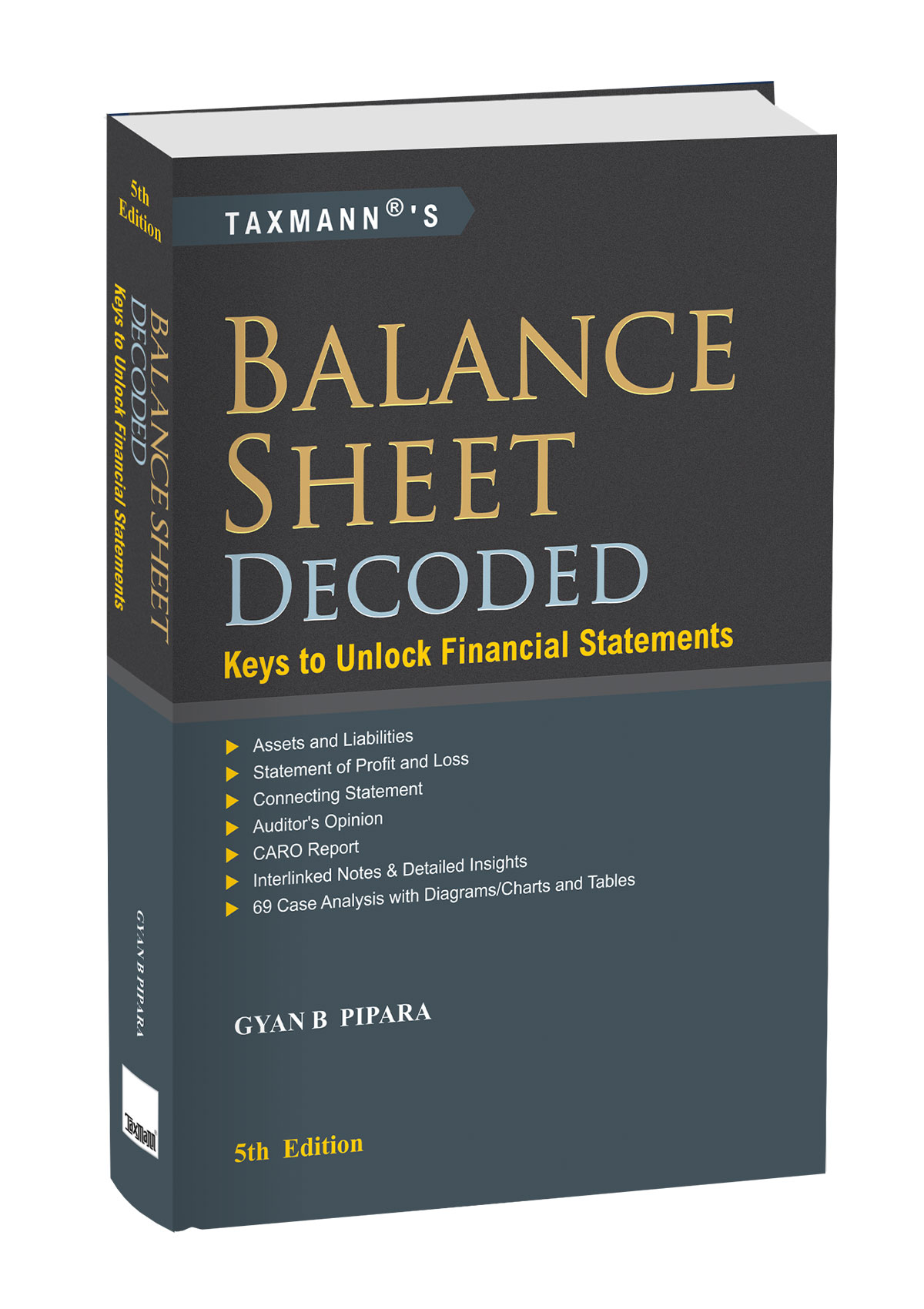
Balance Sheet Decoded – Keys to Unlock Financial Statements
Balance Sheet Decoded – Keys to Unlock Financial Statements is a comprehensive, practitioner-driven guide. The book has established itself as an essential reference for anyone who reads, analyses, or depends on corporate financial statements. The author consistently uses a vivid analogy: just as a trained eye is needed to interpret a person’s horoscope, a specific technique and a critical mind are required to interpret a business’s horoscope – its Balance Sheet. He compares the balance sheet to the brain and nervous system of an entity, and the profit and loss statement to its heart. With this anatomical analogy, the book equips readers with the skills to identify creative accounting, diversion and siphoning of funds, misstatements, and window dressing that may be concealed beneath financial disclosures. Covering over 600 pages, with more than 35 chapters across 5 key sections, over 65 real-world case studies, numerous charts and diagrams, and various annotated data tables (referred to as ‘Boxes’), it provides a step-by-step, practitioner’s methodology for analysing every line item of a corporate financial statement. This edition has been significantly expanded with updated case analyses relevant to Financial Year 2025, the latest legal positions, and new analytical techniques.
This book is intended for every type of stakeholder who finds it difficult to analyse and understand the complexities involved in the details provided in financial statements. It specifically assists:
Bankers and Credit Officers – Officers at commercial banks and financial institutions who evaluate credit proposals, approve loans, monitor borrower accounts, and submit stock statements for working capital loans. The book directly addresses practical banking scenarios, including NPA detection and credit risk assessment
Chartered Accountants and Auditors – Statutory auditors, internal auditors, and forensic auditors who need to sharpen their ability to identify accounting irregularities, understand the tricks employed by management, and provide reasonable opinions on the fairness of financial statements
Financial Analysts and Researchers – Equity analysts, credit rating professionals, and academic researchers who depend on financial statement data for valuation, assessment, and scholarly work
Investors and Portfolio Managers – Individual and institutional investors seeking to make informed investment decisions by understanding the financial health and corporate governance standards of entities beyond what is seen on the surface
Company CFOs and Finance Teams – Finance professionals responsible for preparing, presenting, and explaining financial statements, who benefit from understanding how their disclosures are analysed and scrutinised by external stakeholders
Regulators and Law Enforcement Agencies – Officials at SEBI, RBI, the Enforcement Directorate, SFIO, CBI, NIA, NCB, and other bodies investigating financial fraud, corporate misconduct, and economic offences
CA/CMA/CS Students and Academics – Students pursuing professional accounting and company secretary qualifications who wish to bridge the gap between textbook theory and practical financial statement analysis
Entrepreneurs and Business Owners – Promoters and business leaders who want to understand their own financial standing and monitor the financial health of partners, competitors, and potential acquisition targets
The Present Publication is the 5th Edition, authored by CA. Gyan B. Pipara, with the following noteworthy features:
[69+ Real-World Case Analyses (Numbered and Annotated)] Each item on the financial statement is supported by real and authentic case analyses sourced from publicly available annual reports of Indian companies. These include detailed financial extracts presented in numbered ‘Boxes’, with complete balance sheet snapshots, profit and loss statement data, auditor’s report excerpts, and notes on accounts – all accompanied by point-by-point analytical commentary
[69 Charts, Diagrams, and Working-Cycle Flowcharts] Visual aids are incorporated throughout, including inventory working-cycle diagrams (illustrating the flow from raw materials through WIP to finished goods), comparative disclosure charts (e.g., Chart 5 comparing Ind AS with Non-Ind AS cash and bank balance presentations), borrowing analysis charts linking debt levels with fixed asset additions and revenue growth, summary flowcharts for CARO 2020 clause requirements, and process diagrams for identifying fund diversion
[Structured Five-Part Pedagogy for Every Chapter] Each chapter follows a disciplined internal structure:
What Is It – Explains the nature, definition, and accounting treatment of the line item
Do You Know – Covers the required elements from the Companies Act 2013, Schedule III, Indian Accounting Standards (Ind AS), and other applicable laws
How to Decode – Offers an analytical approach with charts, ratios, and cross-referencing techniques
Case Analysis Box – Displays financial data from real company filings, accompanied by detailed analytical commentary leading to logical conclusions
Bottom Line – Summarises the chapter’s key points and takeaways
[Updated for FY 2025, CARO 2020, and Latest Legal Positions] The 5th Edition incorporates case analyses relevant to Financial Year 2025 (ending March 2025), the comprehensive 21-clause framework of CARO 2020 (Companies (Auditor’s Report) Order 2020), updated Ind AS standards, the latest provisions of the Companies Act 2013, SEBI regulations, and recent RBI guidelines. Tax rates for FY 2025-26, including MAT provisions under Section 115JB, are incorporated. The Edition also addresses new reporting requirements concerning CSR spending, Nidhi companies, and whistleblower mechanisms
[Three-Phase Business Cycle Analysis Framework] A distinctive analytical technique introduced in this book is the three-phase analysis:
Base Phase (initial period when the operational base is established)
Built-up Phase (when assets are developed and loans are borrowed)
Stress Phase (when financial stress becomes apparent)
The book demonstrates how, by analysing sales trends, inventory levels, holding periods, auditor’s observations, and notes on accounts over 5–6-year periods, one can determine which phase a company is in and forecast financial distress before it becomes evident publicly. This framework is illustrated with a detailed 6-year case analysis
[Forensic and Fraud Detection Perspective] Drawing on the author’s experience as a forensic auditor empanelled with the IBA, SEBI, SFIO, NIA, and NCB, the book adopts an investigative approach throughout. It specifically covers:
Detection of inventory inflation through stock statement analysis
Identification of circular loan transactions (evergreening)
ICD rollover mechanisms creating an illusion of activity
Inflated cheque-on-hand balances
Fund diversion through subsidiary investments
Misclassification of exceptional versus prior period items to manipulate profit
Inadequate provisioning for doubtful debts
Creative use of accounting policies for window dressing
The book offers a thorough, detailed analysis of each component of a corporate financial statement. Its 38 chapters are organised under 6 Keys, each unveiling a major section of the financial statement.
Key #1 | Balance Sheet | Assets (Chapters 1–8) – The balance sheet is described as the ‘master control system’ of an entity. This section examines every category of assets through the following chapters:
Chapter 1 | Property, Plant and Equipment (Tangible Fixed Assets) – Explains recognition criteria under Ind AS 16, depreciation methods (SLM vs WDV), revaluation, impairment testing, and how to identify assets that no longer generate economic benefits. Includes case analysis of a company on RBI’s loan defaulter list with declining manufacturing sales despite term loans secured on fixed assets. Features Charts 1–3 and Boxes 1–8
Chapter 2 | Intangible Fixed Assets – Analyses goodwill, trademarks, software licences, customer contracts, and intellectual property. Demonstrates how extended periods of intangible assets under development with limited disclosure can raise questions about deferred write-offs and profit smoothing. Includes Chart 4 and Boxes 9–11
Chapter 3 | Capital Work-in-Progress (CWIP) and Intangible Assets in Development – Includes factory buildings under construction, plant and machinery being erected, and roads and bridges under development. Shows how CWIP can help defer unproductive expenditure and avoid depreciation, with links to revenue growth. Contains Charts 5–6 and Boxes 12–17
Chapter 4 | Investments – Full disclosure requirements under AS 13, Ind AS 109, and Ind AS 40 (Investment Property). Classification into current/non-current, trade/non-trade. Explains how investments in subsidiaries, associates, and JVs may act as conduits for fund diversion, with case analysis of a leading infrastructure company where significant funds were invested into a non-operational subsidiary during a liquidity crunch. Includes Charts 7–8 and Boxes 18–32
Chapter 5 | Loans and Advances – Presentation requirements and detailed analysis. In-depth case study of HCC (Hindustan Construction Company), highlighting how ₹506 crores in fresh loans to related parties was four times the annual PBT. Demonstrates techniques for identifying evergreening and circular transactions. Includes Charts 9–11 and Boxes 33–46
Chapter 6 | Other Assets – Covers items such as security deposits, advances, Inter-Corporate Deposits (ICDs), accrued income, and prepaid expenses. Includes a case analysis of Yes Bank (going concern qualification) and an ICD rollover scheme where borrowers repaid only at quarter-end, with new loans of equivalent amounts issued at the start of the next quarter. Incorporates Charts 12–13 and Boxes 47–55
Chapter 7 | Inventories and Trade Receivables – The most important chapter for banking professionals. Detailed analysis of the entire inventory cycle, including raw materials, WIP, finished goods, stores and spares, and packing materials. Methods to identify inventory inflation through stock statement reconciliation. Ageing analysis of trade receivables with actual data tables illustrating deterioration patterns (e.g., receivables over 180 days increasing from ₹721 million to ₹6,678 million). Cash flow reconciliation to verify reported receivables. Includes Charts 14–16 and Boxes 56–68
Chapter 8 | Cash, Cash Equivalents and Bank Balances – Separate disclosure requirements under Ind AS versus Non-Ind AS entities. Analysis of demand deposits, margin money, earmarked balances, DSRA, and overdraft positions. Case study of Ricoh India’s cheque-on-hand fraud. Explains why substantial cash on hand must align with the nature of the business. Includes Charts 17–18 and Boxes 69–71
Key #2 | Balance Sheet | Source of Funds/Liabilities (Chapters 9–13) – This section explores the funding side of the balance sheet, where the money originates from.
Chapter 9 | Shareholder’s Funds/Net Worth/Capital – Covers share capital structure, promoter contribution, capital adequacy, share premium, buyback provisions, and pledging of promoter shares. Includes analysis of how promoters use share pledging and the cascading risks. Features Charts 18–20 and Boxes 72–79
Chapter 10 | Reserves and Surplus – In-depth analysis of retained earnings, general reserves, capital reserves, securities premium, revaluation reserves, and foreign currency translation reserves. Explains how reserve transfers can be manipulated to conceal worsening financial health. Includes Chart 21 and Boxes 80–81
Chapter 11 | Provisions and Contingent Liabilities – Adequacy of provisions, under-provisioning risks, off-balance-sheet exposures, and the vital distinction between provisions and contingent liabilities under Ind AS 37. Includes Charts 22 and Boxes 82–87
Chapter 12 | Borrowings – A comprehensive analysis of long-term and short-term borrowings, including term loans, working capital facilities (cash credit, packing credit, buyer’s credit), debentures, ECBs, FCCBs, and commercial papers. Features a detailed five-year case study showing borrowing growth from ₹26,897 crores to ₹43,907 crores, linked with fixed asset additions, revenue stagnation, and eventual insolvency proceedings under IBC 2016. Includes Charts 23–24 and Boxes 88–94
Chapter 13 | Trade Payables and Other Liabilities – Significance as early warning signals, ageing analysis of trade payables, statutory dues under litigation (featuring a case with ₹21,309 crores in disputed statutory dues), and MSME payment compliance. Includes Charts 25–27 and Boxes 95–106
Key #3 | Statement of Profit and Loss (Chapters 14–22) – Often regarded as the ‘heart’ of the entity, this section interprets both the credit and debit sides of the P&L across 9 chapters
Chapter 14 | Revenue from Operations – Revenue recognition, segment reporting, detection of inflated or fictitious sales, and the distinction between core and non-core revenue. Includes Charts 28–29 and Boxes 107–111
Chapter 15 | Other Income – Analysis of interest income, dividend income, profit on sale of investments and assets, and the risk of confusing non-recurring other income with sustainable earnings. Case analysis where other income significantly exceeded operating revenue. Includes Charts 30–31 and Boxes 112–116
Chapters 16–17 | Cost of Materials Consumed and Manufacturing Costs – Reconciliation of purchase, production, and sales; product mix analysis; operating margins; and how variations in the cost of materials consumed affect profitability. Includes Charts 32–35 and Boxes 117–120
Chapter 18 | Employee Benefit Expenses and Finance Costs – Analysis of staff costs in relation to revenue scale, and the vital connection between finance costs and borrowing patterns. Includes Charts 36–40 and Boxes 121–123
Chapter 19 | Depreciation and Amortisation – Effects of useful life changes on reported profit, comparison of SLM versus WDV methods, and analysis of amortisation on intangible assets (registrations, brands, customer contracts, software licences). Detailed case with actual amortisation schedules. Includes Charts 41–43 and Boxes 124–126
Chapter 20 | Tax Expenses – Analysis of average tax rates to identify profit manipulation. Includes MAT, DTA/DTL, and reconciliation between book profit and taxable income. Incorporates corporate tax rates for FY 2025-26. Contains Charts 44–45 and Boxes 127–130
Chapter 21 | Other Expenses – A comprehensive 14-point analysis framework covering power and fuel, rent, repairs, insurance, legal fees, auditor remuneration, CSR, donations, forex losses, and more. Includes Charts 46–49 and Boxes 131–133
Chapter 22 | Exceptional, Extraordinary, and Prior Period Items – How these items are often confused (due to lack of knowledge or to mislead). Case analysis of a company with ₹90 million in business combination restructuring and derivative contract losses classified as exceptional items, with three-year comparative P&L data. Includes Boxes 134–137
Key #4 | Connecting Statements (Chapters 23–25) – The essential cross-referencing section that instructs the reader to relate data across all financial statements
Chapter 23 | Significant Accounting Policies – How accounting policy choices (depreciation methods, revenue recognition, inventory valuation) directly influence reported figures. The book treats these not as boilerplate but as essential first readings for any analyst
Chapter 24 | Notes on Accounts – Highlights how seemingly routine notes, related party disclosures, contingent liabilities, segment data, and changes in accounting policies contain key clues for detecting financial irregularities
Chapter 25 | Cash Flow Statement – Comprehensive analysis of operating, investing, and financing activities. Emphasises that cash flow manipulation is more difficult than P&L manipulation. Detailed case analyses with complete 3-year cash flow data, including a case where an entity showed ₹117.87 crore profit but negative ₹145.33 crore operating cash flow. Includes Charts 50–55 and Boxes 156–160
Key #5 | Auditor’s Report and Opinion (Chapters 26–27) – Focused analysis of the statutory auditor’s report and its implications:
Chapter 26 | Auditor’s Report – Understanding unqualified, qualified, adverse, and disclaimer opinions. How to interpret Key Audit Matters (KAMs), emphasis of matter paragraphs, and the distinction between qualified opinion issues and emphasis of matter (which is merely for reference). Detailed case analysis of a company with emphasis of matter issues across multiple financial years
Chapter 27 | Analysis of Emphasis of Matters – Year-by-year tracking of emphasis of matter paragraphs for a single company (Reliance Infrastructure), illustrating how persistent qualifications increase and indicate growing financial distress. Includes Boxes 161–170
Key #6 | CARO 2020 Report (Chapters 28–38) – The most extensive part of the book, dedicated to a detailed decoding of all 21 clauses of the Companies (Auditor’s Report) Order 2020. Each clause is examined individually.
Chapters 28–29 | Title Deeds and Immovable Property – Verification of title deeds and CARO clause analysis for properties held by the company
Chapter 30 | Inventory and Loan Verification – Physical verification procedures and analytical methods
Chapter 31 | Related Party Transactions – Three key CARO 2020 clauses covering loans, advances, investments, and guarantees to related parties, arm’s length transaction analysis, and compliance with Sections 185 and 186 of the Companies Act
Chapter 32 | Legal Compliance – Deposits from the public, Nidhi Company requirements, CSR spending analysis (amount required versus expended versus shortfall), with CSR fund details including PM CARES Fund and Swachh Bharat Kosh
Chapter 33 | Non-Banking Finance Companies (NBFCs) – CARO requirements specific to NBFCs, which have become an essential part of the financial system and have a significant potential to impact public interest
Chapter 34 | Statutory Dues – Analysis of defaults in payment of statutory dues, including income tax, GST, customs, excise, and other levies. Case study of a company with disputed statutory dues amounting to ₹21,309 crores across multiple statutes
Chapter 35 | Financial Health of the Company – Detailed case with actual loan default data – illustrating principal and interest defaults across export packing credit, inland letter of credit, foreign bill discounting, and buyer’s credit
Chapter 36 | End Use of Funds – Critical analysis confirming that borrowed funds were utilised for their specified purposes. Part A (confirmation of correct application) and Part B (details of delay, default, or non-compliance)
Chapter 37 | Frauds and Unrecorded Transactions – Reporting requirements for fraud under CARO 2020 and the importance of unrecorded transactions
Chapter 38 | Resignation of Statutory Auditors – viewed as a major red flag. In-depth case study of Manpasand Beverages, where the outgoing auditor issued limited review reports for three quarters, a new auditor was appointed mid-year and issued a clean full-year report, and subsequent investigation uncovered fraud. The author’s research across numerous cases confirms that sudden auditor changes often precede the discovery of misrepresentation, misstatement, or fraud
The book is organised around a distinctive ‘Key’ framework that mirrors the structure of corporate financial statements. Six Keys open six main sections, comprising 38 chapters distributed as follows:
Balance Sheet | Assets – Tangible and intangible assets, CWIP, investments, loans, other assets, inventories, trade receivables, cash
Balance Sheet | Liabilities – Share capital, reserves, provisions, borrowings, trade payables, statutory dues
Statement of Profit & Loss – Revenue, other income, costs, employee expenses, finance costs, depreciation, tax, other expenses, exceptional items
Connecting Statements – Accounting policies, notes on accounts, cash flow statement
Auditor’s Opinion – Audit opinions, KAMs, and emphasis of matter analysis
CARO 2020 Report – All 21 clauses; Title deeds, inventory, related parties, compliance, NBFCs, statutory dues, end use of funds, frauds, auditor resignation