
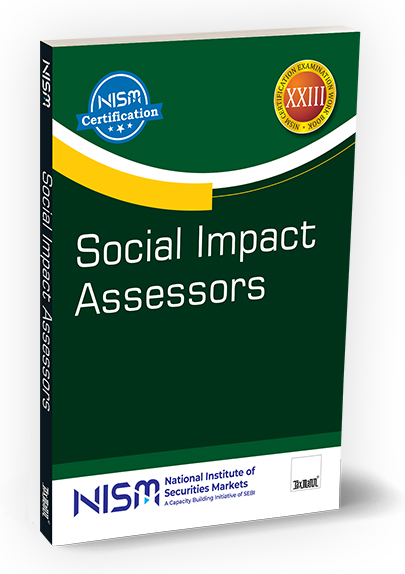
Description
Social Impact Assessors Workbook is the definitive resource for individuals aspiring to become certified professionals in Social Impact Assessment, especially in the context of the Social Stock Exchange (SSE) ecosystem. Developed and endorsed by NISM, in collaboration with ICAI and leading industry experts, this comprehensive guide is tailored to support exam candidates and practitioners with the foundational, regulatory, and applied knowledge necessary to assess, report, and assure the impact of social sector initiatives in India.
This book is intended for the following audience:
Aspiring Social Impact Assessors seeking official certification to conduct Social Impact Assessments (SIA) and audits, particularly for social enterprises listed on SSEs
Social Auditors and Practitioners who require a structured, regulatory-compliant framework for impact measurement and assurance
Chartered Accountants, Consultants, and Compliance Officers involved in the social sector, ESG, sustainability, and responsible investing
Social Enterprise Founders, NGOs, and Intermediaries looking to understand the requirements for listing and impact reporting on Social Stock Exchanges
Students and Academics specialising in social sector finance, impact investing, or sustainable development
Regulators, Policymakers, and Financial Market Professionals overseeing, governing, or facilitating the integration of the social sector into financial markets
The Present Publication is the April 2025 Workbook Version, developed in collaboration with the Certification Team of NISM, Empanelled Resource Persons with NISM, viz., Ms Ananya Prabhavalkar, Ms Bina Joshi and the Institute of Chartered Accountants of India (ICAI), NISM’s knowledge partner for the Social Impact Assessor Certification Examination. It is published exclusively by Taxmann, with the following noteworthy features:
[Comprehensive Coverage] Spans the entire syllabus for the NISM-Series-XXIII: Social Impact Assessors Certification Examination, integrating theory, regulations, practice, and case studies
[Exam-oriented Structure] Includes sample MCQs and case-based questions modelled after the actual assessment, with precise mapping to exam objectives and chapter-wise weightages
[Lucid Explanations] Written in accessible language, with focused content and explanatory notes to aid conceptual clarity
[Industry-relevant] Developed in consultation with experts, the workbook aligns with the latest SEBI, regulatory, and market developments relevant to social impact assessment
[Practical Insights] Features practical case studies, model frameworks, and reporting standards to facilitate hands-on learning and application
[Reference Tools] Provides regulatory extracts, disclosure requirements, sample documentation, and checklists for ready reference
[Developed by Experts] Jointly prepared by NISM, ICAI, and renowned social impact professionals, ensuring authoritative and updated content
[Ethical Focus] Embeds professional ethics, code of conduct, and quality standards as key themes for social impact practitioners
[Career Pathways] Certification opens avenues in social auditing, impact investing, ESG reporting, compliance, and advisory roles in the rapidly growing social finance sector
The workbook comprehensively covers:
Social Sector Ecosystem
History, taxonomy, and landscape of the Indian social sector; Sustainable Development Goals (SDGs); challenges and opportunities
Social Stock Exchange (SSE)
Concept, stakeholders, funding mechanisms, and operational guidelines for SSEs
Listing and Compliance
Step-by-step process for registration and listing on SSEs, with emphasis on rights, obligations, and disclosures
Logic Models and Impact Frameworks
Logical Framework Analysis (LFA) and its application in social programs, including design, evaluation, and reporting
Social Impact Assessment (SIA)
Evolution, principles, roles, processes, standards, and quality control in SIA; use of technology and engagement with field-level agencies
Assessment Techniques and Standards
Various frameworks, guidelines, and tools for effective social impact measurement
Reporting and Disclosure
Detailed guidance on impact reporting, organisational models, and navigating regulatory requirements (SEBI, ICDR, LODR, etc.)
Case Studies
In-depth scenarios covering environmental sustainability, healthcare, gender equality, financial inclusion, and affordable housing
Regulatory and Taxation Aspects
Coverage of SEBI regulations, penalties, and tax incentives (e.g., Sec. 80G, exemptions for social enterprises)
The workbook is organised for optimal exam preparation and practical reference:
Core Chapters – Eleven chapters systematically cover the entire social impact assessment landscape, from foundational concepts to advanced case applications
Syllabus Outline & Weightages – Each chapter is mapped to its exam weightage, enabling focused study and efficient revision
Assessment Aids – Includes sample questions (MCQs and caselets), suggested answers, and practical case studies for hands-on practice
Reference Materials – Appendices with relevant regulatory texts, reporting templates, and additional resources
User-friendly Design – Logical progression from fundamentals to advanced topics, supported by tables, charts, and summary points
![Bharat's Companies Act with Rules [Royal Edition]](https://hindlawhouse.com/wp-content/uploads/2021/03/9789347779169-300x300.jpg)